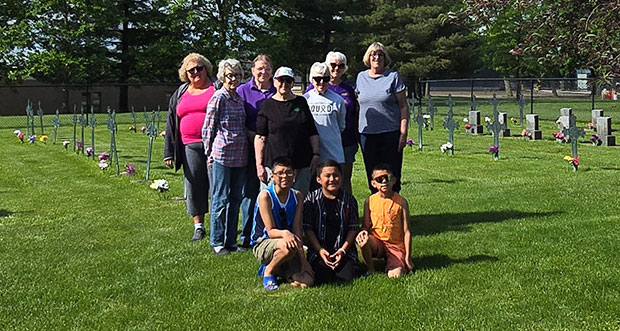
Contributed Catholic Daughters of the Americas and Ottumwa-area Catholics decorate graves of deceased sisters of the Congregation of the Humility of Mary at Mt. Olivet Cemetery in Ottumwa May 23.
By Lindsay Steele
The Catholic Messenger
OTTUMWA — On May 23, Ottumwa Catholic Daughters of the Americas (Court Adelaide Proctor #43) placed flowers at the graves of the deceased sisters of the Congregation of the Humility of Mary at Mt. Olivet Cemetery. This cemetery is on the grounds of what was once Ottumwa Heights College, a private Catholic college operated by the sisters until it merged with Indian Hills Community College in 1979. Nine Catholic Daughters and local Catholics — including three children — participated in the service project.
The Catholic Daughters have placed flowers on the sisters’ graves and prayed a rosary for them every Memorial Day for more than 25 years. “We started doing this because of the relationship with the Sisters who taught at Ottumwa Heights College or worked at Saint Joseph High School” in Ottumwa, said Jane Thomas, the court’s outgoing regent. “One of the (seven) spokes of Catholic Daughters is spiritual, so this is how we fill that.” Sister Kevin Bissell, sister of 50-plus year Court Adelaide member Mary Pester, is buried there, she added.
Five Sisters of Humility established a motherhouse in Ottumwa in the late 1800s. The sisters relocated to Davenport around 1983. Approximately 190 sisters are buried at Mt. Olivet.
OFFICIAL
Diocese of Davenport
Bishop’s Office
Davenport, Iowa 52804
Episcopus Davenportensis Decree
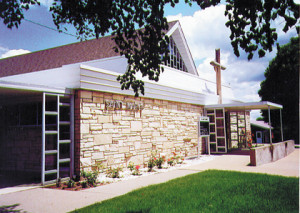
St. Mary Church, TiptonSaint Mary, Mechanicsville
Whereas, the parishes of Saint Mary in Mechanicsville, Saint Mary in Tipton, and Saint Bernadette in West Branch have cooperated and collaborated in various capacities: sharing resources, clergy, staff and ministries for some years; and
Whereas, the parishioners of these very same parishes have expressed their recognition of the benefits that merging these three parishes would bring, including strengthened spiritual formation, better utilization of financial and human resources, and an enhanced ability to serve their parishioners and the wider community; and
Whereas, in a Joint Cedar County Parish Council meeting attended by the councils and parishioners of all three parishes, held February 26, 2026, the topic of merging the parishes was thoroughly discussed with the opportunity for all to raise questions or concerns, and, at the conclusion of the meeting, there emerged a consensus among the faithful that a merger would be just and reasonable to all involved; and
Whereas, at the same a vote was taken in regard to the merger, wherein the parish Councils of both Saint Mary in Mechanicsville and Saint Bernadette in West Branch voted unanimously to merge, and the parish council of Saint Mary in Tipton voted overwhelmingly to merge, and then these results were submitted to me, the Bishop of Davenport, that, should I choose to merge the three parishes, they request the new parish name be: “St. Isidore the Farmer;”
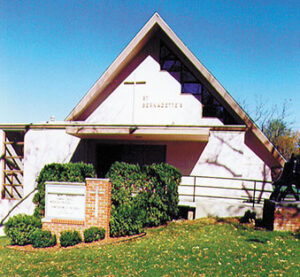
St. Bernadette, West Branch
Whereas, the pastor of the three parishes, Reverend James Flattery, on April 3, 2026, did formally write me and request that I, the Bishop of Davenport, seriously consider the issues, and, if I saw it expedient, to issue a decree merging the three juridic persons of Saint Mary in Mechanicsville, Saint Mary in Tipton and Saint Bernadette in West Branch (c. 121), naming the new entity “St. Isidore the Farmer Catholic Parish;” and
Whereas, I, having viewed their request as both just and reasonable, and in keeping with the Divine Mission of the Church, that is, for the salvation of souls, and, being the sole authority within this diocese which can either erect, suppress, or notably alter parishes (canon 515 §2), in accordance with that same canon, did bring this issue before the Presbyteral council for consultation on April 23, 2026, as well as the College of Consultors on April 23, 2026, and, after having legitimately heard the advice of both bodies, have hereby decided to issue this decree:
Effective July 1, 2026, the three juridic persons, being the parishes of Saint Mary in Mechanicsville, Saint Mary in Tipton and Saint Bernadette in West Branch, are hereby merged, in accordance with canon 121. By this, all their goods, obligations, and patrimonial rights are now become one, keeping in mind that any intentions of the founders or donors must be respected; and
This new juridic person shall henceforth be known as “St. Isidore the Farmer Catholic Parish,” being a parish, and its boundaries shall be the combined boundaries of the prior parishes of Saint Mary in Mechanicsville, Saint Mary in Tipton and Saint Bernadette in West Branch; and
In accordance with canon 518, the parish is to be territorial, and its boundaries are established as:
Western boundary — Cedar County line, to Cedar River, to 210th St, to Baker Ave, to 223rd St, to Morse Rd NE, to Vincent Ave NE, to Strawbridge Rd NE, to Vincent Ave NE, to 280th St, to Oasis Rd NE, to Herbert Hoover Hwy NE, to Lower West Branch Rd SE, to Oasis Rd SE, to 400th St SE, to Johnson Cedar Rd SE, to 326th St, to Adam St;
Northern boundary — Cedar County line;
Eastern boundary — 20th Ave (north of Stockton), to New Liberty Rd, to 10th Ave (in New Liberty), to 280th St, to the Cedar County Line,
Southern boundary — Cedar St in Downey, to Baker Ave, to Buckeye Rd, to Charles Ave, to 310th St, to Atalissa Rd, to Highway 80, to 20th Ave (north of Stockton); and
As the office of pastor of these parishes is now defunct, Reverend James Flattery, in accordance with Can. 520 §2, is hereby appointed pastor of St. Isidore the Farmer parish, for a six (6) year term; and
The pastor of St. Isidore the Farmer, in accordance with canon 533 §1, shall hereby have residence at 208 Meridian Street, Tipton, Iowa, 52772; and
In accordance with Canon 535 §1, the historical and sacramental records of all three parishes will from this time be kept at the same 208 Meridian Street, Tipton, Iowa, 52772, which has been designated as the parish offices for the new juridic person, St. Isidore the Farmer.
Given at the Chancery on April 29, 2026.
Dennis Walsh Bishop of Davenport
Deacon David Montgomery Chancellor
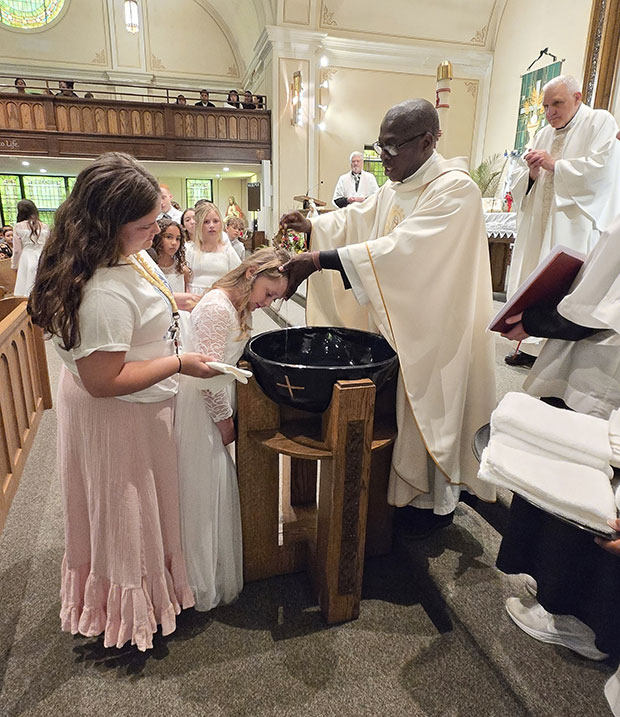
Anne Marie Amacher Second-grader Harper Kelly is baptized into the Catholic Church by Father Nicholas Akindele during Mass May 29 at Holy Family Church in Davenport. Her godparent was Grace Nemechek, her teacher. Watching are fellow students from All Saints Catholic School, along with Father Chris Young and Father William Kneemiller.
By Anne Marie Amacher
The Catholic Messenger
DAVENPORT — “Thirteen baptized, 12 confirmed, and 13 receiving first Communion — a powerful reminder that Catholic schools are not just places of learning, but places where the Gospel takes root and grows in the hearts of children,” said Sister Helen Ajayi, SSMA. The director of faith formation and evangelization at Holy Family Parish led the All Saints Catholic School students through their sacramental preparation to join the Catholic Church during the closing of the school year Mass May 29.
Twelve All Saints Catholic School students in total received all three sacraments of initiation. Another student received the sacrament of first Communion only and another student received baptism only.
“You said yes to God’s invitation, said Father Nicholas Akindele, the parish’s pastor. “Their parents said yes to God to come into their souls.”
At the beginning of the school year, Father Akindele said he started his rounds to the classrooms at the school. He learned there were many students who have never been baptized — in any faith at all. He sent a letter to 50 families about the opportunity to join the Church. He received no responses back…
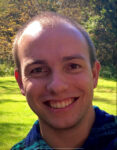
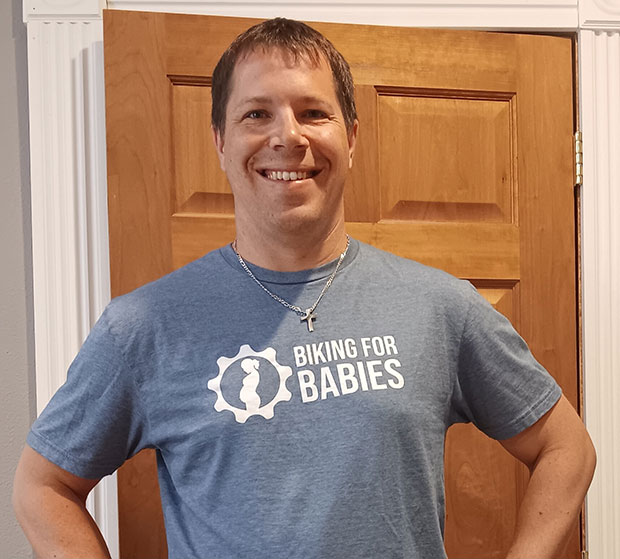
Contributed Brandon Harris, a teacher at Burlington Notre Dame schools and member of St. Alphonsus Parish in Mount Pleasant, will be a missionary with Biking for Babies next month.
By Lindsay Steele
The Catholic Messenger
Brandon Harrison, a teacher at Burlington Notre Dame and a member of St. Alphonsus Parish in Mount Pleasant, will travel through Iowa this July as a Biking for Babies missionary. During the week-long ride, missionaries bike along one of nine routes, connecting with local communities to prayerfully build a culture of life and raise money for pro-life pregnancy centers.
“I have always enjoyed biking and wanted to enrich my faith by adventuring out within the larger community of Catholics,” said Harrison, a husband and father of three boys. “Not only do I hope to inspire others to ride or become members of the support crews in the future, but also to advance the mission of Biking for Babies.”
Following a training and formation period, Harrison will participate in a 600-mile ride July 12-18 from Rochester, Minnesota, to St. Louis, Missouri. Harrison has been assigned to speak about Mary’s Inn, a pregnancy resource center in Dubuque, Iowa, at stops along the route.
In the Diocese of Davenport, the missionary group will stop at St. Mary of the Visitation Catholic Church in Ottumwa on July 16. The public is invited to attend a 6 p.m. presentation to hear missionaries’ testimonies and learn how to support pregnancy centers like Mary’s Inn. Eucharistic adoration will follow from 6:30-7 p.m.
Next week, two unprecedented spiritual efforts are coinciding which will hopefully lead to an increase in unity and charity in the United States.
First, on June 11-12, U.S. bishops will consecrate the nation to the Sacred Heart of Jesus as part of the celebration of the 250th anniversary of the signing of the Declaration of Independence. Archbishop Alexander K. Sample of Portland, Oregon, who chairs the USCCB committee on religious liberty, recently told OSV news the three reasons for the consecration. The first is so that the country can “place ourselves under God’s providence and care.”
“In the history of our nation, it’s undoubtable and it’s irrefutable that the faith — and our reliance on God — really was the foundation that our Founding Fathers placed this nation on.”
Second, Archbishop Sample cited the need for reparation. “We are a great and blessed nation — but there are mistakes that we have made as a people over these 250 years. And so this is a good time,” the archbishop added, “to also make reparation to the heart of Christ for those offenses against his love, and his mercy, and his justice — for all peoples.”
Finally, the archbishop explained that “there’s this desire, through this consecration, to also call us to have a greater heart for the poor and the suffering … as we honor the Sacred Heart of Jesus, we can’t just honor it as a private devotion. It has to move us, and move our hearts.’”
The second event which ties into the consecration is a National Eucharistic Pilgrimage which began May 24 in Florida. The route will go through the original 13 colonies, reach Maine, and then end on July 4 in Philadelphia. Nine young adults from around the U.S. will be “perpetual pilgrims” making the journey primarily on foot.
Mary Carmen Zakrajsek, 26, of Indiana is among those chosen. In an interview with The Criterion, she said: “Gratitude is what carries a nation forward … Like every nation, we are dependent upon grace, upon God. This spiritual pilgrimage is a reminder of our dependence upon him. He desires to renew us, refresh us and bless us with his presence in the Eucharist.”
The first amendment to the Constitution protects individual religious freedom and also prohibits the establishment of a national religion or church. At various points over the decades, courts and other powerful forces have misinterpreted Thomas Jefferson’s line in an 1802 letter to the Danbury Baptist Association about “a wall of separation between Church & State” to justify the exclusion of religious expression from the public square.
The purpose of the first amendment, however, was to create an environment where free expression of religion could thrive and influence public life for the better. At the same time, no one religion could have a government sponsored monopoly. A founding principal of our nation is that our individual rights come from God, so it makes sense to thank our creator publicly and ask for divine assistance at this special time. This principal aligns with Catholic teaching about natural law.
Natural law is the idea that God has written his law on every human heart. The basic summary of this innate morality, often described as our conscience, is that “Good is to be done and pursued and evil is to be avoided,” according to St. Thomas Aquinas.
The upcoming prayers and ongoing pilgrimage will foster good actions and changed hearts.
Bishop Dennis Walsh has invited every Catholic in the Davenport Diocese to join a novena in preparation for the Solemnity of the Sacred Heart of Jesus June 3-11. Father Nicholas Akindele, pastor of Holy Family Parish in Davenport is livestreaming this novena at TheyHaveNoWine.com and on social media. St. Mary Parish in Grinnell will host a eucharistic procession and consecration prayers June 7 at 11:30 a.m. Bishop Walsh will preside at Mass beforehand. (More details are on Page 4)
By Patrick Schmadeke
Evangelization in the World Today
Schmadeke
I was 10 years old on Sept. 11, 2001. I remember the events of that morning vividly — our teacher was summoned to the hallway, an announcement from the principal, our eyes glued to the classroom television. I remember with equal vividness the feelings of patriotic unity that followed. These feelings were cultivated through multiple experiences: a poster in the school hallway of first responders with the twin towers in the background was a daily reminder of the tragic event and the heroic attempts to rescue victims; the popular “Courtesy of the Red, White, and Blue” by Toby Keith gave voice to a certain primal fervor, and was trendy among my fellow middle schoolers in part for the not-so-virtuous use of a single but energetically delivered curse word; the annual music recital for 3rd graders included a performance of Lee Greenwood’s “God Bless the USA” with American flags lining the left and right walls of the church. This final experience left me uneasy. I remember feeling conflicted as I sat in the balcony — I liked Greenwood’s song, but also thought it felt out of place in church. The tension between being patriotic and being Catholic is real. We want to do both well, but it isn’t easy — the waters between religious commitment and national affiliation have always been murky.
Out of the 2,865 paragraphs in the Catechism of the Catholic Church, the terms “patriotic” and “patriotism” do not appear even once. The same is true of the Compendium of the Social Doctrine of the Church (583 paragraphs long) and Fratelli Tutti (287 paragraphs long). The omission is no accident. Patriotism and faithfulness to Christ are not the same thing. The USCCB’s Forming Consciences for Faithful Citizenship and Vatican II’s Gaudium et Spes use the term in ways that clarify a Catholic approach to patriotism.
In an Introductory Note, Forming Consciences for Faithful Citizenship reminds us that patriotism is a matter of love of country. Here’s the full quote: “As Catholics and Americans, we are blessed to be able to participate in our nation’s political and public life. Our freedoms respect the dignity of individuals and their consciences and allow us to come together for the common good. Election seasons, therefore, should contain a sense of gratitude and hope. Our love for this country, our patriotism, properly impels us to vote.”
In Gaudium et Spes, the bishops of the world gathered in ecumenical council taught that our love of country must lead us to love all humanity. Here’s the full quote: “Citizens must cultivate a generous and loyal spirit of patriotism, but without being narrow-minded. This means that they will always direct their attention to the good of the whole human family, united by the different ties which bind together races, people and nations.” (GS #75)
We have before us two compatible ideas: 1) we should develop a love for our country, and 2) that love should extend beyond borders to all people. Therefore, any love of country that does not extend to people beyond national borders is not a genuine love of country, at least from the vantage point of the long and universal view of salvation history that Catholicism takes. There have always been more narrow-minded views on offer in our culture, of course.
We might also take a cue from St. Paul, who in a letter to the Corinthian Christians articulates what is unique about the Christian understanding of love in communal life. For Paul, love is:
Patient
Kind
Not jealous
Not pompous
Not inflated
Not rude
Does not seek its own interests
Not quick-tempered
Does not brood over injury
Does not rejoice over wrongdoing
Rejoices with the truth
Bears all things
Believes all things
Hopes all things
Endures all things
Never fails
It is easy to point out the ways in which public personas are pompous, inflated, rude, seek their own interests, and are quick-tempered. It is also easy to see this as an absence of love, and therefore an absence of authentic patriotism, at least in a Catholic sense.
What is difficult is turning the mirror on oneself. Such a turning may yield grass-roots efforts that shirk the heat of nationalistic fervor in favor of a calm and constant love of God and neighbor. Such a turning will look something like what Paul had in mind for the Corinthian Christians.
(Patrick Schmadeke is director of evangelization for the Diocese of Davenport.)
IOWA CITY — Saving the lives of newborn babies and contributing to their positive health outcomes motivates and inspires Melody Hobert-Mellecker, a longtime nurse at the University of Iowa. After working for 18 years as a psychiatric nurse and then in administration, Melody needed a change to re-energize her career. She found it 12 years ago in newborn screening.
“The most incredibly rewarding 12 years of a nearly four-decade career in nursing,” declares Melody, a wife, mother, grandmother and member of St. Joseph Parish in Hills.
The Centers for Disease Control and Prevention (CDC) “has called newborn screening the ‘most successful public health initiative’ of the last century,” Melody says. Of the nearly 4 million babies born annually, “greater than 98% receive newborn screening and over 12,000 babies a year are identified with a serious health condition that, if left untreated, could result in permanent disability or even death.”
“Every one of the more than 37 core disorders (and numerous secondary conditions) that we screen for cannot be found by just looking at a baby and knowing whether they have a problem that needs prompt medical intervention. These babies look and act completely healthy at birth.”
“Since the advent of newborn screening in 1964, the goal is to find these vulnerable infants before they become symptomatic and bring them to medical attention,” Melody continues. “By intervening early, we quite literally save babies’ lives and improve their lifetime health outcomes. Disorders that 60 years ago would have resulted in death, severe disability, or institutionalization can now be treated and managed to the benefit of the child and their family.”
Newborn screening (required throughout the U.S.) is largely unknown to the general public, “yet tens of thousands of babies and families each year are saved because of it,” says Melody. Today, newborns are screened for cystic fibrosis, hemoglobin disorders such as sickle cell disease, endocrine disorders, neuromuscular disorders, severe immune deficiency disorders, congenital deafness, and congenital heart defects among others.
Behind the scenes
Melody’s work is behind the scenes, reviewing the screenings and notifying the appropriate health care provider if a problem is detected so that action can be taken immediately. In addition to her work in Iowa, she has traveled to Alaska, North Dakota and South Dakota because Iowa provides laboratory and follow-up services for those states. “It has been the honor and privilege of my nursing career to have played a role in the lives of children and families who thrive because of newborn screening,” Melody says.
“Social justice underpins a great deal of the framework of newborn screening, which seeks to offer equal opportunity for every baby born in the United States, irrespective of their social or economic background, to be tested for the discovery of one of these rare disorders.”
Work still needs to be done to equalize the playing field across diverse racial and ancestral backgrounds, Melody says, because “much of the knowledge base of genetics as a discipline is based on Caucasian populations. It is something that the national and international newborn screening community is keenly aware of and is actively working on improving.”
Melody, a convert to Catholicism, says her faith shapes her approach to social action and justice. “I am really centered around Jesus’ command to love others as he has loved us, and that love is the greatest commandment of all. If we would truly take that to heart and live it out to the fullest of our capability, we could never abide poverty, starvation, war, genocides, or any other human-made atrocities that exist in this world.”
“We would focus our time, attention and resources on ensuring that every living being, including our planet, thrives and flourishes. I also believe deeply in employment-related justice and the right of all laborers to have a fair and equitable work environment that supports their right to collective bargaining and their ability to earn a fair, living wage with benefits. I helped to unionize the nurses and professional staff over 20 years ago at the University of Iowa where I have been employed as a staff nurse since 1990. I am very proud of doing that as I believe it has quite literally changed people’s lives for the better.”
Sphere of influence
A commitment to social justice “becomes a way of life, a way of thinking and looking critically at the world around you. Everything becomes viewed through a lens of social, economic, and environmental justice and then you follow that with figuring out how to improve your tiny little corner of the world,” she says. “The world will not always change because of large-scale efforts by a few … the world will change when many, many people commit to consistently making the small-scale changes they can make in their sphere of influence.”
Her sphere of influence includes her immediate family — her husband of 36 years, Marty, and their three children, Meghan (33); Mark (31); and Morgan (30); and grandchildren, Sophie, Leon, Mina, Nora and Edie.
In addition to her family and career, Melody also makes time to contact her state and national elected leaders on issues that reflect her understanding of living out Catholic Social Teaching. Recently, Melody joined the evangelization and faith committees at her parish. “With retirement looming though, I have been praying and asking God to help me discern where I could be of most use,” she says.
Newborns’ health and wellbeing will also guide her approach to next steps. Newborn screening “turned nursing back into a vocation for me,” Melody says. “I thought I saved the babies, but the babies saved me.”






 OFFICIAL
 By Dan Russo