Davenport — Sister Miriam Anstey, CHM, 98, died June 9 at Senior Star Elmore Place.
Miriam Eugenia Anstey was born July 27, 1927, in Cumberland, Iowa, to Archibald William and Annis Faye (McGrew) Anstey. She entered the Congregation of the Humility of Mary in 1947 and professed vows in 1949 as Sister Miriam Elizabeth.
Sister Anstey earned an associate’s degree in music from Ottumwa Heights College in Ottumwa; a bachelor’s degree in music education from Marycrest College in Davenport; a master’s degree in music from the University of Notre Dame; a master’s degree in counseling from the University of St. Louis; and a doctorate in educational leadership from Southern Illinois University, Carbondale, Illinois. She undertook additional education courses in music and education at the University of Iowa, the Minneapolis College of Music, the University of Minnesota and Creighton University in Omaha, Nebraska.
She taught music at St. Alphonsus School in Davenport, St. Theresa School in Des Moines, Aquinas High School and St. Joseph School in Fort Madison, Gehlen Catholic School in Le Mars, Iowa, and St. Austin School in Minneapolis. She then served as vice president for student affairs at Marycrest College — pausing in the middle for a two-year doctoral fellowship study at the University of Southern Illinois; director and chief administrator of the Idyllwild School of Music and the Arts at the University of Southern California in Los Angeles; and dean of continuing education and later vice president for administrative and student services at Emerson College in Boston.
Following her retirement from higher education, Sister Anstey served at St. Thomas Parish in Coralville, was center director of the Humility of Mary Center in Davenport, music director at St. Anthony Parish in Davenport, and finally a volunteer with Humility of Mary Housing.
Music was central to her life. She began performing at age five and, while growing up, played trumpet and sang for local and state competitions. She also played the cello and organ. Sister Anstey performed in University of Minnesota summer concert sessions as a member of the Choral Arts Institute and, after college, taught music during the year and spent her summers at the University of Notre Dame and the Chicago Conservatory studying for her master’s.
A respected educator and administrator, Sister Anstey presented workshops in leadership and management and received numerous honors for her contributions to education.
She also loved to travel. She will be remembered for her generosity of spirit, her dedication to education, and the many students whose lives she touched and for whom she never ceased praying.
A Mass of Christian Burial was celebrated June 15 at the Humility of Mary Center in Davenport. Interment was June 16 at St. Timothy’s Catholic Cemetery in Cumberland, Iowa.
Memorials may be made to the Congregation of the Humility of Mary.
I turned to God long ago in desperation. My entire being shivered at the realization that without God, there was no possible solid ground upon which to build my life. As an agnostic finally searching for God, God found me, literally restoring my life. Later, the first time I read these words of David, I was filled with tearful gratefulness:
“I waited patiently for the Lord; he inclined to me and heard my cry. He drew me up from the desolate pit, out of the miry bog, and set my feet upon a rock, making my steps secure. He put a new song in my mouth, a song of praise to our God. Many will see and fear, and put their trust in the Lord” (Ps 40:1-3).
That is just what God did for me, as God has done for countless others. And God can do so for you, if that is what you need. In gratitude, I offered this prayer about God’s “Grace,” which signifies God’s unearned, undeserved gift of saving love:
“You did not have to do what you did for me: reach out and pluck me from the dark burning of boundless despair, from the mocking meaninglessness that exists apart from the light of your love.”
“You did not have to revive and restore me, living now for You, in the tender atmosphere of the Spirit between us, the gentle Holy Spirit of Your love, which is better than life.”
“Why did You save me at the very hour of my going under, feeling then instead of the last wrenching of futility’s insensate claws, the first healing, knowing touch of Your rescuing fingers?
“That You, the living God, should be for me, who had not been for You; that You would reach out to hold and heal me, who can offer You only gratitude, and that inconsistently, inadequately, is the never diminishing wonder of my life.”
“That You did for me what You did not have to do, at the time when it had to be done, if it was ever going to be done, is the source of the ever-welling spring of life You birthed in my heart, the strength of my cleaving to You in hungering trust.”
“Nothing did You ask of me in exchange for Your grace, no conditions or constraints did You set forth. Yet Your lavish gifting aroused such ardor in me, such endless after-life, that I keep seeking to do for You what I do not have to but choose to do.”
“In saving my life, You gave me Your life to found my life, Your love to ground my love, Your grace to spawn in me grace like light for others.”
As best you can, open to the grace of God, who in Christ has come to save and succor you. Your salvation is not ultimately about you; it is about the Giver, God, who loves you as you are. I do not know of a greater miracle than that, the love of God.
(Hal Green, Ph.D., is author of Pray This Way to Connect with God. You can contact him at drhalgreen@gmail.com.)
Pope Leo XIV asked Catholics June 2 to join him in praying “for the values of sports,” that all sports “may promote peace, fraternity and communion.” He released this request as part of his monthly “Pray with the Pope” video, which is promoted by the Pope’s Worldwide Prayer Network, an Apostleship of Prayer that started in 1844, according to the network.
In the video, the pope reflects on how the Lord teaches us “that in life, as in the game, no one is saved alone.” Pope Leo prays that sport “may always be a school of fraternity, not of empty rivalry, a space of encounter, not exclusion, a path of peace, not violence.”
The pope’s intention comes as the United States hosts the men’s FIFA World Cup (along with Canada and Mexico) for the first time since 1994. The tournament is being held from June 11-July 19.
One of the most interesting aspects of this year’s contest is that the Iran national team was able to play in Los Angeles June 15, tying New Zealand 2-2. The 31 players were allowed into the United States as a “good will gesture,” according to U.S. officials, just hours before the two countries reached a tentative peace agreement, which was set to be signed on June 19. At its worst, sports can become an idol that prompts people to commit bad actions such as “football hooligans” fighting before or during soccer games, riots after championships or frustrated fans throwing snowballs at Santa Claus. (Yes, this really happened at a Philadelphia Eagles game in 1968.)
At its best, sports can lead to new understanding and unity, like when Jackie Robinson broke the color barrier in Major League Baseball in 1947, almost two decades before the Civil Rights Act of 1964 legally ended segregation in public places.
Let’s hope the healthy competition of sports and the camaraderie of athletes will help foster a new understanding between Iran and the United States, and other nations, which at one time or another have been at war.
As Father’s Day approaches, there’s one other benefit to sports that’s worth mentioning. In the United States, the epidemic of fatherlessness today has had such a negative impact on society that the federal government is funding a website called fatherhood.gov to promote “responsible fatherhood.” According to the U.S. Census Bureau, roughly 18.2 million children, about 1 in 4, grow up in homes without biological, step or adopted fathers in the home. Other children experience fathers who live with them, but are not executing this awesome responsibility well. Many influential people, including a former president, have recognized that this fatherhood deficit is hurting our nation deeply.
During a 2009 townhall meeting on Fatherhood, President Barrack Obama, who himself experienced an absent father, stated: “Now, I had a heroic mom and wonderful grandparents who helped raise me and my sister … But despite all their extraordinary love and attention, that doesn’t mean that I didn’t feel my father’s absence. That’s something that leaves a hole in a child’s heart that a government can’t fill.”
Uncles and other male family members can help fill this gap. There is also a very important role for spiritual fathers like priests and deacons to play. It’s sometimes hard for a child without a father or with a bad one to connect with the Christian understanding of God as a loving father.
Another key positive force that aids children lacking fathers has been and will continue to be sports and coaches. More than one successful athlete has talked about the amazing impact of a good coach. One poignant example comes to mind.
Ozzie Smith is a hall of fame baseball player whose father abandoned him and his siblings after his parents separated when he was a kid. He grew up poor in a home where his single mother worked hard to provide for the family. Baseball helped bring him stability and, later, fame and fortune. In 2012, Smith famously donated a bronze bust of his legendary former coach, Merl Eberly, to Municipal Stadium in Clarinda, Iowa, home of the Clarinda A’s collegiate summer baseball team. The famous short stop credited the coach with shaping his work ethic and laying the foundation for his professional baseball career. Smith played two formative summers for Eberly in 1975 and 1976, living with Eberly and his wife, Pat. Smith kept up the relationship with his former coach until Eberly died. From the time they met in a small town in Iowa until his final days, Eberly served as a foster father — reminiscent of St. Joseph — to one of the greatest baseball players of all time. As June continues to speed by like a 100 mph fast ball, let us pray with the pope for sports, for peace and for all fathers and father figures.
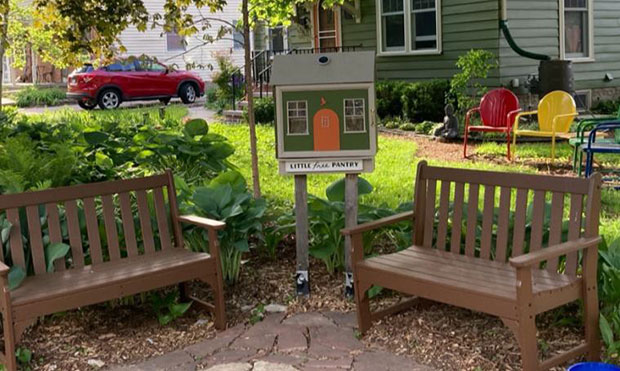
Kim Novak Pictured is the Little Free Food Pantry the author placed on her property. Donated items are distributed to those in need in the neighborhood through the pantry.
By Kim Novak
Unfolding Spirit
Novak
Upon moving to a new home six years ago, Tom and I took on the task of making this corner our own. We planted hostas, sunflowers and coneflowers; tulip, crocus, and daffodil bulbs; and to welcome our neighbors, a Little Free Pantry.
The pantry evolved into a neighborhood project: Lacey, a 5-year-old, likes to donate her own kale-applesauce packets (because she wants to give too!), Mary gives half-loaves of bread, Dave provides cases of tuna, and the summer brings the sharing of tomatoes and zucchini.
Neighbors using the pantry are from all walks of life. Some are experiencing homelessness, living under bridges or in a shelter. Then there is the young, first-year teacher who stops by for pasta because she can’t quite make it through the month. Local kids grab granola bars as they ride their bikes, and a single mom picks up a little here and there to help her get by.
It is a lovely little spot of sharing, and a place that often gives me pause.
One recent afternoon, as I tended to some collapsing irises, I heard a frequent visitor talking loudly, and felt myself “tweaked” just a bit.
“Jackie’s” gaunt, toothless face and thin frame give away her 60 years of difficult living. She often talks of her plans to start a business or move to a new city, of reuniting with an ex-husband, of recent illness, and of finding Jesus. And she returns again and again to our little pantry.
Jackie is direct. If the pantry doesn’t have what she likes or needs, she knocks at our door. And if we aren’t home, she leaves a note indicating what she would like us to buy for her next visit. We take her requests to heart, and try to meet her needs whenever we can.
This particular afternoon, I wanted quiet. Jackie’s voice was grating, and I found myself avoiding her gaze, headphones on. But as she walked away, the “pause” I experienced was a mix of guilt and awareness of my own privilege, of my ability to turn away from need — all because I felt burdened by what she might ask of me.
Author Karen King says, “Part of our poverty as followers of Christ…is the poverty of making ourselves always available, of being profligate toward everybody: even as life is being drained out of us, even when we would so much rather go off and mourn our own losses and griefs in private.”
This call to be “always available” feels like a tall order for an introvert such as myself.
Yet King goes on to say, “Part of the overall plan seems to be that no matter how sad, wounded, neurotic or needy we are, that may be exactly what some other person needs us to be at that time. We don’t know the ways we comfort each other, not only in spite of our wounds, but also in some cases, because of them.”
There is an unfounded pride in the belief that I should know how to help Jackie (or anyone else for that matter), and in failing to acknowledge that she may offer a presence needed for my own healing. There is misjudgment in feeling that I need to show up as anything but human.
This afternoon, as I packed for an early morning flight, Jackie knocked at our door again. Today it was not because she needed food. I sat on the back steps as she shared her fears about her recent lung cancer diagnosis. She cried and I listened. Her current housing situation (of living in a tent) does not mesh well with a chemo regimen, so we talked of options and assistance. I shared a few of the things that were helpful during my dad’s five-year journey with cancer, and she assured me that she’s “a fighter.”
After a while, she looked at the house across the street saying, “You know Annie is doing real good right now. She’s keeping out of trouble.” I nodded in agreement.
She continued, “‘Cause you know none of us choose this. None of us choose to be an addict and none of us choose mental illness. This is no fun.”
I nodded again, saying, “I know. And I know you care about a lot of people.”
Thomas Merton once said, “To be a saint means to be myself.”
Jackie shows up at the pantry and at our door with nothing to offer but her full self, in all its human glory. Perhaps in my pause, I can take just a moment to remember that this is all that is asked of me as well.
Today Christ knocked at the door giving me another opportunity to show up. This time I took it.
(Kim Novak is a member of St. Thomas More Parish in Coralville.)
Faith not just about Jesus and me
Thanks for the June 11 article by Tony Magliano on the new encyclical. He helps us to see that our faith is not just about Jesus and me.
Since Leo XIII in 1893, popes have told us that working for a just society and the common good is an essential element of our commitment to Christ.
The Beatitudes and Matthew 25 best tell us our obligation.
Our politics should be determined by our faith and not the other way.
Thoughtful people will see that so many proposals in today’s politics are directly in conflict with love of neighbor. Our duty to vote and how should be a faith decision.
Donald Moeller Professor Emeritus, St. Ambrose University Davenport
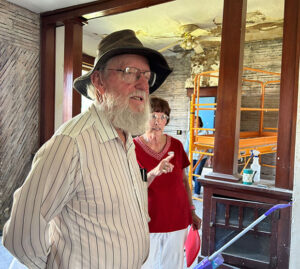
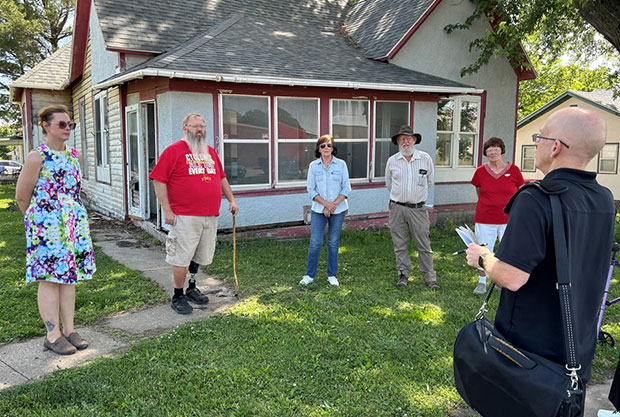
Barb Arland-Fye Deacon Kent Ferris shares his thoughts with members of the Appanoose County Homeless Coalition during a visit to the Lazarus House, a work-in-progress transitional home for people living unhoused. Pictured from left are Rev. Sarah Rohret, pastor of First United Methodist Church; Father Ron Hodges, pastor of St. Mary Park-Centerville; Jan Spurgeon, member of Drake Avenue Christian Church-Centerville; Jim Schweizer, member of First United Methodist; and Dewey McConville, member of St. Mary Parish.
By Barb Arland-Fye
For The Catholic Messenger
(This is part of an ongoing series on housing.)
CENTERVILLE — Inside a modest house on a corner, stripped to its bare walls and flooring, members of the Appanoose County Homeless Coalition share their vision for transforming this neglected structure into a home for a family living unhoused. In 2025, 15.4% of the county’s population of 12,100 was living with “severe housing problems,” according to Data USA. The percentage of Appanoose County residents living in poverty (17.5%) is higher than the national average (12.5%).
Deacon Kent Ferris, director of the Diocese of Davenport’s Social Action Office, and two volunteers from the office visited Centerville to learn more about the efforts of the coalition, whose members represent five Christian denominations, including the Catholic Church. The coalition grew from a priority of the First United Methodist Church in Centerville, which realized early on that collaboration with other faith communities would be essential, explained the Rev. Sarah Rohret, pastor of First United Methodist.
On a warm afternoon in early June, she laid out the plans that the coalition has been working on for around 18 months while they cleared garbage, stripped walls and assessed the house’s many infrastructure and exterior needs. The house’s occupants abandoned the house a few years ago and the City of Centerville took ownership, selling it for a small dollar amount for the coalition to use as a transitional home for a family or individuals without housing.
“We envision a place where people can live for six months to a year and gather the resources they need (counseling, training, education, for example) so that they can be successful on their own,” Pastor Rohret said. The coalition, which conducted listening sessions and received input from people who work directly with individuals struggling with homelessness, chose the name “Lazarus House,” a place to begin anew.
A painful reminder of the struggle occurred last summer when unsafe living conditions at a mobile home park in Centerville resulted in police tagging 10 mobile homes as junk vehicles. Officers worked with Appanoose County Homeless Coalition, Common Ground and the Red Cross to assist residents in finding short-term housing, the Centerville Police Department’s Facebook page reported. “It was devastating,” Father Ron Hodges, pastor of St. Mary Parish said of that situation. He is a member of Common Ground, a ministerial association with close ties to the coalition. “The parish is 100% behind the coalition,” he added.
Gathering input
Pastor Rohret, who moved to Centerville in 2023 to serve as the Methodist church’s pastor, had asked her congregation to identify the pressing needs in their community. Homelessness was the top priority, but the congregation couldn’t address it alone. “I knew that Appanoose County was on the top of counties for homelessness (per capita) in Iowa … it’s a big problem and takes everyone to help,” Pastor Rohret said. She organized a public meeting to gauge interest in collaboration.
Dewey McConville, a retired physician assistant, longtime member of St. Mary Parish in Centerville and a mental health advocate, attended the meeting and subsequently became a coalition officer. “When you work with people with mental illness you end up working with people who are homeless,” McConville said. “I became very aware of the homeless situation.”
McConville returned to her parish to ask for its support. “Our parish completely embraced it,” she said, referring to financial as well as volunteer support. “We asked them to support the meals programs we have and we asked them to support the Lazarus House and we have asked them to fill blessing bags that we hand out with commodities” at events such as “Connections Day” in City Park in July for people who are unhoused or housing insecure.
Other faith communities also embraced the coalition’s efforts. Representatives from the Methodist, Catholic, Presbyterian, Lutheran and Disciples of Christ churches serve in leadership positions with the coalition, whose members also include civic leaders. Each faith community provides funding for the coalition to go toward the organization’s efforts, which include renovation of the house and creation of an Empowerment Center providing case management for people struggling with homelessness or housing insecurity. Fundraising is ongoing.
The coalition also serves a meal Monday evenings, which is as much about connection as it is about physical nourishment. “We want to invite them (the diners) to get to know us so they feel connected to the community,” Pastor Rohret said.
Barb Arland-Fye Jim Schweizer, a member of First United Methodist Church in Centerville talks with Dewey McConville, a member of St. Mary Parish in Centerville inside the Lazarus House, a work-in-progress transitional home for people living unhoused. This work is a major undertaking of the Appanoose County Homeless Coalition, an ecumenical nonprofit organization.
Empowering people
Providing the support necessary for people to gain self-sufficiency is an essential component of the coalition’s efforts. Their vision includes the Empowerment Center where people who are homeless or housing insecure would receive the support services they need to resolve their challenges. The coalition is working through Central Iowa Shelter & Services (CIS), which provides a counselor for several hours on Mondays in Centerville. Opening an Empowerment Center for daily services would help equip families and individuals to move toward independent living.
“Homelessness is often caused by and/or exacerbated by the inability of public support systems to address the complex needs of people in extreme poverty experiencing housing crises,” the Iowa Homelessness Needs Assessment study (2024) states. “These systems include education, hospitals, behavioral health, criminal justice, and child welfare. Engagement and service delivery approaches need to be responsive to the particular needs of people at imminent risk or experiencing literal homelessness.”
During his visit to the Lazarus House, Deacon Ferris praised the Appanoose County Homeless Coalition’s response. “Hats off to it being an ecumenical effort. You all understand your community. You all understand what is possible,” he told members.
Later, he said the ecumenical coalition efforts demonstrate how faith communities are “responding to an outstanding, urgent, unmet community need in ways that are thoughtful, realistic and enable the community to be supportive through their offerings of time, talent and treasure. It is also a great example of subsidiarity, local folks responding to local need.”
“Knowing how Centerville is responding to homelessness in their community is important for us in the Social Action Office because it can be a source of celebration and inspiration,” Deacon Ferris continued. “If indeed the best ideas are common property, sharing the Centerville story may give other parishes a sense of what is possible in responding to homelessness.”
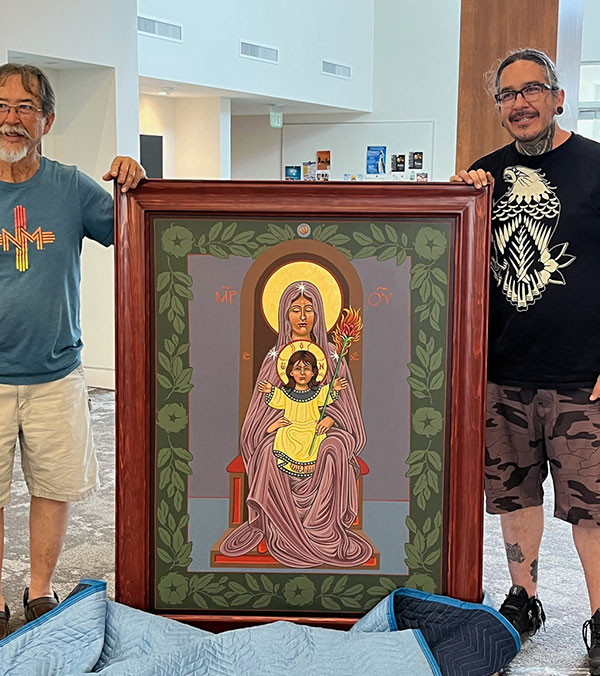
Contributed Custom framers Roberto and Jose Lavadie deliver artist Father William Hart McNichols’ original icon, “Mother of God, Seat of Wisdom,” to St. Thomas More Parish in Coralville May 28.
By Lindsay Steele
The Catholic Messenger
CORALVILLE — A renowned iconographer’s original work has come home to St. Thomas More Parish.
Last year, the parish commissioned Father William Hart McNichols, a former Jesuit whose work is on display at the Vatican Museums, to write an icon of “Mother of God, Seat of Wisdom.” The Litany-derived title holds special meaning to the parish, due to its proximity to the University of Iowa, said lay leader Mary Lu Callahan.
Callahan became acquainted with the priest-artist two years ago when he spoke at an Outreach conference at Georgetown University. Touched by his art and testimony, she brought home a book about the priest and artist and showed it to her pastor, Father Chuck Adam. He was likewise impressed. “I was very intrigued by the way his icons uniquely portray Jesus, Mary and the saints,” he said. “I also appreciated reading about his background and involvement in social issues of his time and the way important themes of peace and justice and mercy are reflected in his works.”
Father McNichols studied iconography under Russian-American master Robert Lentz and personally delivered an icon of “Our Lady of the New Advent: The Burning Bush” to St. John Paul II in 1993. Time magazine once heralded the priest-artist “as among the most famous creators of Christian Iconic imagery in the world.”
The parish initially struggled to get in touch with the busy artist, who also serves as a sacramental priest in the Albuquerque, New Mexico, area. However, Father James Martin, S.J., an internationally known Jesuit who has friends in the Coralville Catholic community, helped the parish and artist to connect last fall.
Fr. McNichols
“I love this title, along with many evocative titles of Mary,” Father McNichols said. “Even though the icon would be fairly large — 3 feet by four feet — I just couldn’t say no, because it sounded like a calling, a vocation, as challenging as any icon I’ve ever been asked (to write).” St. Thomas More — the parish’s patron saint, is “himself a wisdom figure,” he added. A parishioner, who wished to remain anonymous, split the cost of the commission with the parish.
In the Eastern Catholic and Orthodox traditions, the verb “write” is usually used instead of “paint” to describe the process by which an icon is made. The terminology comes from the Greek word for creating icons which literally means “to write.” St. Luke, the Gospel writer, is traditionally credited as the first iconographer. He depicted Mary and the child Jesus. The Second Council of Nicea proclaimed, in the year 787, the special place that icons and other holy art depicting Jesus, Mary and others saints have: “The more frequently they are seen in representational art, the more are those who see them drawn to remember and long for those who serve as models, and to pay these images the tribute of salutation and respectful veneration.”
This was Father McNichols’ first time writing an icon of “Mother of God, Seat of Wisdom.” According to Notre Dame University, “Mary has this title in her Litany, because the Son of God, who is also called in Scripture the Word and Wisdom of God, once dwelt in her, and then, after his birth of her, was carried in her arms and seated in her lap in his first years. Thus, being as it were, the human throne of Him who reigns in heaven, she is called the Seat of Wisdom.”
The parish gave Father McNichols space to pray and discern how to write the icon. “We didn’t see any of it while it was being created,” Callahan said. Father McNichols developed and wrote the icon over a six-month period, using symbols such as the border of blossoming flowers of wisdom and Mary’s scepter of a flaming rose, “symbolic of a very different kind of kingdom,” he said. “She, herself (was) a throne for the little king, eyes cast down deferring to the Christ Child, holy wisdom, and the dancing flames of wisdom, igniting purification and a New Pentecost.”
Upon completion, Roberto and Jose Lavadie of nearby Taos, New Mexico, framed the work. Serendipitously, the Lavadies, who frequently collaborate with the priest, planned to travel to Iowa City in late spring to visit family. They took the framed icon with them and delivered it to St. Thomas More Parish on May 28.
During the big reveal, Father Adam was immediately drawn to the way Father McNichols portrayed the Blessed Mother. “She is looking down lovingly and reflectively at the child Jesus.”
“The way Mary is looking down with protectiveness and pride on Jesus is a look every mother understands,” Callahan said, adding that she observes serenity and peace in the gaze of the Christ child.
The parish officially unveiled the image during Masses the weekend of June 6-7. It then moved to its permanent place in the parish’s devotional chapel, which includes diverse statues and images for the faithful to gaze upon while praying to God.
Father Adam hopes everyone who prays before the icon will find inspiration, as Mary did, “looking to Jesus as the one who shows us true holy wisdom and the path to peace and unity in the world.”
Prints of “Mother of God, Seat of Wisdom” are available on Father McNichols’ website. For more information go to https://tinyurl.com/SeatofWisdom26.






 On a warm afternoon in early June, she laid out the plans that the coalition has been working on for around 18 months while they cleared garbage, stripped walls and assessed the house’s many infrastructure and exterior needs. The house’s occupants abandoned the house a few years ago and the City of Centerville took ownership, selling it for a small dollar amount for the coalition to use as a transitional home for a family or individuals without housing.