




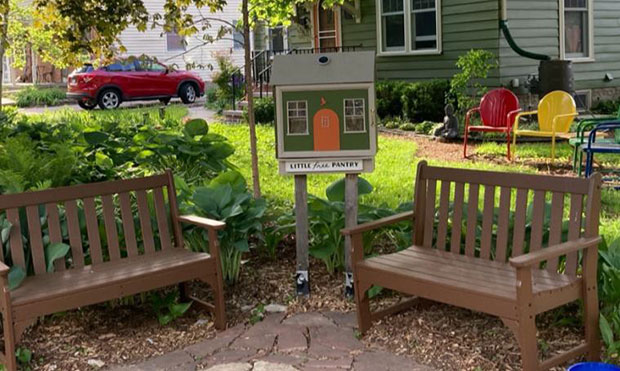
Pictured is the Little Free Food Pantry the author placed on her property. Donated items are distributed to those in need in the neighborhood through the pantry.
By Kim Novak
Unfolding Spirit

Upon moving to a new home six years ago, Tom and I took on the task of making this corner our own. We planted hostas, sunflowers and coneflowers; tulip, crocus, and daffodil bulbs; and to welcome our neighbors, a Little Free Pantry.
The pantry evolved into a neighborhood project: Lacey, a 5-year-old, likes to donate her own kale-applesauce packets (because she wants to give too!), Mary gives half-loaves of bread, Dave provides cases of tuna, and the summer brings the sharing of tomatoes and zucchini.
Neighbors using the pantry are from all walks of life. Some are experiencing homelessness, living under bridges or in a shelter. Then there is the young, first-year teacher who stops by for pasta because she can’t quite make it through the month. Local kids grab granola bars as they ride their bikes, and a single mom picks up a little here and there to help her get by.


It is a lovely little spot of sharing, and a place that often gives me pause.
One recent afternoon, as I tended to some collapsing irises, I heard a frequent visitor talking loudly, and felt myself “tweaked” just a bit.
“Jackie’s” gaunt, toothless face and thin frame give away her 60 years of difficult living. She often talks of her plans to start a business or move to a new city, of reuniting with an ex-husband, of recent illness, and of finding Jesus. And she returns again and again to our little pantry.
Jackie is direct. If the pantry doesn’t have what she likes or needs, she knocks at our door. And if we aren’t home, she leaves a note indicating what she would like us to buy for her next visit. We take her requests to heart, and try to meet her needs whenever we can.
This particular afternoon, I wanted quiet. Jackie’s voice was grating, and I found myself avoiding her gaze, headphones on. But as she walked away, the “pause” I experienced was a mix of guilt and awareness of my own privilege, of my ability to turn away from need — all because I felt burdened by what she might ask of me.
Author Karen King says, “Part of our poverty as followers of Christ…is the poverty of making ourselves always available, of being profligate toward everybody: even as life is being drained out of us, even when we would so much rather go off and mourn our own losses and griefs in private.”
This call to be “always available” feels like a tall order for an introvert such as myself.
Yet King goes on to say, “Part of the overall plan seems to be that no matter how sad, wounded, neurotic or needy we are, that may be exactly what some other person needs us to be at that time. We don’t know the ways we comfort each other, not only in spite of our wounds, but also in some cases, because of them.”
There is an unfounded pride in the belief that I should know how to help Jackie (or anyone else for that matter), and in failing to acknowledge that she may offer a presence needed for my own healing. There is misjudgment in feeling that I need to show up as anything but human.
This afternoon, as I packed for an early morning flight, Jackie knocked at our door again. Today it was not because she needed food. I sat on the back steps as she shared her fears about her recent lung cancer diagnosis. She cried and I listened. Her current housing situation (of living in a tent) does not mesh well with a chemo regimen, so we talked of options and assistance. I shared a few of the things that were helpful during my dad’s five-year journey with cancer, and she assured me that she’s “a fighter.”
After a while, she looked at the house across the street saying, “You know Annie is doing real good right now. She’s keeping out of trouble.” I nodded in agreement.
She continued, “‘Cause you know none of us choose this. None of us choose to be an addict and none of us choose mental illness. This is no fun.”
I nodded again, saying, “I know. And I know you care about a lot of people.”
Thomas Merton once said, “To be a saint means to be myself.”
Jackie shows up at the pantry and at our door with nothing to offer but her full self, in all its human glory. Perhaps in my pause, I can take just a moment to remember that this is all that is asked of me as well.
Today Christ knocked at the door giving me another opportunity to show up. This time I took it.
(Kim Novak is a member of St. Thomas More Parish in Coralville.)
