OFFICIAL
Diocese of Davenport Bishop’s Office
Davenport, Iowa 52804
Appointments
Effective July 1, 2026 Rev. John Lamansky, assigned as parochial vicar of St. Joseph Parish, Ottumwa and St. Mary Magdalen Parish, Bloomfield. Rev. Charles A. Adam, while remaining as pastor of St. Thomas More Parish, Coralville, reappointed as Dean of the Iowa City Deanery for a three-year term. Rev. Jacob M. Greiner, while remaining as pastor of Divine Mercy Parish, Burlington, and St. Mary Parish, Dodgeville, reappointed as Dean of the Burlington Deanery for a three-year term. Rev. Joseph Sia, while remaining as pastor of St. Joseph Church, Ottumwa and St. Mary Magdalen Church, Bloomfield, reappointed as Dean of the Ottumwa Deanery for a three-year term.
During the last week of May, my family and I trekked across Iowa and Missouri to Benedictine College in Atchison, Kansas, for Family Week: a weeklong retreat where both parents and children receive formation and families grow in Catholic community and witness to authentically living out our Catholic understanding of the sacrament of marriage. The event is put on by the Benedictine College Center for Family Life and is just one example of how this thriving Catholic college in Kansas has discovered that putting Catholicism at the center of its identity and mission is the key to continued growth and success.
Family Week is a blast for kids and parents alike. My kids look forward to it all year. The kids love staying in the dorms, eating in the cafeteria and reuniting with friends. The younger children experience The Catechesis of the Good Shepherd program each morning and the older children split up into different “guilds” where they learn skills such as acting, music or sports, led by habited religious sisters from numerous orders who travel from surrounding areas to assist with the children’s formation classes.
It is during this morning session that the parents get to listen to a variety of speakers, including professors and religious, on Catholic formation. The afternoons are spent on family activities such as soccer with the monks from the Benedictine abbey on campus and even a meditation hike led by a priest. The entire experience is punctuated by a morning rosary and daily Mass before dinner for a thoroughly Catholic daily routine.
The beauty of all the vocations working together for the good of the Church, especially the sacrament of marriage, really becomes evident during the week. In addition to the opportunities to interact with religious brothers and sisters, there are priests giving talks, hearing confessions, celebrating Mass and eating meals with families.
Attending Family Week has been a great opportunity for my children to experience a truly Catholic college and my hope is that those good memories will impact their college discernment. Many Catholic colleges in the United States today have diluted their Catholic identity to the point that they resemble secular colleges.
In response to this, Pope John Paul II, in his 1990 apostolic constitution, Ex Corde Ecclesiae (Latin for From the Heart of the Church), laid out norms which must be followed by any higher education institution wishing to use the word “Catholic” in their school name or identity.
I would like to draw attention to one of the norms of Ex Corde Ecclesiae in particular: the mandatum. According to the United States Conference of Catholic Bishops (USCCB) document, “The Application for Ex Corde Ecclesiae for the United States,” approved in 1999, “The mandatum is fundamentally an acknowledgment by Church authority that a Catholic professor of a theological discipline is a teacher within the full Communion of the Catholic Church.” Benedictine College has embraced this idea and has been very vocal about the fact that all of their theology professors must receive the mandatum from the local bishop. Adherence to all the norms laid out in Ex Corde Ecclesiae and reiterated by the USCCB is a visible sign that the Catholic college is operating under the authority of and in union with its local bishop.
In my opinion, seeking the mandatum for all teachers of theology would be an excellent way to assure students and their parents of higher education institutions’ commitment to transmitting the Catholic faith. Catholic colleges and universities thrive when they embrace their Catholic identity. This is exemplified by the growing attendance at Benedictine’s Family Week (with the event continually being sold out) as well as the college’s increase in student enrollment year over year.
A mandatum for all teachers of theology at Catholic institutions seems to me to be one of the most effective ways to maintain a lasting and vibrant Catholic presence in higher education.
(John Oven is a parishioner of St. Mary Magdalen Parish in Bloomfield. He is a member of his parish’s vocations committee.)
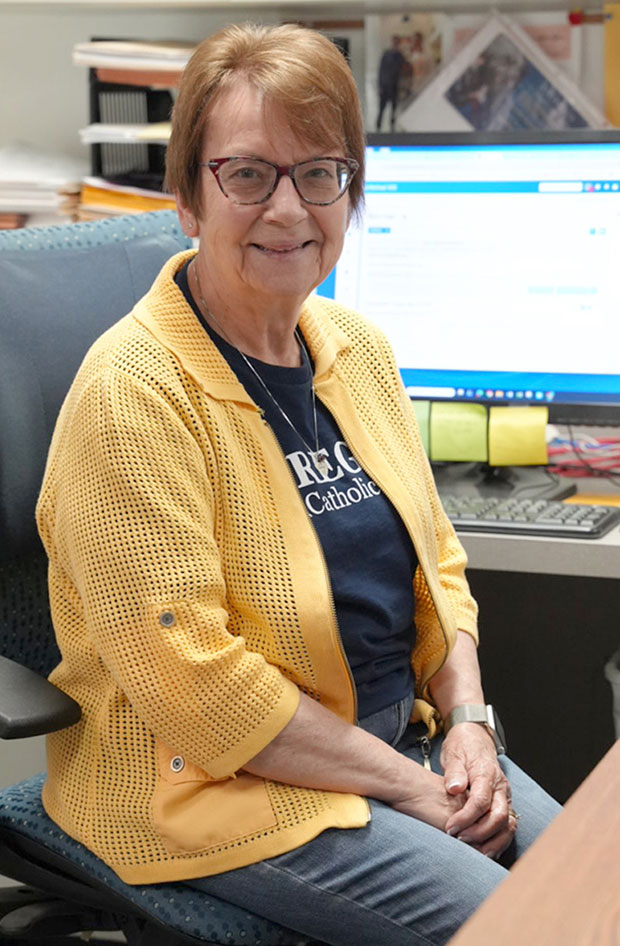
Contributed Marlene Frantz pictured Today. She has been with Regina Catholic Schools in Iowa City since 1968.
By Lindsay Steele
The Catholic Messenger
IOWA CITY — In 1968, Marlene Frantz took a temporary job working in the Regina High School office. She never left.
“I’ve seen students become parents, and I’ve seen parents become grandparents. That’s how long I’ve been here,” she said.
Frantz plans to retire this summer, after nearly 58 years of helping students, staff and visitors find their way. “I’m not sure how we are going to make it without our ‘North Star,’ but she does deserve a break,” said elementary principal and alumnus Celeste Vincent. “Regina has been blessed by her dedication.”
Frantz — nee Wombacher — first set foot on campus as a freshman in high school. “It was just (grades) 9-12 at the time,” she said, and most came from local Catholic grade schools. Having attended public school previously, she didn’t know many of her classmates, but “I remember how accepting the other students were, and it was easy to get to know them. It seemed like I fit in right away.”
She counted her future husband, Harry, among her school friends. Their relationship blossomed into love, and they got married three months after Marlene graduated from Regina in 1968. She entered the working world while her husband — a member of the class of 1967 — attended college.
Contributed Marlene Frantz is pictured above in the 1980s .
The new Mrs. Frantz was between jobs when Regina’s principal, Father Edmund Weeg, called to see if she’d be interested in filling in for a secretary who had gone home to take care of an ill parent. The secretary didn’t return, and Frantz stayed. She enjoyed helping students when they came into the office, and showing visitors where to go.
Frantz’s mother, Genevieve Wombacher, also worked at the school. As Cafeteria Manager, she prepared meals for students, but her involvement went far beyond that, Frantz observed. Wombacher founded Regina’s annual Thanksgiving meal for seniors, and Frantz’s father, Ernest, helped out by deboning turkeys and making turkey rolls. The Wombachers supported the Regina Regals by attending sporting events and being involved in various school activities.
The Frantzes followed their example, especially while their children, Barry and Kim, were attending Regina. For many years, the couple spent Saturdays at Kinnick Stadium selling popcorn with the Regina Boosters. One of Frantz’ favorite memories is organizing and recruiting athletes for an alumni softball tournament.
As the years went by, Frantz began to see her own role at the school as more than just a job. “It kind of became a ministry … to help people.” Her dependable and caring nature was a comfort to students like Vincent. “My first impression was that Marlene would always find a way to make everything ‘right’ for students, no matter what the problem or challenge,” she said. “(That’s) so reassuring when you are a high school student and a small problem seems so big.”
Her steadfast presence reflected positively on staff, as well. “She has helped me through many tough times,” said Glenn Plummer, junior/senior high principal. “Marlene has been a rock for me as I have evolved from a teacher and coach to assistant principal to principal,” and she’s been like a second grandmother to his two children. “There is nothing I can do or say that would be sufficient in expressing how much Marlene means to me and this community.”
Frantz weathered numerous changes during her time at Regina. The school — now known as Regina Catholic Schools — grew to include junior high students in 1969 and elementary students in 1987. Frantz primarily served older students as the junior/senior high office associate, and her responsibilities grew to include more operational responsibilities and financial duties. Marlene worked through technological and personnel transitions, as well. Those changes were challenging at times, but because of the support and camaraderie she felt at Regina, “nothing ever felt insurmountable.”
“She’s been through a lot,” acknowledged Father Steve Witt, a former Regina provost. He appreciated Frantz’s vast institutional knowledge, as well as her kindness and friendliness. “If you ever needed anything she’d get it for you; she knew where to find it.” Plummer said Frantz’s organization and attention to detail “has helped keep the office running efficiently and effectively for well over 50 years.”
The young population Franz has assisted over the years has experienced their own shifts along the way, particularly with the advent of cell phones and social media. Some things remain the same, like their need for support, encouragement and people they can trust, Frantz believes. “I think students needed that back in the ‘60s, and I think they still need that today.”
Perhaps the greatest challenge came two years ago when Marlene’s husband of 56 years passed away. She originally planned to retire that year, but changed her mind after realizing how much she needed the comfort of her school family. “Harry was part of the school as much as I was,” she said. “Everyone was so supportive.” Well-wishers donated money to establish the “Harry and Marlene Frantz Scholarship” for Regina graduates — a “generous” gesture that meant the world to Frantz.
Those well wishes have continued as news of Frantz upcoming retirement spreads. It’s a milestone the septuagenarian is approaching with a sense of gratitude. “I don’t think there’s many people that can say they loved or enjoyed their job for 57 years, but I can honestly say I enjoyed it here,” she said. “I truly believe this is where I was supposed to be.”
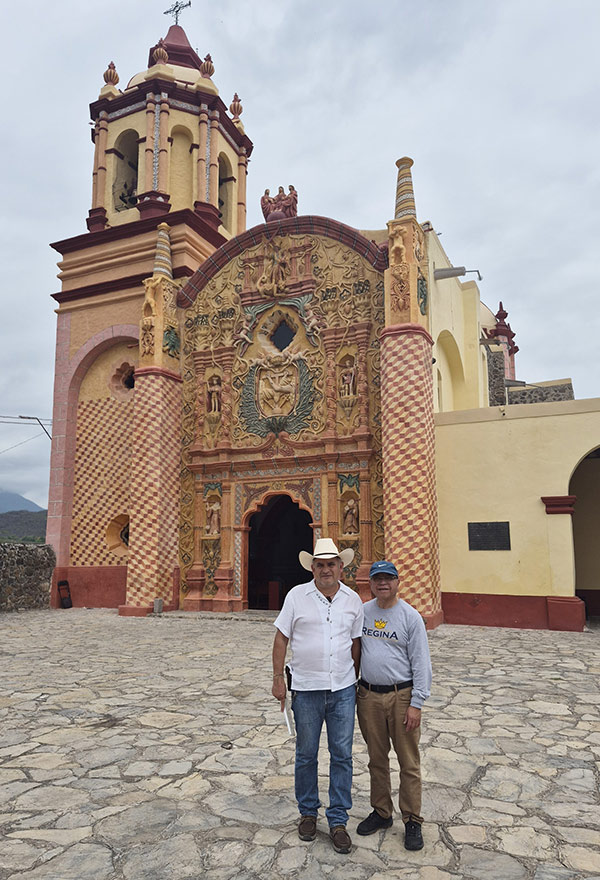
Contribuido El padre Rudolph Juárez, a la derecha, posa con su guía frente a la iglesia de la Misión de San Miguel Concá, dedicada a San Miguel Arcángel.
Por: Dan Russo
El Mensajero Católico
DAVENPORT — Mientras el padre Rudolph Juárez conducía recientemente en una camioneta SUV Volkswagen con aire acondicionado a través de la Sierras Gordas, pensó en los viajes empapados de sudor del padre Junípero Serra y sus hermanos frailes, quienes habían avanzado paso a paso por esta escarpada zona del centro de México siglos atrás.
“Caminaba con sus hermanos franciscanos a dondequiera que iban”, dijo el párroco de la parroquia de San Antonio en Davenport. “Se tomaba en serio su voto de pobreza. No tenían caballos. El caballo era el equivalente a un auto de 50,000 dólares de hoy”.
El párroco de la parroquia de San Antonio en Davenport ha visitado México con regularidad desde hace muchos años. Con frecuencia realiza labor pastoral con las hermanas del Sagrado Corazón en la Arquidiócesis de Morelia; sin embargo, este viaje fue diferente. Durante una peregrinación de 10 días el mes pasado que comenzó el Lunes de Pascua, el nativo de las Quad Cities siguió el camino de uno de los evangelizadores más famosos en la historia del continente. El padre Juárez visitó cada una de las cinco misiones que San Serra fundó en México.
“Había querido hacer esto desde hace unos años”, dijo el padre Juárez. “Poder lograr tanto. Qué enorme impacto tuvieron (los misioneros franciscanos) en la historia, y algunos de ellos en tan poco tiempo”.
Después de construir en la década de 1750 una serie de iglesias y complejos habitacionales destinados al ministerio de los pueblos indígenas, el sacerdote nacido en España, canonizado en 2015, se dirigió al norte, hacia la actual California, donde fundó 21 misiones adicionales. Sierra Gorda significa “Fat Mountains” en inglés. La tribu Pame, de la cual muchos se convirtieron al cristianismo, trabajó con los franciscanos para construir las comunidades. La arquitectura de las cinco iglesias de las misiones es asombrosamente única porque los edificios combinan influencias artísticas de la cultura europea, indígena e incluso árabe. Todavía funcionan como parroquias católicas activas.
“A través de su trabajo (del pueblo Pame) y el servicio de los misioneros, construyeron estas hermosas iglesias que los albergarían a ellos y a las futuras generaciones”, dijo el padre Juárez, cuyos abuelos y padre inmigraron a los Estados Unidos desde ese país. “Dondequiera que vayas en México hay un recordatorio de la fe católica… Al mismo tiempo… algunos (mexicanos) todavía están sin iglesia”.
Después de bajar de un barco en Veracruz, Serra caminó más de 250 millas hasta la Ciudad de México. En el camino, la picadura de un insecto se le infectó, dejándole una cojera que padecería por el resto de su vida. Su legado y el de otros misioneros católicos españoles se vió complicado por las acciones del gobierno español, que gobernó la “Nueva España” durante 300 años, de 1521 a 1821. Las autoridades españolas en ocasiones ejercieron la violencia y explotaron a los pueblos indígenas. En 2020 y 2021, los críticos de San Serra en los EE. UU. comenzaron a vandalizar estatuas que lo representaban, incluida una en los terrenos del capitolio de California. La legislatura de California aprobó el Proyecto de Ley de la Asamblea 338, el cual acusaba al misionero de “esclavitud tanto de adultos como de niños, mutilación, genocidio y agresión contra mujeres”. Los registros históricos muestran que el santo no cometió atrocidades ni aceptó la injusticia de manera pasiva. Los documentos aportan pruebas de que defendió a los indígenas. En 1773, redactó la “Representación”, un informe legal de 32 puntos, y viajó 2,000 millas a la Ciudad de México para presentarlo ante el virrey español. La propuesta incluía disposiciones para proteger a los nativos de California de los abusos de los soldados y para asegurar sus derechos legales.
“La realidad es que juzgamos con nuestros estándares actuales algo que fue histórico”, dijo el padre Juárez. “Durante el período colonial, hubo debates en España sobre este nuevo pueblo indígena. Si estas personas son seres humanos y poseen un alma, son dignas del bautismo y del nuevo estatus como cristianos. Había un corazón involucrado allí y un deseo por la salvación de las almas”.
El padre Juárez pudo celebrar una misa en la misión principal de la Sierra Gorda en Jalpan, donde hay una estatua de San Junípero Serra, el “patrono de la misión permanente de la Diócesis de Querétaro”.
“Lo que aprendí fue la atemporalidad de la fe y la evangelización. Para mí, todos estamos en un estado de trabajo misionero permanente”, dijo el padre Juárez.
El padre Juárez continúa brindando apoyo a los inmigrantes de México y otros países. “La razón de mi esperanza es la continua novedad del llamado a la fe y a la santidad. El trabajo que hacemos es el trabajo de Dios”.
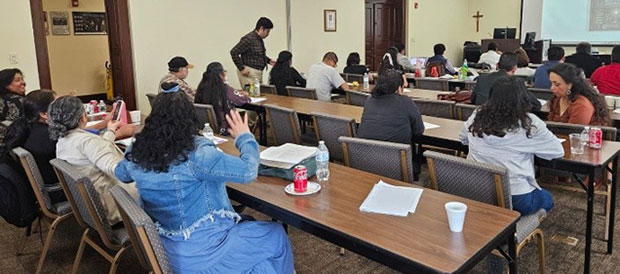
Contribuido Católicos participan en una sesión para aprender cómo podemos poner la tecnología al servicio del Evangelio el mes pasado en Davenport.
Por: Miguel Moreno-Iberico
El Mensajero Católico
Con gran entusiasmo se llevó a cabo la última sesión del Programa de Formación Laical Hispano de la Diócesis de Davenport. En esta ocasión, el enfoque estuvo en un pilar fundamental para los tiempos actuales: la tecnología al servicio del Evangelio.
El taller fue impartido por el profesor Anthony Chávez, quien guio a los participantes en el uso práctico de herramientas digitales diseñadas para potenciar el trabajo pastoral. Durante la jornada, los asistentes aprendieron a descargar e interactuar con aplicaciones clave para la evangelización, descubrieron cómo dar sus primeros pasos en el uso de la inteligencia artificial y adquirieron destrezas para diseñar folletos atractivos para sus comunidades.
Además de la creación de contenido, la sesión tuvo un fuerte componente crítico. Chávez enseñó estrategias esenciales para reconocer noticias falsas (fake news), un paso crucial para mantener la verdad y la integridad en la comunicación digital de la Iglesia.
Un momento destacado de la sesión fue el análisis de la reciente encíclica del papa León XIV, Magnifica Humanitas, la cual aborda la custodia de la persona humana en el tiempo de la inteligencia artificial. El profesor resaltó cómo este documento pontificio nos llama a asegurar que los avances tecnológicos siempre respeten la dignidad humana y estén guiados por la sabiduría cristiana.
En un ambiente de comunidad, aprendizaje activo y compromiso, donde los laicos se preparan para salir al mundo digital no solo como espectadores, sino como creadores de contenido que anuncian la Buena Nueva con las herramientas del siglo XXI.
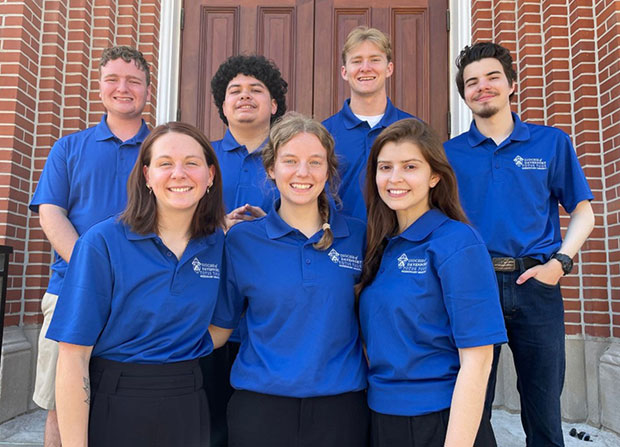
Contributed Totus Tuus missionaries serving the Davenport Diocese this summer are, front, from left, Madison Meyer, Faith Neeley and Natalie Hertzler. Back, Justin Meier, David Cortez, Coleton Daniel and Mason Heath. Sofia Cabada, not pictured, is also serving as a missionary.
The Catholic Messenger
Two teams of young adult missionaries are leading Totus Tuus programs in the Diocese of Davenport this summer.
Totus Tuus is a weeklong Catholic youth program dedicated to sharing the Gospel and promoting the Catholic faith through evangelization, catechesis, Christian witness and eucharistic worship. Participants explore vocations in a broad sense. This includes priesthood, consecrated life, lay ministry, marriage and the diaconate.
“Our missionaries come from a variety of backgrounds, including college students, seminarians and young professionals, but they share a common desire: to proclaim the Gospel and accompany young people in their faith journey,” said Trevor Pullinger, diocesan director of Faith Formation and Catechesis coordinator. “Through prayer, catechesis, witness and joyful fellowship, they help young people grow in their relationship with Jesus Christ and his Church.”
Missionaries participate in a multi-day training session before the program begins and travel as a team to minister to youths in participating parishes and parish groups. Responsibilities include keeping a well-defined daily schedule of prayer and activities, preparing for liturgies, catechetical instruction and organizing daily community-building activities. Missionaries actively promote a safe environment for children and youth, in accordance with diocesan Safe Environment policies.
Team One:
Team Leader Justin Meier of Our Lady of Victory Parish in Davenport is a seminarian discerning the priesthood for the Diocese of Davenport. He has been in seminary formation for nearly a year and enjoys riding his bike, riding his motorcycle, playing cards, and meeting new people. His favorite saint, and confirmation patron, is St. Joseph because of his humble self-giving and faithful care for Jesus and Mary.
Co-leader Mason Heath is a seminarian for the Diocese of Davenport and a member of Ss. Mary & Mathias Parish in Muscatine. He enjoys hiking, playing board games, spending time with friends through communal video games, and reading. His favorite saint is St. John Paul II, whose joyful witness and love for Christ continue to inspire him.
Liturgy coordinator Natalie Hertzler is from Central Texas and is excited to serve the Diocese of Davenport this summer. She holds an associate’s degree in business administration and is currently discerning how God is calling her to serve him most fully. Her favorite saint is St. Louis de Montfort because of his deep devotion to the Blessed Virgin Mary.
Supplies coordinator Faith Neeley is a member of St. Boniface Parish in Farmington. She recently graduated from Grand View University in Des Moines with a degree in kinesiology and health promotion. Faith enjoys hiking, spending time outdoors, and exploring God’s creation. Her favorite saint is St. Kateri Tekakwitha, whose faith and perseverance inspire her.
Team two:
Team Leader David Cortez is a seminarian for the Diocese of Davenport and a member of St. Patrick Parish in Iowa City. He enjoys reading, traveling, spending time with family and friends, and exploring new places. One of his favorite saints is St. Óscar Romero, whose courage and dedication to the Gospel inspire him to lay down his life for Christ.
Co-leader Madison Meyer is a member of St. John the Baptist Parish in Houghton and a senior at the University of Northern Iowa, where she studies gerontology. In her free time, Madison enjoys volunteering, reading, and watching movies. Her favorite saint is St. Teresa of Calcutta, whose example of loving service and devotion to Christ continues to inspire her.
Liturgy and Supplies Coordinator Coleton Daniel is a member of St. Patrick Parish of Iowa City and a senior at the University of Iowa studying exercise science. He enjoys shared meals, spending time outdoors and staying active with friends. One saint he greatly admires is St. Josemaría Escrivá, whose pursuit of holiness in ordinary daily life has had a profound impact on him.
Sofia Cabada, the newest addition to team two, is a member of St. Thomas Aquinas Parish in Madison, Wisconsin. She in an incoming junior at Franciscan University of Steubenville in Ohio, where she studies philosophy. Her favorite saint is St. Paul the Apostle, whose conversion and witness to the Gospel inspire her faith.
Pullinger encourages the faithful of the Diocese of Davenport to pray for the missionaries this summer. “Please pray that their witness may bear abundant fruit and that all those they encounter may grow closer to Christ through the intercession of our Blessed Mother.”
Upcoming Totus Tuus programs will take place at the following locations:
June 27-July 3: St. Mary-Williamsburg, St. Mary-Solon.
July 11-17: St. Joseph-DeWitt, St. Mary-Pella.
July 18-24: St. Joseph-Ottumwa.
July 25-31: Holy Family-Riverside
To sign up or volunteer, contact the parish.
(Trevor Pullinger, diocesan director of Faith Formation and Catechesis coordinator, and Lindsay Steele, diocesan reporter for The Catholic Messenger, contributed to this article.)
En un mundo cada vez más dominado por algoritmos, el papa León XIV ha publicado su esperada encíclica, Magnifica Humanitas. Este histórico documento magisterial aborda uno de los desafíos más apremiantes del siglo XXI: la custodia de la persona humana en los tiempos de la inteligencia artificial.
León XIV no rechaza el progreso tecnológico; al contrario, reconoce su potencial para el desarrollo de las sociedades. Sin embargo, el corazón de su mensaje es una firme advertencia contra la deshumanización. El Sumo Pontífice enfatiza que la tecnología debe estar siempre al servicio de la humanidad, y nunca al revés. La encíclica hace un llamado urgente a científicos, gobernantes y creadores de contenido para que la ética sea el eje central en el diseño de estas herramientas.
“Ningún algoritmo puede sustituir el alma humana, ni la compasión, ni la mirada misericordiosa de Dios”, resuena como el lema principal de este texto.
Para la Iglesia, Magnifica Humanitas se convierte en una brújula pastoral. Invita a las comunidades a evangelizar el entorno digital, asegurando que la IA se utilice para construir puentes de fraternidad, proteger la verdad frente a la desinformación y defender la dignidad inalienable de cada hijo de Dios.






 OFFICIAL