




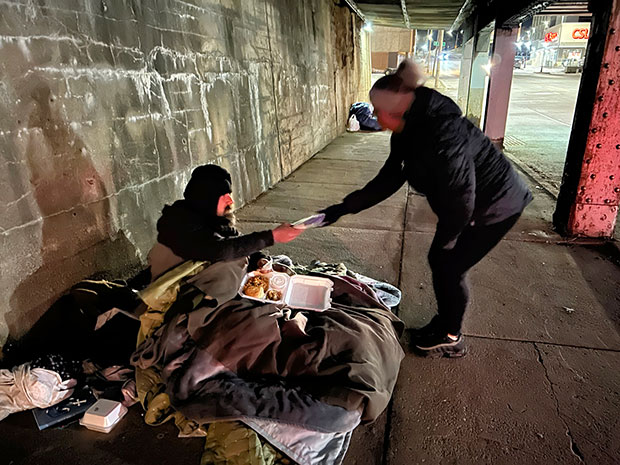
Volunteer Johnna Collins of Davenport presents a warm, home-cooked dinner to Mike, who is spending the night under the railroad bridge in this file photo.
By Barb Arland-Fye
For The Catholic Messenger
DAVENPORT — A new report on homelessness proposes a roadmap to reduce unsheltered homelessness in the Quad Cities region that focuses on a regional, emergency management approach. The proposed $8.9 million plan would help “more than 1,500 adults and families each year avoid or exit homelessness while creating a more coordinated regional response to unsheltered homelessness,” according to the Quad Cities Community Foundation and Downtown Davenport Partnership.
The two nonprofits released the report June 26, two months after hosting a daylong event with regional partners to brainstorm an issue that confronts communities large and small across Iowa and the nation. So much so that a bipartisan bill passed in Congress, the “21st Century ROAD to Housing Act,” which addresses housing supply, financing, homelessness, veterans’ housing, and disaster recovery (National Low Income Housing Coalition).
The Iowa Finance Authority recognized the gravity of homelessness in its own needs assessment report released in 2024, when it estimated 17,000 households in Iowa — single and family — would experience homelessness in 2025. Single adult households constituted 80% of those households.


Housing “is a basic human right that must be available to all persons so that they may lead a life that reflects their God-given dignity,” the Catholic Church teaches (https://tinyurl.com/3xaxsfvn).
In the Quad Cities, approximately 1,200 single-adult households and 350 family households enter homelessness annually, according to the Clutch Consulting Group, whose report addressing homelessness emerged from the April brainstorming event. Of the single-adult households, approximately 120 are long-term stayers in homelessness and about 15 family households are long-term stayers. Most households are newly homelessness (81% of single-adult households and 88% of family households), the report found.
Housing market conditions play a significant role in driving homelessness, the report states. Cities “with higher rental rates and less vacancy have higher rates of homelessness. Mental health, addiction and poverty can be precipitating factors that make one more susceptible to homelessness but are not the drivers of homelessness…. Homelessness is driven by structural factors in the housing market and further challenged when homelessness response systems are not able to seamlessly connect individuals to housing opportunities.”
Hope and strategy
The report outlines “a practical regional strategy focused on ending unsheltered homelessness and preventing it from recurring, building on the strong foundation already created by organizations, donors, and public partners across the Quad Cities,” the Community Foundation and Downtown Davenport Partnership said in a read-out of the report.
Hope and strategy are essential components of the plan’s first phase. The strategy must include:
- Laser focus on the people who are already sleeping outside or cycling through shelter without a path out.
- Fast, practical exits for households newly entering homelessness before a short-term crisis becomes a long-term condition.
- Clear standards for maintaining public spaces, paired with real housing, shelter, treatment, and stabilization pathways.
The Clutch report advises response take place on two parallel tracks:
- Increase housing supply and affordability. The regional housing agenda must continue to advance production, preservation, and access to affordable housing, so the market does not keep pushing more households into crisis. The Quad Cities Housing Council and its Local Housing Trust Fund can and should continue serving as the backbone for this longer-term supply strategy, with jurisdictions advancing local policy, financing, and development tools.
- Secure and connect housing opportunities for people experiencing homelessness now. This report focuses on the emergency rehousing track: the operating model required to resolve current unsheltered homelessness, accelerate shelter exits for single adults and families, and prevent new long-term homelessness from forming.
Regional commitment
“The community coming together and saying they want to address this (issue) as a region, that’s powerful,” said Leslie Kilgannon, who leads the Quad Cities Housing Council (QCHC) and participated in the brainstorming event.
QCHC and the Quad Cities Housing Cluster (of which QCHC serves as the resource development arm) “have been advocating for a regional response for both housing needs and homelessness needs. We’re anxious to see the next steps and how we can all play a role,” Kilgannon said. “We need units for shelter and we need services and we need this next step — permanent housing — and that’s where the Cluster group comes in.”
 In collaboration with five other housing organizations, QCHC is working to make affordable housing available for all with its Silos to Solutions project to create 25 new or rehabilitated rental and homeownership units over the next three years. In fact, the Community Foundation recently awarded its three-year, $300,000 Transformation Grant to the housing council.
Humility Homes and Services (HHSI), based in Davenport and founded by the Congregation of the Humility of Mary, also participated in the brainstorming event and partners with the Downtown Davenport Partnership in street outreach. In a June 30 Facebook post, HHSI said:
“Through this year-round street outreach partnership, we’ve been able to connect with and support individuals experiencing homelessness in our community. Now, we’re excited to build on that partnership and expand this work even further together. Thank you to Downtown Davenport Partnership for your collaboration and commitment to creating meaningful solutions. The work ahead is big — and we’re ready for it.”
John Cooper, pastoral associate for St. Anthony Parish in downtown Davenport, works closely with unsheltered individuals who visit the parish’s McAnthony Window for food, other basic necessities and support services. He also participated in the brainstorming session and believes the regional approach will “do a lot to address homelessness.”
An infusion of funds (which still needs to be secured) is essential. “It will be used to get people off the street, out of the shelter and into stable housing, Cooper said. The second part hinges on a commitment to addressing the needs of the people who are chronically homeless. “There will need to be a commitment to helping the person right in front of us.”
“The secret sauce of this approach,” Cooper said, “seems to be a consistent, concerted effort to address the whole person and/or family. Lots of time will be needed to make sure the non-chronically homeless make it through the 12 months where the housing is provided and during that time develop a 13-month action strategy that keeps the person/family from relapsing into homelessness.”
Cooper said he works with folks struggling with serious issues “and it’s the saddest part of what I do at St. Anthony’s McAnthony Window.’ The consulting group’s proposed roadmap has been successful in other cities,” he said. “What I like about this approach is that it’s not a quick fix. Quick fixes rarely reflect what Jesus would do. Holistic, long-term commitment exercising compassion and meaningful assistance, now that sounds like Jesus.”
Operating structure for reducing homelessness
Clutch Consulting Group, which produced a report on addressing homeless in the Quad Cities region, recommends an operating structure that is “a modified incident command model — the same type of disciplined coordination the region has used during floods, COVID-19, and other emergencies,” according to a report read-out. “The work requires a shared command structure, clear roles, a single operating picture, and a regular cadence for decisions and problem solving.”
To read the report, go to (https://tinyurl.com/ytn5cnd3).
