




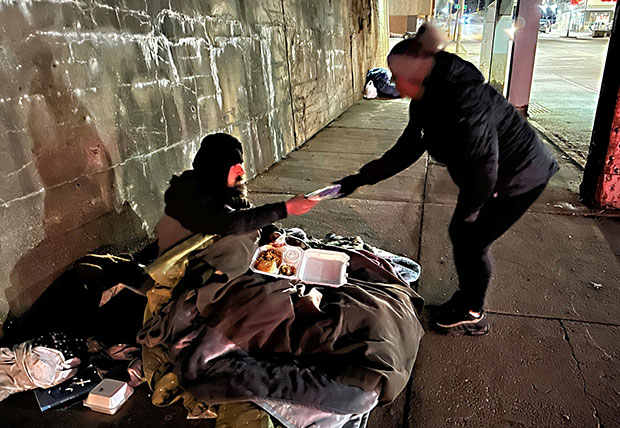
Volunteer Johnna Collins of Davenport presents a warm, home-cooked dinner to Mike, who is spending the night under the railroad bridge at 5th and Main streets in Davenport Jan. 29. Collins doesn’t want anyone to go hungry.
By Barb Arland-Fye
For The Catholic Messenger
(This is the third part in a series.)
DAVENPORT — In its comprehensive Needs Assessment Report on homelessness in 2024, the Iowa Finance Authority estimated that 17,000 households in Iowa — single and family — would experience homelessness in 2025. Single adult households constitute 80% of those households. In this installment of our series on affordable housing and homelessness, we follow an outreach navigator and a middle-aged mom reaching out to people who are unsheltered and experiencing homelessness.
Rob, 44, attempts to restring his guitar with his weathered fingers inside a classroom at The Center in Davenport, which offers outreach to people in need. It is a bitter cold day, Jan. 27, but Rob, who has lived unhoused for about four years, is prepared. He wears headphones around his neck, a fleece-lined flannel shirt under his jacket, thick weather-proof pants and heavy shoes.



Chris Dunn, a guitarist himself and an outreach navigator with Davenport-based Humility Homes and Services Inc., which the Congregation of the Humility of Mary founded, offers Rob encouragement and suggestions. Dunn spends his days building relationships with individuals living outside to get a better understanding of their particular barriers to housing. He works to gain trust, makes referrals to appropriate social services, and is ready to help “whenever people seem ready to move forward” in their lives. He accompanies individuals to government agencies to get Social Security and ID cards or other documents necessary to move forward with obtaining housing, healthcare and jobs. Outreach navigators also serve as liaisons to businesses and police departments to address concerns and make contact with persons living on the street.
Dunn invites Rob to stop by his office at HHSI in Davenport’s Central Community Circle neighborhood to sign up for Coordinated Entry, a process to assess and assist the housing needs of people who are homeless or at risk of homelessness. HHSI focuses on ensuring that everyone has access to affordable, safe, decent housing, which the nonprofit states is a basic human right.
Catholic Social Teaching underscores housing as a basic human right. The Iowa Catholic Conference states, “… governments, the private sector, nonprofit organizations, and churches and their ministries, have a shared responsibility to ensure all people have access to affordable and stable housing” (ICC, 7-22-24 e-newsletter).
Counting the unhoused
Rob accepts Dunn’s invitation to stop by in the morning, packs up his guitar and other belongings and heads outside just before The Center closes at 2 p.m. “We’re doing a count tomorrow morning,” Dunn tells Rob, referring to the Point in Time (PIT) Count, a national survey of “sheltered and unsheltered people experiencing homelessness on a single night in January” (HUD Exchange). “Count me in,” Rob responds. He won’t divulge where he plans to spend the night. “I’ve got a spot away from everybody else.”
Some people who are unhoused are reluctant or unable to stay in an emergency shelter or a hotel room. Some ask for help but can’t find an open bed in a shelter. Others sleep in their cars or hope that a friend or family member will allow them to stay the night.
“State of Iowa homelessness systems are currently operating from a position of resource deficit,” according to the Needs Assessment Report. “The current inventory of beds and resource slots is insufficient to accommodate appropriately all people experiencing a housing crisis who need resources to resolve their homelessness.”
The report further states that “Iowa’s homelessness system emergency shelter beds and housing units would need to be increased across all project types (emergency shelter, transitional housing, rapid rehousing, permanent supportive housing and other permanent housing) to meet the expected demand.”
 Battling the elements
Everett, wearing a red athletic suit that doesn’t protect him from the cold, greets Dunn as they both walk out of The Center. “I’m on the street,” Everett tells Dunn. “How’d you sleep?” Dunn asks. “I didn’t,” Everett responds, wondering if Dunn might know about an available room to spend the night.
Dunn calls HHSI, which operates an emergency shelter along with its affordable housing programs and services. The shelter, unfortunately, is full for the night. Meanwhile, Everett needs to get his prescriptions refilled at Community Health Care Inc. in downtown Davenport, which provides accessible, affordable health care. Dunn drives Everett to the clinic.
Afterwards, Dunn takes Everett to the Corner Closet Donation Center on the HHSI campus, about a half-mile away, to search for a coat, gloves and boots. Everett selects a coat from a rack but struggles to make it fit his lanky, 6-foot-4-inch frame. None of the coats are big enough. Dunn finds a pair of oversized coveralls, along with a pair of new, lined boots. The coveralls will work, the boots fit, and a grateful Everett smiles. He grabs a wrapped peanut butter sandwich, picks up the large bag containing his new possessions, and heads to Dunn’s car.

Several men gather around a trash can in front of the Davenport Public Library to eat a warm, home-cooked meal Jan. 29 that volunteer Johnna Collins made for people who may be living unhoused in downtown Davenport.
Meals on wheels for the hungry
Johnna Collins of Davenport, a mother of two adult daughters, can’t bear to see people go hungry, so she prepares meals several nights a week with donated food items or groceries she purchases. (KWQC News in Davenport recently honored Collins with its Hometown Hero Award for her efforts.)
On Jan. 29, she loads her older model van with freshly cooked pasta and sides packaged in Styrofoam containers (desserts are in separate containers), along with blankets and coats to serve people living unhoused in downtown Davenport.
The first place she stops is a parking lot behind an old brick building, where a man is living in an open space between the building’s outer walls. A battered piece of plywood keeps the man hidden. Collins greets the man cheerfully, hands him his meal and assures him that she will be back.
At the next stop — the railroad bridge at 5th and Main streets — a man named Mike sits under the bridge on the sidewalk swaddled in blankets and quilts. Collins greets him like a friend and hands him a meal, which he accepts with gratitude. Then she heads down the street to the Davenport Public Library on Main Street, where backpacks and a cart of blankets line the gate in front of the well-lit library. Several men approach the white van that displays the colorful handprints of people experiencing homelessness. After each one accepts a meal (and chooses a brownie or pie slice for dessert), they walk back toward the library, form a cluster around a trash can, and eat their meals.
At another stop outside an old building near downtown, Collins drops off a meal to a man she has been serving for the past 2-½ years. Bundled in multiple blankets, he accepts his meal eagerly. Another man walks up, saying he plans to spend the night outside. However, he has no bedding and a coat that won’t keep him warm. Collins hands him a meal and pulls out several quilts and a jacket from her van for the man, who is touched by her generosity.
Collins’s last stop, a hidden space near the Mississippi River, is home to an older man, whom she fusses over and treats like a member of her family. The warmth of their relationship takes a chill off the night.
Filling in the gaps
The Iowa Finance Authority Needs Assessment Report “documents the significant gap in crisis response services and rehousing support for Iowans experiencing homelessness.” Adding bed/unit and service capacity will help, but system improvements are also necessary, the report found. Among the recommendations:
• Increase accessible, affordable housing. “The shortage of rental units accessible to … people in extreme poverty puts pressure on households to double up, settle for substandard housing, or make economic choices that put their housing stability at risk.”
• Address basic needs of clients. “While each Iowa planning region identified different strategies for providing safe, crisis shelter for residents without housing, the execution of these strategies is often dependent on external partners and adjacent systems of care.”
• Build capacity and support professional advancement of direct care staff. The report notes that direct care staffing in homeless systems often are entry level, low-paying positions. “Staff could benefit from frequent, high-quality supervision, access to training and skill-building opportunities … The long-term success of clients is dependent on quality case management services.”
• Improve coordination with adjacent systems. “Homelessness is often caused by and/or exacerbated by the inability of public support systems to address the complex needs of people in extreme poverty experiencing housing crises. These systems include education, hospitals, behavioral health, criminal justice, and child welfare.”
