




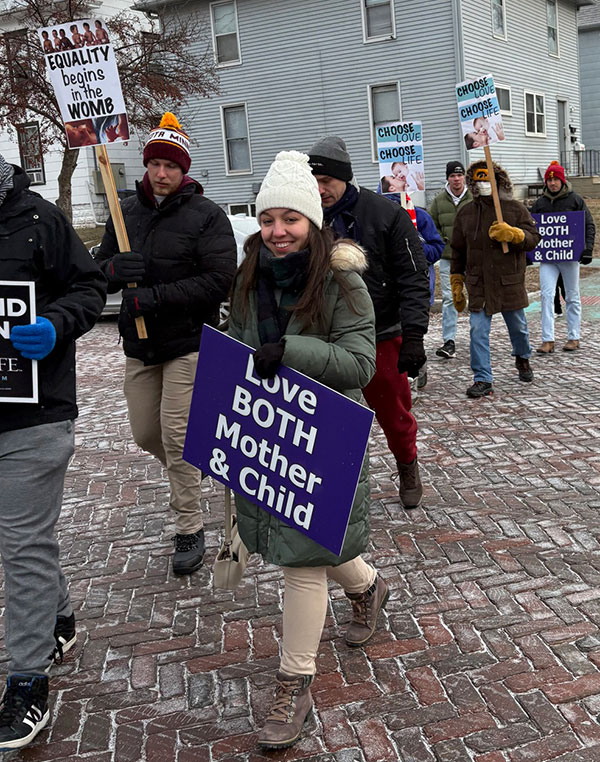
Pro-life advocates participate in the Iowa City March for Life Jan. 24.
By Lindsay Steele and Dan Russo
The Catholic Messenger
IOWA CITY — Pro-life advocates are celebrating the upcoming closure of Planned Parenthood in Iowa City. The facility, which helps clients access and afford chemical and surgical abortions in addition to other services, will cease operations on July 31 as part of a regional restructuring effort.
Sheryl Schwager, executive director of Johnson County Right to Life in Iowa City, called the closure a “victory for life… we offer all praise and thanksgiving to God.”
Planned Parenthood North Central States (PPNCS) shared the news on its website June 29 — three days before a new Iowa law requiring Iowans seeking medications that induce abortions to see a physician in person went into effect — noting that services will transition exclusively to the Susan Knapp Health Center in Des Moines. The organization will also reduce staff across its North Central States region.


The pro-life community in Iowa City, led by Johnson County Right to Life founder Pat McTaggart, has prayed for Planned Parenthood’s closure for decades, Schwager said. “The prayers and faithful witness of many members of our community have been instrumental in bringing about this long-awaited victory.”
PPNCS believes “unrelenting political attacks, growing restrictions on care, and an unsustainable rise in uncompensated and undercompensated care,” precipitated by cuts to federal funding and Medicaid coverage, made the closure and staff reductions inevitable.
State-level legislation across the region — made possible by the overturn of Roe v Wade in 2022 — have further hampered Planned Parenthood’s operations, according to the statement. In Iowa, a near-total abortion ban “has fundamentally reshaped how patients access care, contributing to an 80% decrease in Iowans accessing abortion services in-state and significant increases in travel to neighboring states.” Iowa’s fetal heartbeat law, which took effect in 2024, prohibits most abortions once cardiac activity is detected, which is typically around six weeks of pregnancy. Previously, abortion was legal up to 20 weeks of pregnancy.

This 2021 image shows the Planned Parenthood clinic at 850 Orchard Street in Iowa City.
The number of Planned Parenthood clinics in Iowa has shrunk from 12 to one in less than a decade. In the Diocese of Davenport, clinics in Burlington and Bettendorf closed in 2017. The Emma Goldman Clinic in Iowa City, which provides abortions, is not affiliated with Planned Parenthood and remains open. It is one of two in-person options for Iowans seeking an abortion, including the Planned Parenthood clinic in Des Moines.
The number of Iowans seeking abortions dropped 22% from 2024 to 2025, according to the Guttmacher Institute, an organization that supports legal access to abortion. The data include numbers from Iowans who got abortions at one of the state’s brick-and-mortar clinics and through telehealth appointments, including those who received abortion pills from out-of-state medical providers in states with shield laws. The institute reports that about 75% of Iowa abortions in 2023 were chemical abortions, higher than the national average of about 65%.
An increase in drugs being sent through the mail prompted a response from Iowa legislators. On July 1, a new law took effect in the state which requires medications used in chemical abortions to only be dispensed at a medical center after an in-person exam. Known as HF 2788, the legislation prohibits sending drugs like mifepristone, which causes the death of a baby in utero and misoprostol, which expels the body from a mother’s womb, through the mail. Side effects for women can include possible hemorrhage, infection, sterility, and death, according to the Food and Drug Administration (FDA). The agency first relaxed its in-person dispensing rule for mifepristone in 2021, before making the rule change permanent in 2023. The FDA is now engaged in a major safety study of the drug. The Iowa law requires “written informed consent” by the pregnant woman before the drugs are prescribed and addresses emergency care.
Ruth Richardson, president and CEO of Planned Parenthood North Central States, believes the “reproductive freedom movement” is experiencing one of its hardest moments in modern history. She hopes that the restructuring of Planned Parenthood will protect the organization’s core infrastructure so “we will be ready to expand care again when the pendulum shifts — because it will. After seeing the resilience of our patients, communities, supporters, champions, and our staff and providers, I believe we have what it takes to sustain our strength and build back.”
Other pro-life organizations joined JCRTL in supporting the new law, such as the Iowa Catholic Conference and Dubuque County Right to Life. They hope the measure will increase safety and shield women from coercion and abuse. “We’ve seen the damage (surgical and chemical abortions) can do,” said Art Gilloon, an attorney and vice president of Dubuque County Right to Life. “What we have legislated is protections. Women deserve better.” Gilloon regularly brings a group from Dubuque to pray with Iowa City-area pro-life activists.
JCRTL plans to host a celebration “to give thanks to God and honor everyone who has faithfully sacrificed their time praying outside the Planned Parenthood facility,” Schwager said. Details will be published in an upcoming edition of The Catholic Messenger.
Local pro-life advocates know the fight to make abortion unthinkable in Iowa is not over. They will continue to pray in front of Emma Goldman Clinic, as they have for many years, while working to address some of the issues that lead women to believe that abortion is their only option. “We are not protestors or picketers,” Gilloon said. “We stand with a sign that says ‘You’re not alone. We can help you.’ There’s thousands of pro-lifers ready to help.” Pro-life advocates along the right-of-way aim to provide long-term material and spiritual support to pregnant women so they can have and raise their babies. This can include a variety of actions including aiding families with medical care, food and rent. Pro-life activists are also working to educate the community about the risks associated with medication abortions, raising awareness of abortion pill reversal, and hosting “sidewalk advocacy” training.“
“Together, we are working to end abortion in our community while connecting mothers and families across Iowa with the resources and support they need to flourish,” Schwager said.
