




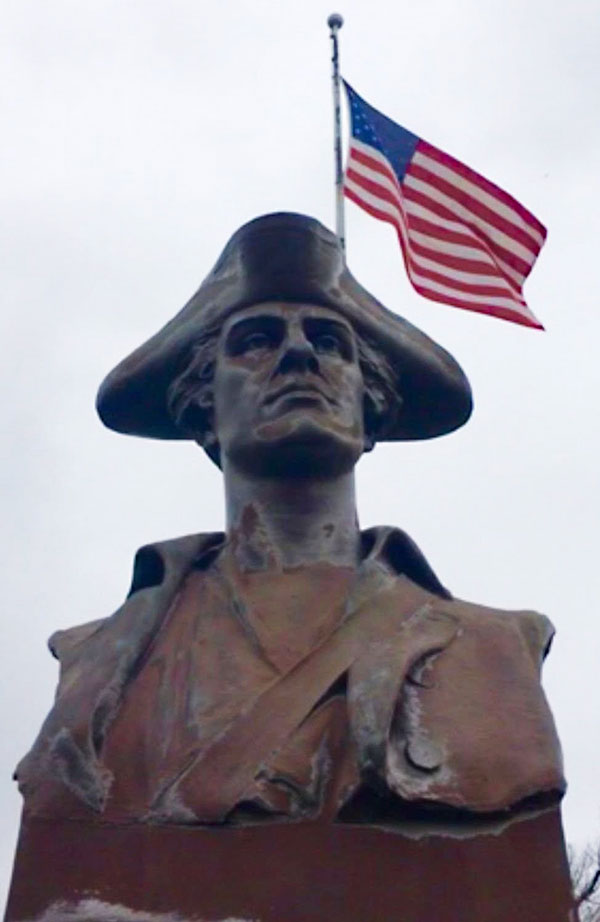
A memorial to American Revolutionary War veteran Timothy Brown is located in Washington, Iowa.
By Dan Russo
Editor

As the United States prepares to celebrate the 250th anniversary of the signing of the Declaration of Independence on July 4, many Americans may focus on events in Washington D.C. There’s another town named after the famous general and president — Washington, Iowa — which also deserves some attention. This tiny city of about 7,000 people has a connection to the American Revolution and its ideals that is less grand than the capital’s, but no less significant.
About 40 veterans of the Revolutionary War settled in the Hawkeye state. In Washington, Iowa’s Elm Grove Cemetery lie the remains of Timothy Brown.
Born in New Jersey in 1762, Brown was about 16 when he became a private in the company of Captain Richard Cox in the Third Regiment of the New Jersey Line. He was younger than your average recruit. He took the place of his father in the service for reasons unknown. “Brown served under General Washington at Monmouth, Springfield, and Yorktown and witnessed the surrender of General Cornwallis at Yorktown. He served from April 1780 to June 5, 1783; pension papers contain a certificate of discharge for three years service signed by George Washington,” according to information from the Abigail Adams Chapter of the Iowa Society of the Daughters of the American Revolution.


Newspaper reports state that Brown later moved to Iowa to join family members and farm. He had suffered a wound in the war to his leg and hip, which may have led to him receiving a military pension.
He was buried in an old pioneer cemetery which later fell into disrepair and was all but forgotten. In 1903, a local newspaper rediscovered the story of Private Brown. Local people worked to have Brown’s remains moved to their current location. Eventually, the state of Iowa and local citizens paid for a monument to be erected at Brown’s grave in Elm Grove.
Today, Washington, Iowa, is surrounded by farms similar to the one Brown used to work. There’s at least one factory in town that makes roof shingles. There are many churches in the tiny community, including one Catholic parish — St. James — that is part of the Davenport Diocese. One of its current members, Audrey Reed goes to Mass there every day. The 91-year-old widow lost her husband, an Air Force veteran, several years ago. They raised their children in the Washington area.
“We had eight children,” she told The Catholic Messenger recently. “We were farmers. I’ve got three sons who farm currently.” Reed’s ancestors came to Iowa from Ireland. Her great-grandchildren go to St. James Catholic grade school alongside some children whose parents are recent immigrants.
“My faith and family are upper most in my life,” she said. Reed still has a farm. She and her husband were able to save it during the farm crisis of the 1980s with a loan, “by the grace of God.” She’s proud of her sons who still farm and would bring meals out to them as they worked the fields until just recently. Reed loves her parish and community.
The ideals of the American Revolution — “that all men were created equal” and that we have the right to “life, liberty and the pursuit of happiness” have never been implemented perfectly and there have been some dark times since our nation’s founding. However, there has also been amazing progress over 250 years. This progress comes in large part due to the deep faith, courage and hard work of everyday people like Timothy Brown, the Reed family and many other people whose names will never appear on social media or in documentary films.
Washington, Iowa will mark Independence Day at the fairgrounds with live music and fireworks and that’s great. Despite our differences and divisions, there is a lot to celebrate this year.
Phyllis Wheatley, a former slave who was the first African American woman to publish a book of poetry, famously wrote General Washington in 1775 in support of the American Revolution. She staunchly backed the cause because she believed its ideals of freedom and equality were aspirational. She knew even then that they would eventually be applied to all.
Wheatley once wrote: “In every human breast, God has implanted a Principle, which we call Love of Freedom; it is impatient of Oppression, and pants for Deliverance.” As we prepare to carry our national ideals into the future, I hope we can find common ground by remembering our heroes and giving thanks for the blessings so far.
(Dan Russo can be contacted at russo@davenportdiocese.org.)
