




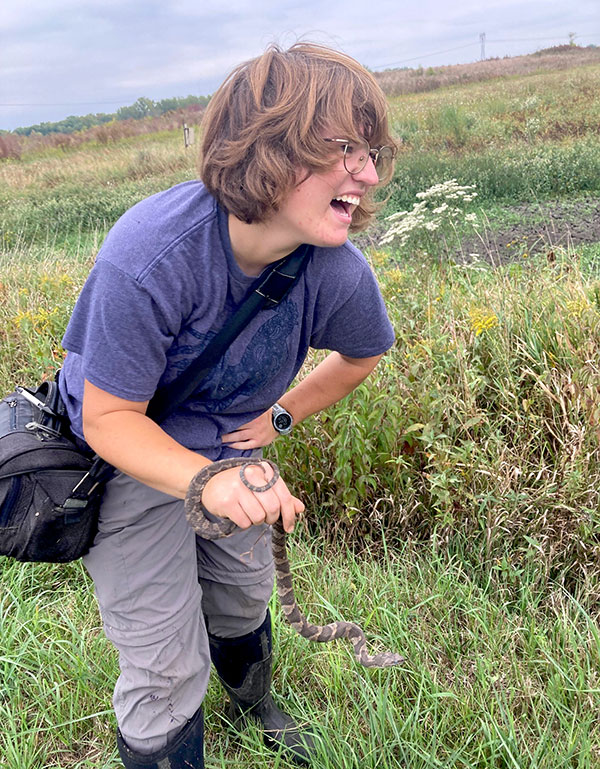
Carley in her element on the Iowa prairie.
By Kim Novack
Unfolding Spirit
The youngest of our blended group of seven children, Carley, has floated in and out of our home over the past few years. Following college, work in the world of natural resources has proven to be seasonal, nomadic, and unpredictable.
Those who know Carley may note that she is “quirky” or has always “marched to the beat of her own drum.” I was never sure how to take this comment, but I felt the truth of it. At 5-years old, Carley might wear a princess dress, complete with plastic high heels and bag, but you could be certain that bag was full of dinosaurs and that she knew the scientific name of each one. One day she might be lining the entire front porch with cicada shells, and the next tucking boxes of “special rocks” throughout the house.
By the time she was seven, you could hear her sprinkling her knowledge about as we walked the Omaha zoo.


“Actually, that is a caiman, not an alligator. They are smaller and from a different area of the world.”
“That animal is crepuscular — that means it’s active dusk and dawn.”
“Venomous, not poisonous.”
As she went through horse, owl, dog, chicken and reptile “phases,” she didn’t just learn names, she learned genus, species, sub-species, and minute differences in appearance and behavior. “Relaxing” and watching a show together meant yet another David Attenborough documentary.
And when Carley wanted a pet, she might just write and submit a full, referenced report about it as a persuasion tactic. By the time she was 10 she had her first snake, followed by another, and a skink, and a gecko and… Friends asked “Why?” Wouldn’t she outgrow this phase? Did I really want this in my home? But it has always been so clear that these passions, whether I understand them or not, are part of the essence of who Carley is.
Thomas Merton once said, “The beginning of love is the will to let those we love be perfectly themselves, the resolution not to twist them to fit our own image. If in loving them we do not love what they are, but only their potential likeness to ourselves, then we do not love them: we only love the reflection of ourselves we find in them.”
Whether surrounded by the buzz of mosquitoes in the Everglades, the rippling beauty of an Iowa prairie remnant or trudging through the sand dunes of western Texas, Carley was, and is, masterful at noticing. And in this noticing, she finds a flow of awe and delight in creation that is simply contagious. For witnesses of this joy, she opens eyes anew to the sacredness of all creation.
There is nothing I could want more for Carley than to be perfectly herself, living in this place of “holy noticing.” What gifts the world misses out on, and what suffering we cause, when we don’t allow others to be fully themselves.
But this journey of growth is not easy. In this culture, it is abundantly clear to kids and adults when they don’t “fit the mold.” Belonging becomes elusive and loneliness real. We see this not just in neurodiversity, but in LGBTQ+ youth and other marginalized groups. For Carley, this meant learning to live with anxiety and depression starting at a young age.
As parents, we share this pain. I find it my role to help Carley love herself, not find a way to “fit in.” In the past this meant a Friday evening doing puzzles together as she learned to sit with anxiety, working through the transition to college, or doing “church” out on a trail on Sunday morning. It meant being willing to simply walk with her. Today, it means cheering her on in adventures that are well beyond my comfort zone and understanding.
And although Carley is not aware, I have anointed mystic and saint, Hildegard of Bingen, as her guide and protectress. This 12th century patron saint of ecology reminds us that “Every creature is a glittering, glistening mirror of Divinity.” This is a truth Carley has always known and lived.
Hildegard also encourages each of us to know and live in the truth of who we are created to be, writing, “We cannot live in a world that is not our own, in a world that is interpreted for us by others. An interpreted world is not a home. Part of the terror is to take back our own listening, to use our own voice, to see our own light.”
May we all love one another so well that we allow and encourage each person to show up as perfectly and authentically themselves. And may we love ourselves enough to take back our own listening, use our own voice, and see our own light — maybe even marching to the beat of our very own drum.
(Kim Novak is a member of St. Thomas More Parish in Coralville.)
