




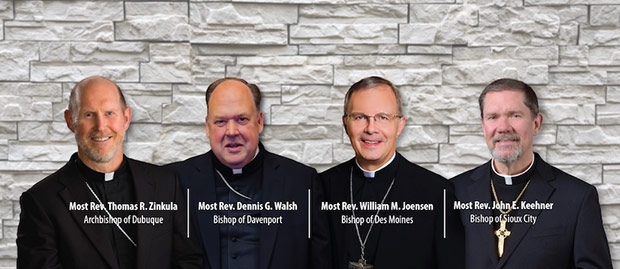
Here is a compilation photo of the four bishops in Iowa.
By Dan Russo
The Catholic Messenger
DES MOINES — With political activity across the state heating up as the 2026 general election approaches, Iowa’s four Catholic bishops have begun a social media campaign on “Faithful Citizenship” that they hope will have an impact long after all of this year’s votes are cast.
The leaders of the dioceses of Des Moines, Dubuque, Sioux City and Davenport have started releasing short videos this month in which they answer questions on public policy and politics. Archbishop Thomas Zinkula of Dubuque kicked off the effort Sept. 3 by addressing, “How do I maintain my Catholic values in the political sphere?”
“By letting the Gospel shape your politics more than a party or ideology,” responded the archbishop. “By putting Christ before public pressure. By letting Catholic teaching judge politics rather than politics judge Catholic teaching. Political engagement is important, but discipleship comes first. So form a conscience rooted in truth, stay anchored in Catholic social teaching and keep Christ at the center.”


The videos were produced by the Iowa Catholic Conference (ICC), the public policy advocacy organization of the bishops. They are appearing on the ICC’s Facebook, Instagram and YouTube accounts. Early voting in Iowa begins in mid-October. Election day is Nov. 3. The Q&A clips, which are generally under a minute in length, will continue regularly until May 2027. There are plans to release several videos per week, according to Tom Chapman, ICC’s executive director.
Bishop John Keehner of the Sioux City Diocese tackled the question of “How can we engage with others with civility?” in the second video in the series, posted Sept. 4.
“I would suggest that we listen before we respond,” he said. “Much political conversation fails because people are preparing their rebuttal rather than trying to understand. Catholics should ask honest questions, name common concerns where possible, and avoid reducing people to party labels, slogans or the worst version of their position.”
Bishop Dennis Walsh of Davenport and Bishop William Joensen of Des Moines are scheduled to appear in videos in the near future.
Some of the upcoming questions the bishops will answer include: why are Education Savings Accounts (ESAs) good for families; how can Catholics inform their conscience before they vote; is it acceptable if I do not align with either major political party and what political issues is the Catholic Church most focused on?
The Iowa Catholic Conference is also offering a flyer in English, Spanish and French to help Catholics in their discernment about how to participate in the political process. The Iowa bishop’s work coincides with that of the U.S. bishops as a whole. The United States Conference of Catholic Bishops (USCCB) explores the issue of civic engagement in depth in its document, “Forming Consciences for Faithful Citizenship,” which emphasizes that Catholics have a duty to participate in civic life. The Catholic Church does not endorse or oppose any political candidates or a particular political party, according to the USCCB, but it does encourage individuals to take part in politics with guidance from Church teaching.
“The Church’s obligation to participate in shaping the moral character of society is a requirement of our faith,” states “Forming Consciences for Faithful Citizenship.” “It is a basic part of the mission we have received from Jesus Christ, who offers a vision of life revealed to us in Sacred Scripture and Tradition….”
The ICC Faithful Citizenship flyer for 2026 offers information for Catholics preparing to vote, such as questions to ask candidates and a reflection on Catholics’ role in politics.
“Civic engagement is a moral obligation and we have a duty to inform ourselves about issues and vote conscientiously,” reads the ICC flyer. “Our choice of how to vote in every instance must follow our best understanding of what is the good for all, following a time of reflection and prayer. Our tradition recalls the story of the Last Judgment (Mt. 25:31-46) and instructs us to put the needs of the poor and vulnerable first. Of course, our commitment to the common good does not end with voting. We can start solving problems at the local level by organizing with others in charitable work to help meet the basic needs of individuals … The message of our Catholic teaching is one of hope, grounded in faith and reason. Making decisions in the light of our faith will not be easy, and it may lead us to a place we don’t want to go. But it is our life-long obligation to say ‘yes’ to God in all things, and listen for His voice sounding in our heart.”
The bishops’ short videos are available on the ICC’s social media platforms. More information about the social media campaign, the flyer and other faithful citizenship information is at iowacatholicconference.org. Sign up for Iowa Catholic Conference news and alerts at https://www.votervoice.net/icc/home.

‘On Christians as Citizens’; “From day to day it becomes more and more evident how needful it is that the principles of Christian wisdom should ever be borne in mind, and that the life, the morals, and the institutions of nations should be wholly conformed to them.” ~ Leo XIII, SAPIENTIAE CHRISTIANAE,1890.
Your Excellencies,
Thank you for the recent Faithful Citizenship videos and for the clarity and charity with which you have begun this statewide conversation. The tone you have set—placing discipleship before ideology and conscience before party—deserves real gratitude.
If helpful for future messaging, I offer a brief reflection that may be published.
Faithful Citizenship has always meant more than political alignment. As Leo XIII reminded us, “the life, the morals, and the institutions of nations should be wholly conformed” to the enduring principles of Christian wisdom. That is the heart of civic responsibility: not merely participating in politics but allowing the Gospel to shape the way we engage our neighbors and our society.
Fulton Sheen once observed that a nation of dependent citizens is not the nation we set out to be. His point was not ideological but moral: authentic freedom—political, economic, and spiritual—requires responsibility, ownership, and virtue. Faithful Citizenship invites Catholics to rediscover this deeper understanding of freedom, one rooted in human dignity rather than in partisan narratives.
Your recent videos echo this tradition beautifully. By encouraging Catholics to listen before responding, to form conscience before voting, and to place Christ before pressure, you are helping restore a civic vocabulary that has been lost in our polarized age.
Thank you for continuing to lead with wisdom drawn from the Church’s long tradition. It is a gift to Iowa.
With respect and gratitude