




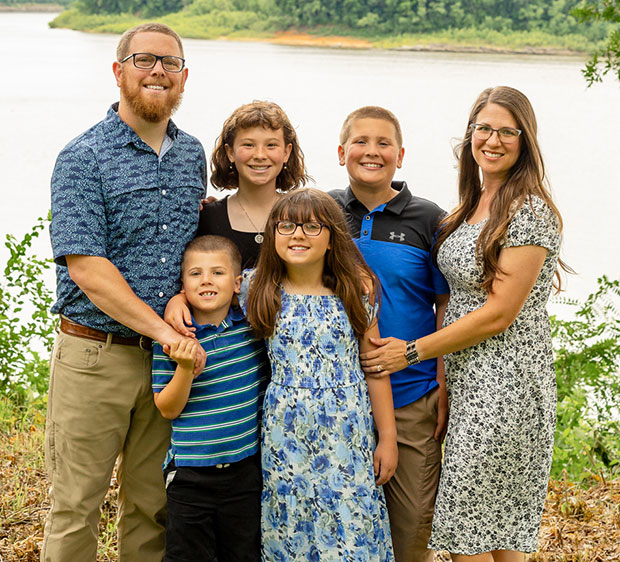
Brandon and Emily Nitcher pose for a family photo with their four children earlier this year.
By Lindsay Steele
The Catholic Messenger
(Editor’s note: National Natural Family Planning (NFP) Awareness Week is July 19-25. It celebrates God’s gift of marriage and vision for human sexuality and highlights the anniversary of the papal encyclical Humanae Vitae, released July 25, 1968.)
SOLON — Early in their marriage, Emily and Brandon Nitcher struggled to conceive. Searching for answers, Emily turned to Natural Family Planning and began monitoring her fertility signs. “Because I was charting, we were able to find fluctuations in my hormone levels that were preventing us from conceiving.”
After the birth of their fourth child, who has special medical needs, the Nitchers shifted their focus from conception to prayerful discernment. While they haven’t ruled out the possibility of having more children in the future, “we don’t feel we could properly care for him in his situation and have a baby,” said Emily, a member of St. Mary Parish in Solon. Once again, NFP has been an invaluable support for the couple as they follow what they believe is God’s plan for their family at this moment.

Natural Family Planning (NFP) is an umbrella term for certain methods used to achieve and avoid pregnancy. Couples adjust their behavior based on observation of the naturally occurring signs and symptoms of the fertile and infertile phases of a woman’s menstrual cycle, such as cervical mucus, body temperature, hormone tracking and cervical position. Couples can choose a method that works best for their lifestyle and family planning goals. “It’s not a one-size-fits-all thing,” Emily said.
Older, calendar-based methods of NFP gained a negative reputation for being unreliable, as they did not take into account the variances in a woman’s cycle. However, newer, symptom-based NFP methods demonstrate an accuracy of about 99% in identifying times of fertility and infertility, according to the European Society for Human Reproduction and Embryology.
NFP is the only family planning method approved by the Catholic Church. The Church does not view NFP as a contraceptive, since it does nothing to suppress or block conception. Its successful use to achieve or avoid pregnancy relies on couples following what they know about the method and one another (usccb.com).
All couples in the Diocese of Davenport who wish to marry in the Church are required to take a Natural Family Planning intro course as part of their marriage prep, said Lisa Willows, diocesan marriage & family life coordinator. The Nitchers have taught the intro course for the past nine years, primarily through monthly, virtual workshops. If a couple wishes to learn more about a specific method, the diocesan Faith Formation Office can help them get in contact with a local teacher.
To conceive or not to conceive?
“The Catechism of the Catholic Church” teaches that marriage and conjugal love are by their nature ordained towards the begetting and educating of children. “Children are really the supreme gift of marriage and contribute very substantially to the welfare of their parents” (CCC par. 163).
The Church also recognizes the role of periodic abstinence within a marriage. The Apostle Paul told married couples, “Do not deprive one another, except perhaps by agreement for a limited time, that you may devote yourselves to prayer” (1 Cor. 7:5).
Multiple popes, especially in the past 100 years, have shed light on periodic abstinence as a way for couples to space pregnancies. Pope Pius XI in the 1930s said the decision to do so must be consensual and made with sound, moral judgment. Pope Paul VI explored the discernment process further in his 1968 encyclical, “Humanae Vitae.” Couples, he wrote, should first consider what they believe God’s plan is for their family at that moment, then their own physical and emotional resources for accepting another child, the needs of other family members, and, lastly, the good of the human society in which they live.
Support for all seasons
Emily believes NFP is useful throughout a woman’s fertile years, and beyond. Teaching adolescent girls about their menstrual cycles can help them gain confidence and respect for their bodies, and reduce the shame associated with periods. As women exit their fertile years, NFP can help them navigate and understand perimenopausal hormone fluctuations.
NFP can also help couples strengthen their bond, regardless of their immediate family planning goals. Researchers have found that couples who use NFP are about 40-50% less likely to divorce than the general population (ccli.org).
“The benefits it has in your relationship and marriage are huge, creating (opportunities for) communication and finding different ways to love each other, and not just see each other as objects. It’s beneficial throughout marriage,” Emily said.
Al and Beth Budelier, who will celebrate their 20th anniversary in October, learned about NFP while they were engaged and have instructed couples through Couple to Couple League for many years. The couple, members of St. Paul the Apostle Parish in Davenport, have five daughters. “I have a real appreciation for the gift of our shared fertility, the rhythm that using NFP has brought to our marriage, and for the dozens — probably hundreds — of conversations we’ve had over the years that we wouldn’t have had, if either of us were sterilized or I was on long-term birth control,” Beth said. “Using NFP has pushed us to discuss issues that come up in marriage — finances, discipline, family size, values, expectations we have for each other — and address them before they become problems.”
Types of NFP methods
There are three major categories of symptom-based NFP methods:
Cervical Mucus Methods (CMM) involve learning to identify the normal, healthy, cervical mucus that indicates the days that sexual intercourse is most likely to result in pregnancy. CMM methods include Billings Ovulation Method Association — USA, Creighton Model FertilityCare™ and Family of the Americas.
Sympto-Thermal Methods (STM) observe several signs of fertility and crosscheck two or more of the signs to pinpoint ovulation. STM typically combines charting the basal body temperature (BBT) and cervical mucus with other optional indicators, such as changes in the cervix and secondary fertility signs. NFP providers teaching these approaches include Couple to Couple League and Northwest Family Services.
Sympto-Hormonal Method (SHM) This method, which observes several signs of fertility and adds the use of an ovulation predictor kit (OPK) or fertility monitor, is known as the “Sympto-Hormonal Method” or “SHM.” Similar to STM, this approach adds the self-detection of reproductive hormones in the urine with the assistance of an OPK or fertility monitor. Various diocesan NFP programs utilize SHM as well as Marquette University’s Institute for NFP (Marquette Model).
Learn more about NFP classes and instructors in the Diocese of Davenport at https://www.davenportdiocese.org/natural-family-planning.
