




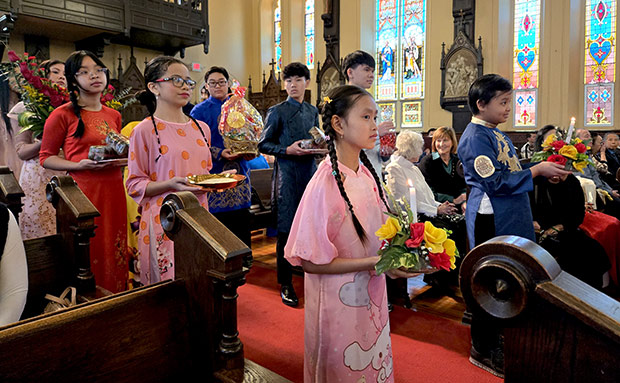
Youth from the Vietnamese Catholic community at Sacred Heart Cathedral in Davenport carry gifts during the Lunar New Year Mass earlier this year.
By Anne Marie Amacher
The Catholic Messenger
(This is the third part of a series on Catholics originally from Asia who have settled in the Diocese of Davenport. May is Asian American and Pacific Islander Heritage Month.)
DAVENPORT — Waves of Vietnamese came to the United States from around 1976, again in the later 1980s and then early 1990s. Many settled in Iowa — including the Quad-City area.
Lien Truong of the Vietnamese Catholic community at Sacred Heart Cathedral said after the fall of Saigon, people fled the country due to the communist takeover with political persecution, re-education camps and economic hardship.


That first wave were the “boat people. More than half died at sea trying to escape,” Truong said. “They were willing to risk their lives to seek freedom.” She, herself, fled Vietnam with her family in 1977. After two failed attempts, the family finally escaped and made their way to the Philippines. The family then resettled in the United States in 1978 thanks to sponsorship from a church in Moline, Illinois. She joined the Catholic Church in 2007.
The United States, as well as other countries, welcomed the refugees from Vietnam in the 1970s. Iowa Governor Robert Ray extended an invitation to refugees to settle in his state.
In the late 1980s and early 1990s there were humanitarian operations, Truong said. This included South Vietnamese workers who were imprisoned by the communist government and Amerasian children whose mothers were Vietnamese and fathers were U.S. servicemen were the next two arrival groups. “Those children were stigmatized,” Truong said.
Trien “Martin” Ngo came to the United States as a teen in 1991 with his family. His father had been imprisoned by the communist party for several years because of his work for the former regime. The family did not feel safe and sought to leave the country.
“America always looked better as we watched television,” Ngo said. Right before Christmas 1991, the family arrived in Oklahoma. But he said he missed his life in Vietnam; missed his friends. In the U.S., children did not play with one another as they did in Vietnam. There was more “community.”
“My parents worked hard here,” Ngo said. He finished high school and graduated from Oklahoma State University. After living in Texas and New York post graduation, he decided he wanted a less hectic life. So he came to the Quad Cities in the mid 2000s. Online he found the Vietnamese Mass at Sacred Heart Cathedral. He joined the Legion of Mary and the parish around 2008. He currently serves as president of the Vietnamese Catholic community, a position he took over when Truong stepped down. “He is amazing,” she said.
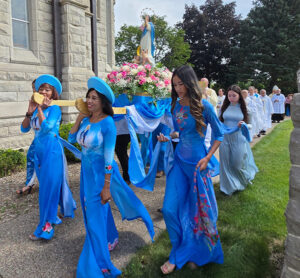
Young women from the Vietnamese Catholic Community carry a statue of Our Lady of LaVang into Sacred Heart Cathedral to celebrate the Solemnity of the Assumption of the Blessed Virgin Mary in this August 2025 photo.
Vietnamese Catholic community
As numbers grew in the Quad Cities, a Vietnamese priest for the Diocese of Peoria, Illinois, celebrated Mass on the Illinois side of the river. Eventually the community established itself at Christ the King Chapel on the St. Ambrose University campus, Ngo said.
In 2000, Bishop William Franklin asked the Vietnamese community to integrate into a parish in the city. An invitation was extended by Sacred Heart Cathedral. On Aug. 19, 2001, the community said farewell to St. Ambrose and processed with a caravan to the cathedral — 16 blocks away.
There are 490 Vietnamese households registered at the cathedral, said Julie Doan, office assistant at the cathedral and a member of the Vietnamese Catholic community. Around 180-200 people attend the weekly Mass at the cathedral in Vietnamese, Ngo said. For the larger celebrations of the Lunar New Year and the Solemnity of the Assumption of the Blessed Virgin Mary — crowds are much larger.
In 2014, when the Vietnamese speaking priest left for an assignment outside the diocese, the pastor at the time, Father Rich Adam, presided in English. Truong said the community read the readings in Vietnamese and answered and recited prayer in Vietnamese. “Father Rich did what he could for our community,” she said.
Seeing that the diocese did not have any of its other Vietnamese- speaking priests available to serve in the Quad City area, Father Adam contacted Divine Word College in Epworth, Iowa. For the last 12 years, Vietnamese speaking priests have come down to celebrate Mass with the community.
Preserving Vietnamese culture
Doan’s parents came from Vietnam more than 35 years ago. Julie, herself, was born in the United States.
She sees the Vietnamese community at the cathedral as a family. “Family is most important to us,” she said. “We are working to continue the culture, traditions for future generations.”
Doan said there are challenges as some young want to live the “American way” and not continue traditions. Ngo said his kids are more Americanized than he is as they were born here, so he sees that too. “English is the first language of the young.”
“As a community, we want to keep the Vietnamese language. We offer classes after Mass each Sunday,” Ngo said. “We encourage them to do readings at Mass and petitions.” He noted classes in Vietnamese had been held on and off over the years, but for at least the last 10 years, classes have been consistent.
Doan said in addition to teaching the language, youths have the opportunity to “hang out, sing, learn dance and more.”
Traditional attire, the ao dai (meaning long dress) is popular no matter the age to wear to Mass, especially for special feasts and holy days, said Truong.
She noted many families in the Catholic community travel back to Vietnam yearly to visit family still there. They often bring back items not just for their families, but for others. She said tourism to cities throughout Vietnam are open now. “We were not allowed to go to many places when the communists took over,” Truong said. One example is Hanoi. Travel was not allowed to that city. “Today everyone can visit.”
The future
Ngo said the number of Vietnamese households overall and the number of Vietnamese who attend Mass regularly have been steady the past 10 years. But he notes the younger generation “want to go to college and move to bigger places.” Regardless, he has faith that the community will maintain its households, customs and traditions.
