




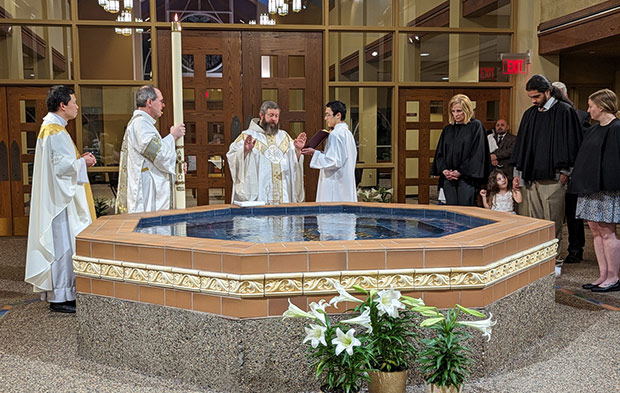
From left, Father Khoa Le, Deacon Andrew Hardigan, Father Paul Appel, an alter server and parishioners listen to a blessing during the Easter Vigil at Jesus Christ, Prince of Peace Parish in Clinton in this 2025 photo.
By Dan Russo
The Catholic Messenger
(This is the final story in a series on Lent.)
CLINTON — Holy Week is a feast for the senses — waving palms, splashing water of foot washings and baptisms, the smell from incense and the feel of the jagged wooden cross. As the story of salvation approaches its climax, the flame of the Paschal candle, like a new dawn, rises above everything else.
Just as in many Catholic parishes around the world, the Paschal fire burns at Jesus Christ, Prince of Peace Parish in Clinton at the opening of the Easter Vigil. From this bonfire’s flames, a massive 5-foot tall, 40 to 50 pound Paschal Candle is lit. It sits high upon a 7-foot stand. On the night before Easter, slow as the sun rising, light enters a darkened church through a torrent of individual tiny candles that are ignited using the giant one. This Service of Light takes place during the Easter Vigil Mass — something “the Church was built around,” according to Deacon Jeff Schuetzle.


“Holy Saturday is the holiest night of the year,” he said. “I think the big thing for (our parish) is the reverence with which we do it.”
After the candle is blessed, liturgy instructions call for a deacon to sing or chant the Exsultet (Easter proclamation), which says, in part: “The sanctifying power of this night dispels wickedness, washes faults away, restores innocence to the fallen, and joy to mourners, drives out hatred, fosters concord, and brings down the mighty. On this, your night of grace, O holy Father, accept this candle, a solemn offering, the work of bees and of your servants’ hands, an evening sacrifice of praise, this gift from your most holy Church.”
The Paschal (Easter) candle symbolizes Christ, the light of the world, triumphing over death.
“… This portion of the Easter Vigil has not always been the only example of a ‘service of light,’” wrote Father Michael J. Flynn, former head of the United States Conference of Catholic Bishops Liturgy Office, in a commentary. “Such services were once commonplace. Imagine how precious a candle, as the only source of light, must have been to families and monastic communities alike as the day came to an end and the sun began to set … in the early Middle Ages. There were of course no electric street lights, no lamps … Candles were costly, and often a single candle provided the sole source of light throughout the impenetrable darkness of the night. The importance of such a light found liturgical expression in evening lamp-lighting services called lucernaria.”
The vigil is the culmination of the Triduum, a celebration which includes Holy Thursday, Good Friday and Holy Saturday. Bishop Dennis Walsh encouraged all Catholics to go to these events on a recent episode of the Catholic Messenger Conversations podcast.
“I often said as pastor that these are feast days that nobody goes to because the liturgies are often times longer,” said Bishop Walsh. “We have become very transactional in our understanding of Church, that we go, we fulfill an obligation and that’s it. But the Triduum really is the high feast of the local parish community and Catholics should make an effort to do the whole Triduum … Those are three services but they’re one liturgy … over three days.”
Palms and Oils
On Palm Sunday, the build-up to Easter begins with processions involving palms that re-enact Christ’s entrance into Jerusalem just days before his death. Religious Supply Center in Davenport furnishes palms to many of the parishes in the Davenport Diocese. The business relies on a palm tree farming operation which is perhaps the largest in the United States.
“A lot of our palms are grown on our own land,” said Dirk Westphal, president of the company. “We have over 500 acres in South Texas as well as contracts with other farmers. Most of our employees are Catholic and have a vested interest in the products they are harvesting and packaging which I think is reflected in our product.”
After Palm Sunday, holy oils become the next major sacred item to dominate during Holy Week, when Chrism Masses take place at cathedrals worldwide. Traditionally, these occur on Holy Thursday, but can happen earlier. Locally, this year’s Chrism Mass will take place March 30 at Sacred Heart Cathedral in Davenport.
“(The Chrism Mass is) when the whole Church or at least representatives from every parish should be present at the cathedral,” said Bishop Walsh. “All priests are in attendance with their bishop. All priests will renew their priestly vows, their promises of obedience to the bishop … And it’s also at that Mass that the bishop will bless all the all the oils that are used throughout the Church year. Those oils that are used for the sacraments, baptism, confirmations, ordinations (and) the sacrament of the sick.”
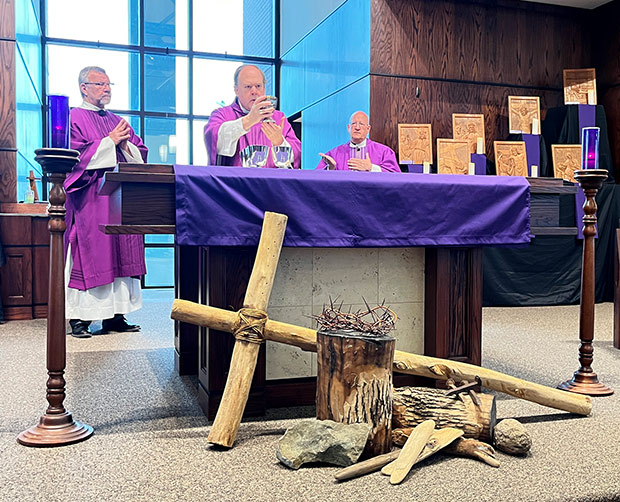
Symbols of Holy Week are seen in front of the altar at St. Ludmila Parish in Cedar Rapids, Iowa, during the Iowa Catholic Youth Conference March 22. Pictured, from left, are Deacon Mike Linnenbrink and Bishop Dennis Walsh of the Diocese of Davenport, and Father Ken Glaser of the Archdiocese of Dubuque.
Thursday and Friday
Holy Thursday includes a commemoration of the Last Supper, during which Jesus instituted the Eucharist and the priesthood. During this Mass, there is a foot washing ceremony. Pastors often play the role of Christ cleaning his disciples’ feet — an act of service that echoes his words in Matthew (20:16). Jesus gave his followers the mandate to serve with love, which is why the day is often called “Maundy” Thursday. (This comes from mandatum, which is mandate in Latin.)
On Friday, priests’ vestment colors change from purple, a sign to repentance, to red, a sign of Christ’s passion. Good Friday is the only day in which the liturgy of the Eucharist is not offered anywhere. The Blessed Sacrament is removed from churches.
“The Blessed Sacrament is placed in a tabernacle elsewhere in case it is needed for viaticum,” said Deacon Schuetzle.
Many churches hold liturgies during which a crucifix is venerated. At Prince of Peace, this service has a gravity that is unique because the parish has a relic of the True Cross. It is in a reliquary most of the time. On Good Friday, it is taken out and placed in a five foot cross where people can pray before it. That evening, the community prays the Stations of the Cross.
“We have 14 candles on the altar and after each station, one is extinguished,” said Deacon Schuetzle. “So we end in the dark. Then we have one light turned on for veneration of the cross containing the relic.”
To the Open Tomb
During Easter Vigil Masses globally, new Catholics are welcomed into the Church and receive sacraments, including baptism. Catechumens come in from the west to the east side because the sun sets in the west and rises in the east. Their movement symbolizes the transition from darkness to light, according to Deacon Schuetzle.
The baptismal font in the Clinton Parish is an octagon, which represents the seven days of creation, plus the Resurrection. New holy water is blessed during the Vigil. Prince of Peace has a special tradition during which the entire congregation visits the font to make the sign of the cross rather than a sprinkling rite as people stay in pews.
“It’s so moving to see everyone step up to the font to bless themselves,” said Brenda Bertram, director of faith formation. “It’s a sign of our baptism. You’ve just renewed your (baptismal) vows.”
At Masses on Easter Sunday flowers often decorate altars, a sign of new life. Christians rejoice in the Resurrection of Jesus. Clergy vestments colors change to white and the Alleluia is sung for the first time since Lent began.
