




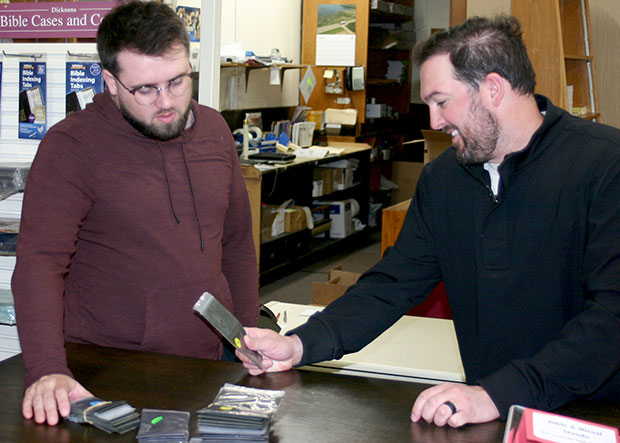
Brendan, left, and Colin Gould inspect ashes that are being sold to parishes around the Diocese of Davenport through Religious Supply Center. The Davenport-based business, owned by the brothers’ father Mark Gould, supplies the majority of the ashes used on Ash Wednesday at churches throughout the diocese. Orders begin coming into the store in January and are sent around southeastern Iowa and the nation in time for Lent’s beginning. The ashes are made from burned palms that come from trees in Texas, according to Gould.
By Dan Russo
The Catholic Messenger
(This is the first article in a series.)
Although Father Bernie Weir is now retired from active ministry, his tangible connection to the traditions of Ash Wednesday is still strong.
It began shortly after he was ordained in 1986.


“I started (making ashes) at St. Joseph Parish-Columbus Junction,” remembered the priest. “One of the kids asked, ‘where do the ashes come from?’”

Unsatisfied with giving the boy the quickest answer — that the ashes came from a local religious-goods store — Father Weir decided to dig into the matter and learn the process for making ashes himself. The Roman Missal instructs the faithful that ashes are usually supposed to be made by burning last year’s Palm Sunday palm branches. Father Weir decided to recruit parishioners to help him do that in his community rather than buying the ready-made versions available. He found out that there is an art to making ashes and it’s not always easy.
“That first year was not very successful,” he said. “They didn’t stick well. After the first year, we mixed the store-bought ones with the ones we actually burned.”
Father Weir also learned other important lessons about making ashes, like be sure to check the weather before you get started.
“One year we had a fire in front of the church and a big wind came and blew the ashes away,” he said.
Despite the obstacles, Father Weir continued making ashes in the parishes he served right up until his last assignment as a pastor, which concluded in 2025. Gathering around fires over the years burning palms together led to special experiences for the priest and the people he served.
“Palm Sunday isn’t just a one-day thing,” he said. “The joy leads to crucifixion. Along the way, we need to do penance. Ash Wednesday isn’t just a day of ashes and mourning, hopefully. The fire burning the palms is connected to the new fire of Saturday night (of the Easter Vigil). For me, it was a way to tie the whole liturgical year together.”
Roots of the Tradition
Ash Wednesday will fall on Feb. 18 this year. The practice of marking one’s self with ashes is linked to ancient times. One of the phrases commonly used while marking people with ashes is a reminder of our mortality from Genesis 3:19. God tells Adam that he was made from dust “and to dust you shall return.” Over the centuries, dust (in the form of ashes) also came to be associated with penance for sins.
“To cover one’s self with ashes to signify mourning or contrition is a gesture often mentioned in the Bible,” reads a section on “Lent from Days of the Lord: The Liturgical Year” (Vol. 2), a commentary on the liturgy published by the Order of St. Benedict’s Liturgical Press. “It was natural that this practice be used by Christians and it was, for sinners, a public sign of penitence. For several centuries, however, this sign remained a private observance without liturgical expression.”
Beginning in the 13th century, the pope took part in the ashes rite at papal liturgies. From that time until 1970 the imposition of ashes happened before Mass. Now it happens after the Gospel. The Roman Missal says that ashes are to be blessed and placed on the forehead in the sign of the cross.
Supplying Ashes
Since producing ashes from palms takes time and can be challenging, most parishes in the United States buy them pre-made. Mark Gould, owner of Religious Supply Center in Davenport, estimates that he provides ashes to “95%” of the 73 parishes in the Diocese of Davenport.
“I sell them all over the country,” he added, explaining that his non-local customers can order items through the company website.
On a recent Monday, shortly before the beginning of Lent, Gould and two sons — Colin and Brendan — took out one of the brown cardboard boxes marked “ashes” which typically sit in a back room of the store. Each box contains plastic pouches of varying sizes. The bags are marked for the amount of people the ashes could cover. The three sizes offered are 100, 500 and 1,000 with a price range of $7.75-$17.25.
“The palms come from a distributor in south Texas, right on the border,” said Gould.
The ashes are a very fine black powder. Professional producers sometimes mix the ashes with a binding agent, like olive oil or holy water, so that they adhere to people’s foreheads better. Gould family members and staff begin receiving orders in January and prepare them for shipping. The proprietor, a member of St. Paul the Apostle Parish in Davenport, usually attends Ash Wednesday Mass each year, despite it being a busy time of year for religious-goods suppliers.
“I went last year with my daughter,” Gould remembered.
A Popular Mass

Youths from St. James Parish in Washington burn palms in this file photo to make ashes for Ash Wednesday outside the church.
Each year, Jesus Christ, Prince of Peace Parish in Clinton asks the faithful to take their palms home after Mass on Palm Sunday. It’s “a way to remind us throughout the year of our journey with Jesus,” said Deacon Jeff Schuetzle, who serves the parish.
The parish collects the palms several months later, about three weeks before Ash Wednesday. “We get a good number of palms to burn each year,” said Brenda Bertram, the parish’s director of religious education. Parishioners gather for a short prayer service and start the fire to burn the palms. The palms are then sifted and blended before being added to the ashes used for Ash Wednesday.
Ss. Mary & Mathias Parish in Muscatine is another community which has kept to the tradition of using ashes made from their own palms.
“A former staff member here burned enough palms to last us for quite some time,” recalled Father Chris Weber, pastor. “He had a way of burning them that resulted in a very fine, consistent and black ash that makes them perfect for distribution. We don’t add any oil or anything else to them.”
Kevin Custis, a cantor at Ss. Mary & Mathias and member of the parish’s hospitality team, has been involved in preparing for Ash Wednesday Masses. Of the multiple Masses offered, there is always one around noon that is celebrated in conjunction with the school, which has students from preschool through middle school.
“Ash Wednesday is our third-most-popular Mass (day of Masses) behind Easter and Christmas,” said Custis. “We think it is popular for a few reasons: It is a unique Mass and it only happens once a year. People seem to embrace Lent as a season of preparation, and Ash Wednesday is a great ‘kickoff.’”
The visual element of ashes seems to resonate, according to the cantor.
“There aren’t many outward signs of being Catholic, but ashes on your forehead is recognizable,” said Custis. “People are proud of their Catholic faith and maybe this is a small way to display that.”
(Lindsay Steele contributed to this story.)
