
No prayer is ever wasted

By Father Thom Hennen
Question Box Column


Q. What happens with prayers we say or Masses we have offered for people in purgatory if they are already in heaven?

A. This is a great follow-up to last week’s question on purgatory. The short answer is: I don’t know. I know that is not a very satisfying answer but we are squarely in the territory of speculative theology here. That also means we can “play” a little.

Fr. Hennen

At the very least, I feel confident in saying that no prayer is wasted. It’s not as though St. Peter is up there tallying up prayers and saying, “Looks like we got another batch for Mrs. McGillicuddy. Too bad. She’s been in for ages!”

This brings up another point about prayer in general. While we believe that prayer is effective, we also know that not all of our prayers are answered in the way we might hope, but that doesn’t mean those prayers are “wasted.” Prayer in itself — the act of asking, thanking, praising God — is good. In prayer, we are not trying to bend God’s will to ours but in fact the other way around. For this reason, I think all good prayer should include some version of “thy will be done” or it ought to be implied at least. We find this in the “Our Father” and in Jesus’s personal prayer in the Garden of Gethsemane the night of his betrayal, “My Father, if it is possible, let this cup pass from me; yet not as I will, but as you will” (Matthew 26:39).

We can think here, too, of the passage in Luke’s Gospel where Jesus says, “What father among you would hand his son a snake when he asks for a fish? Or hand him a scorpion when he asks for an egg? If you then … know how to give good gifts to your children, how much more will the Father in heaven give the holy Spirit to those who ask him” (Luke 11:11-13). The fact is, sometimes we ask God for the “snake” or the “scorpion” but, thankfully, he knows better than to give us exactly what we ask for.

In one of his letters, St. Augustine writes, “Why [God] should ask us to pray, when he knows what we need before we ask him, may perplex us if we do not realize that our Lord and God does not want to know what we want (for he cannot fail to know it) but wants us rather to exercise our desire through our prayers, so that we may be able to receive what he is preparing to give us.” In his commentary on one of the psalms St. Augustine writes, “For the desire of your heart is itself your prayer.”

How might we apply this to those seemingly “unused” prayers for our beloved dead or for those prayers that are “unanswered,” at least in the way we might wish? These prayers still “exercise our desire.” They grow our trust in God and expand the heart. They are still acts of love. If nothing else, they change us and draw us closer to God.

Since we are playing, I wonder if those we pray for who are already in heaven might have some say in how those “extra” prayers and graces are applied. Maybe for other family members or for those who have no one to pray for them, those most in need of our prayers, those just on the threshold of heaven and those “last in line.” As with so many things, I guess we’ll find out when we get there.

(Father Thom Hennen serves as the pastor of Sacred Heart Cathedral in Davenport and Vicar General for the Diocese of Davenport. Send questions to messenger@davenportdiocese.org)
Posted on

Students explore future career options

Anne Marie Amacher
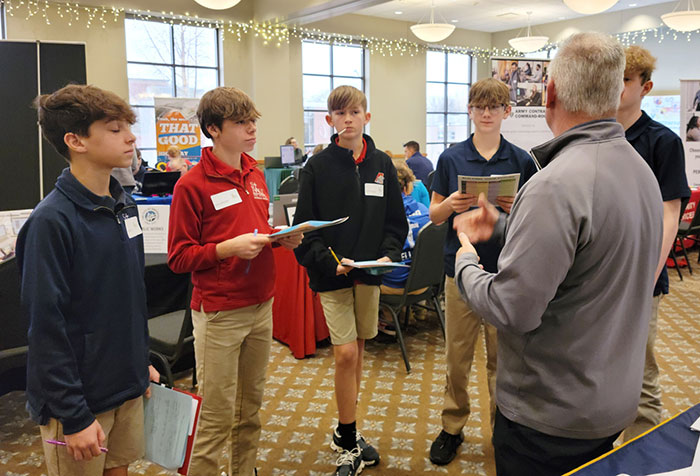
From left, students Tim Bassier, Lucas Mitchell, Asher Langan, Lachlan Gimbel and Parker Bushek talk with David Ragone during a career fair at St. Ambrose University in Davenport March 3.

By Anne Marie Amacher
The Catholic Messenger

DAVENPORT — A robotic dog, a plastic model of a fetus inside a womb, tactical police gear and animal pelts were some of the items on display during a career fair for eighth-graders from Scott County Catholic schools. St. Ambrose University hosted the event March 3 in the Rogalski Center.

Students from Lourdes Catholic School in Bettendorf and All Saints, John F. Kennedy and St. Paul the Apostle schools in Davenport met with different vendors and with students from St. Ambrose to learn about college life. All the eighth-graders attended a session on vocations. Boys met with Father Jacob Greiner, vocations director for the Diocese of Davenport, and the girls met with Sister Anthony Worrell, OSF.

The annual career fair that began in 2012 with about two dozen business vendors continues to grow, said Leigh Johnson, counselor at Lourdes. Each of the students who attended chose eight vendors of interest, she said. “We try to get them in (to visit) their top three choices.”

Amy Tallman, counselor at St. Paul the Apostle, was excited to see new vendors including Niabi Zoo and Nahant Marsh, which focus on animals, nature and the environment. A record 38 vendors this year required moving the talk with St. Ambrose students and the lunch to a different part of the Rogalski Center.

Scott Smith, a maintenance electrician from Nestle Purina in Clinton, operated Spot, a robotic dog by Boston Dynamics. He said he has been learning how to operate the dog, which inspects machinery in the plant. Spot is equipped with an infrared camera and moves into various positions to perform the inspections.

“This frees up our manpower,” Smith said. The robotic dog’s cameras allow Smith to take pictures and analyze video of various components. Currently the company is testing the product. If everything works out, Smith hopes that Spot can operate 24 hours a day and not just first shift. To accomplish this, more workers would undergo training to operate the robotic dog.

Human resources personnel Lori Cawiezell and Montanna Krogram joined Smith. The two women talked with students about various departments in which workers are employed and about recycling and waste initiatives the company uses in the pet food facilities.

David Ragone, a coach and recruiter at Augustana College in Rock Island, Illinois, talked about the importance of education. “What matters is academics,” he told the students who stood at his station. He encouraged them to work on getting good grades in high school. He emphasized that colleges look at the overall grade point average, not just junior and/or senior year. “Grades are number one in selecting our students and athletes.”

One student asked if Augustana would accept an athlete who excelled in his sport but didn’t have good grades. “No. Having athletic ability is great, but grades are number one. We prepare our students (and athletes) for the future. We prepare them for their future career and to be a good husband, father and community member. We love it when our athletes come back with their wife and children to introduce them to us.”

Someone asked if an Augustana football player had ever made it into the National Football League. Yes, Kenny Anderson, Ragone said. Anderson was drafted by the Cincinnati Bengals in 1971. He later coached for the Bengals. Ragone emphasized to the students “you need to perform in the classroom wherever you go — high school and college.”

Eighth-grader Cayden Leners from John F. Kennedy said he enjoyed the career fair. “It was fun.” He attended sessions on engineering, construction, and finance and computer technology. “I might consider the construction industry,” he said.

All Saints student Shannan Makena said the day was “interesting, with lots of detail.” Some of the stations she attended were nursing, health, acting and coaching. “I want to be a doctor or entrepreneur.”

Posted on

Letter to the editor: Restore Peace

To the Editor:
I agree with the OSV article in The Catholic Messenger of 3/02/23 that deplores the suffering of the people of Ukraine throughout their history and in the ongoing war. The violence and destructiveness of war is never an answer to differences that can be solved through diplomacy that respects the rights of both sides of a problem situation.

As Ukranian Archbishop Borys Gudziak said, “The road to peace will not be easy.” This is true of all wars. However, this war was completely avoidable from its start, followed by the Minsk Agreements negotiated by Ukraine, Russia, France and Germany in 2015, agreements that dealt with treatment of Russian citizens in eastern Ukraine by a nationalist Ukrainian faction. The war could end through a peace proposal offered by China based upon principles embedded in the United Nations Charter.

Unfortunately, interest in restoring peace with justice is being undercut by militaristic support from countries pursuing their personal goals. Propaganda replaced truth concerning blame for events between the coup of 2014 and Russia’s invasion in 2021.

I urge The Catholic Messenger, Lumen Christi Institute at the University of Chicago and the Church itself to stand for peace and to join Pope Francis in his call for immediate negotiation of a just end to this dangerous conflict. It is a call not just for sanity but also for a mindset that truly grasps the message of Jesus’ teachings.
Sally McMillan
Iowa City

Posted on

Faith elevates Assumption grad’s career goals

Dixie Whitty
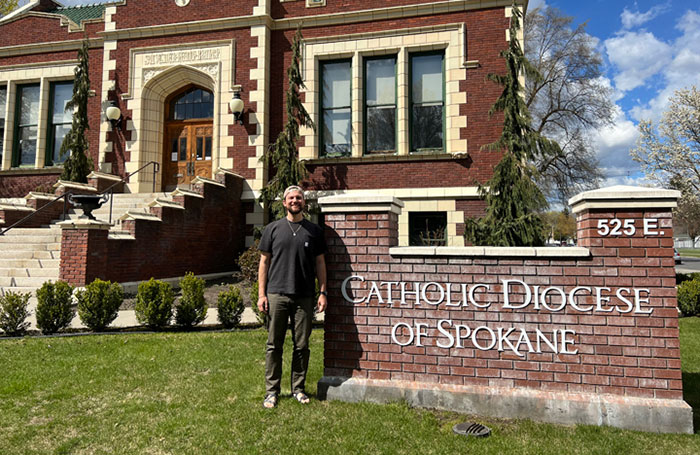
Grant Whitty stands outside the Catholic Diocese of Spokane, Washington’s chancery building. Whitty currently serves the Spokane Diocese as director of Catholic media.

By Lindsay Steele
The Catholic Messenger

Grant Whitty used to dream of traveling throughout North America as a ski photographer. “I wanted to live in a van and photograph things,” he recalls.

After graduating in 2015 from Assumption High School in Davenport and moving to Colorado, his dreams seemed as close as the snow-capped mountains. While studying journalism and media communications at Colorado State University in Fort Collins, Whitty started building a name for himself in the creative side of the ski industry.

The closer he came to his dream, however, he felt God pulling him away. Last year, Whitty, 25, began using his multimedia skills to serve the Diocese of Spokane, Washington, as director of Catholic media. “I’m the one-man band of the communications department,” he explained.

Whitty’s journey to the West Coast began 10 years ago when his older sister, Emma, encouraged him to attend the National Catholic Youth Conference (NCYC) in Indianapolis. The cradle Catholic stopped going through the motions and began to seek a personal relationship with Christ. “When I walked into the stadium I saw all of these joyful people. I didn’t have that kind of joy,” he said. NCYC “started the adventure of me figuring out who Jesus was in my life,” he said.

The adventure continued in college as he built relationships with young adult FOCUS missionaries on campus and began leading Bible studies. FOCUS is a Catholic collegiate outreach whose mission is to share the hope and joy of the Gospel with college and university students. Each year, approximately 800 FOCUS missionaries are sent in teams to serve at 180 college campuses at the invitation of the local bishop and with the support of the local campus ministry.

Whitty also enjoyed participating in eucharistic adoration and being part of the lively Catholic community on campus. “The spark (of faith) was set back home … but it excelled in college. I was more mature at the time and could take it more seriously,” he explained. College “was my time to be real with Jesus … he became more real to me and that affected how I experienced Mass and the Catholic community.”

Whitty felt torn as graduation drew near. He was chipping away at his dreams, but unhappy. “I had encountered Christ and desired to live a life that was oriented toward him.” He initially rejected an offer to become a FOCUS missionary, but had second thoughts after spending time in prayer and changed his mind. He served the organization for about three years, first as a missionary and later as a team leader.

In early 2022, Whitty began to feel an inexplicable pull toward the Spokane area. “I felt a draw that I couldn’t describe. I took it to prayer and the perfect job came weeks later.” He and his wife, Dixie, moved to Spokane that summer. “There is a strong young adult community here, lots of young families,” he said. The Whittys welcomed their first child, Hazel, in December.

In his new role, Whitty maintains Inland Catholic’s news website, writes press releases and manages the diocesan social media pages. He relaunched the diocese’s magazine, noting that an online-only approach is not ideal — even for young adults who grew up with internet-based news. “It can be easy to come out of a journalism program where almost everything was digital” and assume that people don’t want print media, “but there is no set rule on how to reach someone.”

Whitty no longer dreams of living in a van but does hope to take his family to the nearby ski slopes someday. “We (he and his wife) do desire to have a van and camp, but I don’t think it would be a lifestyle, we still like our house,” he quipped. “We just hope to have it for family adventures.”

Posted on

‘Willing Workers’ feed the hungry for 40 years

Contributed
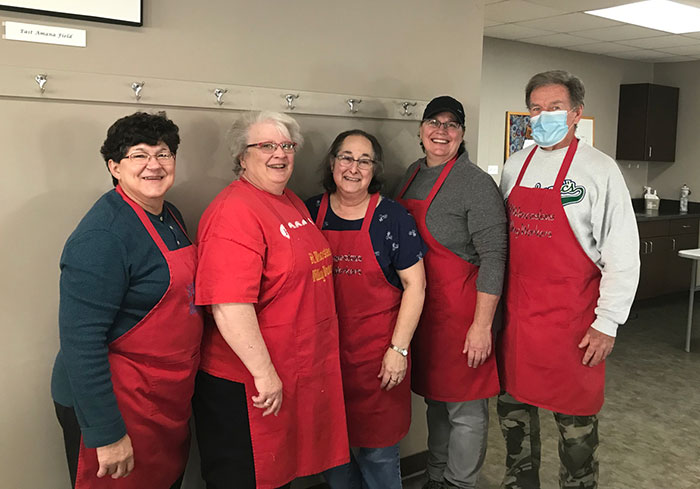
Members of the St. Wenceslaus Willing Workers volunteer with the Iowa City Free Lunch Program earlier this year.

By Lindsay Steele
The Catholic Messenger
IOWA CITY — On the fourth Monday of each month, volunteers from St. Wenceslaus Parish lovingly prepare and serve meals to persons experiencing food insecurity.

The St. Wenceslaus Willing Workers, so named by longtime parishioner Marilyn Jensen, have been volunteering with the Iowa City Free Lunch Program for about 40 years. They are among the longest-serving volunteer groups, lunch program co-director Kai Kiser told The Catholic Messenger.

“We try to see the face of Christ in each person we serve,” said longtime ‘Willing Worker’ Mary Anderson. “We see people with small children, those with physical and mental disabilities, people traveling through and elderly folks.”

The lunch program provides free meals from noon to 1 p.m. six days a week, no questions asked, at its South Gilbert Street location. The program relies on 30 different religious, student, neighborhood and social groups in the community taking turns to prepare and serve meals. Last year, these groups helped serve 34,000 meals. “Volunteers bring a spirit of caring and compassion to our program as the people we serve are treated as guests,” Kiser said. “We come together knowing that we’re all deeply connected and dependent on one another, no matter our current circumstances.”

Willing Workers leader Jackie Simpson said about 15 St. Wenceslaus parishioners volunteer each month. Tasks include donating food, cooking, serving and cleaning up. The parish sets aside $125 each month for food purchases and parishioners donate the rest. This giving of “time, talent and treasure” makes it possible for volunteers to provide two home-cooked entrees, plus a variety of sides and desserts, she said. “You see the light in (patrons’) eyes when they see all the food on the table and know they have a choice in it.”

Meatloaf is a favorite of the patrons, who also look forward to “hamburger and hot dog day” in the summer, Simpson said. Willing Workers also provide sandwiches to go for patrons.

The St. Wenceslaus group serves about 140-160 patrons during its time slot, she said. Volunteers primarily serve adults in the winter months; in the summer, they serve more families and kids. Simpson estimates that 20-30% of patrons are homeless. “The rest are people with food insecurity, low incomes or disabilities that need help getting through the day.”

Parishioner Kathy Holeton assists with cooking and preparing food items, serving and cleaning up. When she joined the Willing Workers about 20 years ago, she wasn’t sure what to expect. “I’d never dealt directly with the homeless population or those in need of a good meal,” she recalled. She quickly learned that many patrons needed a friend as much as they needed a meal. “I enjoy helping out. It puts one’s life in perspective,” she said.

“People really appreciate what you do for them,” Simpson said. Two regular patrons help clean up each day as a way to give back. “You’re going to have a better day if you don’t have to worry about where you’re going to get a meal,” she added.

Posted on

St. Ambrose University delves into augmented reality

Contributed
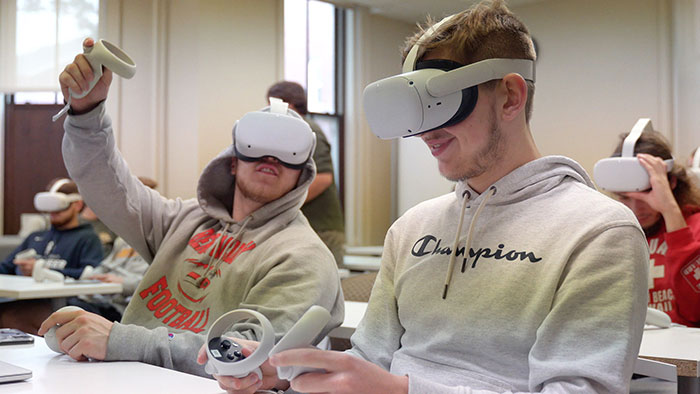
Students at St. Ambrose University in Davenport use augmented reality glasses in class.

For The Catholic Messenger

DAVENPORT – A virtual and augmented reality partnership between VictoryXR and St. Ambrose University transports students into a new setting. Recently an environmental ethics class “stood in the middle of a thundering herd of migrating bison,” thanks to the augmented reality (AR), a news release states. AR uses real-world settings while virtual reality (VR) uses virtual settings.

During that recent AR environmental ethics experience, students “roamed the prairies, encountered populations of wolves, elk, deer, and birds and aided a fire ecologist with a prescribed prairie burn.” SAU President Amy C. Novak launched the partnership with VictoryXR as part of the university’s strategic initiatives to help emphasize the new generation of learners and better strengthen student engagement.

St. Ambrose “will be the first school globally to test the launching of a full augmented reality campus within the physical campus,” said Novak. “It became clear after conversations with VictoryXR CEO Steven Grubbs that St. Ambrose would be an ideal test site for learning through both virtual reality (VR) and augmented reality (AR). We are all equally invested in understanding what it would look like if higher education began to develop an infrastructure to support these new ways of learning.”

Grubbs said VictoryXR worked with T-Mobile and Qualcomm to build the AR on the St. Ambrose campus. Students use glasses from Lenovo “to see a world of learning that is otherwise invisible.” St. Ambrose faculty in the departments of history, theology, philosophy, business, engineering, biology and nursing are exploring these technologies. The Engineering department has already adopted a virtual welding lab to strengthen competencies, Novak noted.

Theology professor Father Bud Grant transported his environmental ethics students into what he described as an engaging educational lesson. “I created the virtual prairie where students could move with a migrating herd of bison,” he said. “The students quickly picked up on it, learning to move and ‘teleport’ within minutes, and some even began drawing their own 3D images. On day two of the virtual lesson, I added a direwolf who stood beside me to ensure good behavior. After the giggles subsided, we were able to go on a virtual field trip to the Loess Hills, where students flew over the terrain and studied the topology and invasive woodland species.”

As this new technology is still evolving, the university discovered the need to expand its bandwidth. “While this will not substitute live classroom instruction, we are asking the fundamental questions of how students will learn differently in the future and how we best equip them for that learning. The way I describe it to faculty is that it is another tool in the toolbox of high-impact learning and teaching practices,” said Novak.

Posted on

Question Box with Fr. Thom Hennen: Praying for souls in purgatory

By Fr. Thom Hennen
Question Box Column

Q. Why do we pray for souls in purgatory?
A. In moments of exasperation with myself I have sometimes said to God, “If you need me to turn out the lights in purgatory, I will do it!” In other words, if I am the last person in purgatory I am

Fr. Hennen

okay with that because at least I will know I am heaven-bound. I am only half-joking. Of course, I would much rather march straight into heaven but I am painfully aware of my own weakness, pettiness and attachment to sin. For me, as for most, I think something will need to happen between the moment I breathe my last and the glory that awaits the blessed. That something is purgatory.

The Catechism of the Catholic Church puts it this way: “All who die in God’s grace and friendship, but still imperfectly purified, are indeed assured of their eternal salvation; but after death they undergo purification, so as to achieve the holiness necessary to enter the joy of heaven” (par. 1030). Heaven is by definition a state of absolute perfection. Even if I die a good man, a good disciple, a good priest, as I hope to do (not too soon, mind you), there likely will be aspects of my life that are less than perfect. These might not merit hell but they still have no place in heaven. Purgatory is simply that state of transition in which these lesser faults are purified and any lingering sinful attachments are resolved.

However, the souls in purgatory are no less part of the one body of Christ and remain connected to us. We used to speak of this as the “church militant,” meaning those of us still “fighting the good fight” during our earthly life; the “church suffering,” meaning the souls of the faithful departed undergoing their final purification; and the “church triumphant,” meaning the saints (canonized or not) now living forever in perfect communion of love with God. Just as we can do something about those suffering in this life, we believe we can also do something to aid the “church suffering” in purgatory. We can pray for them. Again, the Catechism states, “From the beginning the Church has honored the memory of the dead and offered prayers in suffrage for them, above all the Eucharistic sacrifice, so that, thus purified, they may attain the beatific vision of God” (par. 1032). To pray for the souls in purgatory is, therefore, a generous spiritual work of mercy.

I think there are some people who have died in a state of perfection, among them many of the canonized saints of our tradition. Many of them, in a sense, did their purgatory here on earth and through their suffering became more perfectly conformed to their crucified Lord. When they died, they had largely let go of anything that would have been a hindrance to their fully embracing God’s love in heaven. I believe many people today still work out a lot of their purgatory here on earth, insofar as they unite their suffering to the perfect suffering of Christ.

Many Catholics think of purgatory as a sad, dark teaching long past its time, but to me it is a beautiful expression of God’s love and mercy. I hope that when I die people will pray for me and have Masses offered for me and not just assume that I am “up there playing pinochle with St. Peter.” I don’t know how to play pinochle, but I’m guessing St. Peter can teach me …when I’m ready.

(Father Thom Hennen serves as the pastor of Sacred Heart Cathedral in Davenport and Vicar General for the Diocese of Davenport. Send questions to messenger@davenportdiocese.org)
Posted on