
Proposed bill would benefit Iowa moms in need

Contributed
Jeni Van Buer checks in on a child named Santiago. She supports legislation to extend postpartum Medicaid coverage for Iowa moms in need.

By Barb Arland-Fye
The Catholic Messenger

Jeni Van Buer is a longtime early childhood educator, wife and mother, and a member of St. Thomas More Parish in Coralville who knows what moms and their young children need. A proposed bill to extend postpartum Medicaid coverage to 12 months would fulfill an important need, she believes.

“Children develop and learn best when fully supported by the healthy adults in their lives,” Van Buer said. “The first three to five years of a child’s life are the most crucial for continued developmental success. If a child lives with a healthy and thriving parent, that will have a great and positive effect on the likelihood of that child’s overall health and developmental success. These are crucial years in the life of a child that we cannot afford to sacrifice.”

Medicaid covered 40.8% of births in Iowa in 2021 but new mothers lose their health coverage after 60 days postpartum, Common Good Iowa (CGI) reported. States have the option to choose whether eligibility for Medicaid coverage continues. Iowa is one of the states that has not yet extended Medicaid coverage beyond 60 days postpartum.

CGI, an advocacy group for Iowa families and communities, also reported that maternal mortality rates have doubled in the last 20 years. Among the women who died in the postpartum period, “about a quarter were eligible for Medicaid at the time of birth and their deaths occurred after their Medicaid postpartum coverage ended” (Iowa Maternal Mortality Review Committee, 2021).

Meanwhile, the Iowa Maternal Health Strategic Plan (https://tinyurl.com/yck9meyu) found that “Mental health conditions are the most common complication of childbirth impacting 1 in 5 individuals during pregnancy and the year following pregnancy. Untreated maternal mental health conditions can have (a) negative and long-term impact on (a) pregnant and postpartum (woman) and her infant. Mental health conditions are a leading and preventable cause of maternal mortality. Despite these negative consequences, depression and anxiety largely goes undiagnosed and untreated during pregnancy and postpartum periods.”

Among the strategic plan’s recommendation is to “Expand insurance coverage (Medicaid and private insurance) for pregnancy related services such as lactation services, doula services, and extending postpartum Medicaid coverage for 12 months.”

Extending Medicaid coverage would ensure that “New moms have continuity in their health care after pregnancy and medical concerns arising from pregnancy can be treated without high costs to the family,” CGI states (commongoodiowa.org).

Last year, the Iowa Legislature passed the Iowa MOMS (More Options for Maternal Supports), which provided $500,000 to help pro-life agencies support pregnant women and new moms with baby essentials and counseling. However, funding was not included for the extension of coverage for mothers who receive Medicaid, the Iowa Catholic Conference (ICC) reported.

This year, the Medicaid bill is back and appears to have bipartisan support. One lawmaker noted that fact in her recent e-newsletter:

“Bipartisan progress for new moms and babies: Two months after all Senate Democrats cosponsored Senate File 57 to increase postpartum Medicaid coverage for pregnant Iowans, we’re glad to see that House Republicans have introduced a similar bill, House Study Bill 226,” said State Sen. Cindy Winckler, D-Davenport. “Senate Democrats hope to see more bipartisan support for this common-sense legislation that would better support pregnancies and newborns in Iowa.”

Tom Chapman, executive director of the ICC, the public policy voice of Iowa’s bishops, said he and his staff are “actively talking to House subcommittee members about the bill and have been discussing this with legislators (along with other groups) for more than a year.”

Schwager

“This is legislation that all Iowans can support,” said Sheryl Schwager, director of Johnson County Right to Life. “These extended benefits would encourage mothers to choose life, improve their maternal health, and ultimately help their families flourish.”

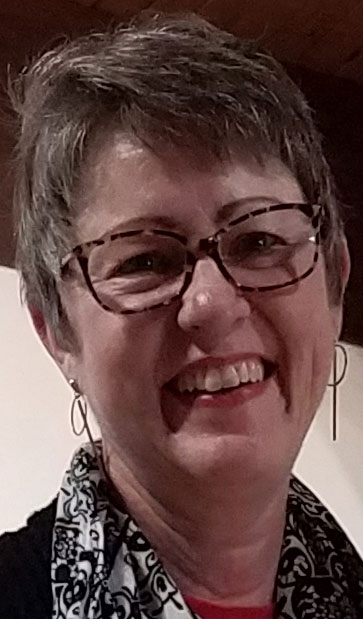
Lisa Levy, a hospice nurse and president of Christ Child of the Quad Cities, said she has been involved in the pro-life movement since high school in the late 1970s. Her career and her volunteer work span life from its beginning to its end.

The proposed legislation “speaks to the dignity of motherhood and these beautiful new children and how we can help these families,” said Levy, also a member of Our Lady of the
Levy

River Parish in LeClaire. Moms need many resources. “They need education on early childhood development and help caring for their newborns and support as new mothers, especially when they have other small children.”

Christ Child Society supports the Women’s Choice Center in Bettendorf (a pro-life organization) and Head Start in Rock Island, Illinois, and provides layettes to new moms heading home from the hospital. Home is where the mothering and parenting begins and support in those early years is essential, Levy says. It’s all about “mind, body and spirit — not only for the mom, but for the baby.”

Posted on

Los trabajadores piden al obispo, que se oponga a los cambios propuestos en la ley de trabajo infantil

Barb Arland-Fye
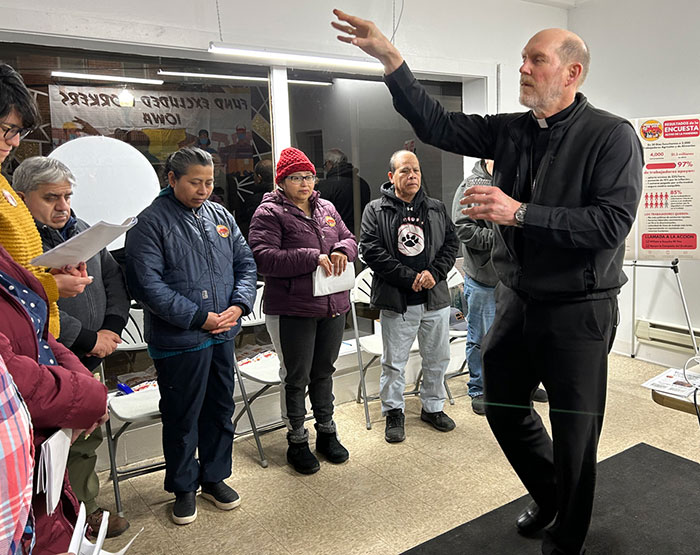
El obispo Thomas Zinkula bendice a los trabajadores de la planta empacadora de carne y a los defensores de los trabajadores el 27 de febrero en Columbus Junction. Los trabajadores compartieron sus
objeciones a los cambios propuestos en la ley de trabajo infantil de Iowa.

Por Barb Arland-Fye
El Mensajero Católico

COLUMBUS JUNCTION — El obispo Thomas Zinkula se reunió con cerca de 20 trabajadores de una planta empacadora de carne, el pasado 27 de febrero, para escuchar sus objeciones a los cambios propuestos en la ley de trabajo infantil de Iowa.

La legislación, que ha sido aprobada por los comités de la Cámara de Representantes y el Senado de Iowa, permitiría que los menores de 14 a 17 años, realicen trabajos –como en fábricas-, que en este momento están prohibidos; como parte de un programa de capacitación a través de su escuela o empleador. El proyecto de ley también ampliaría las horas de trabajo para los adolescentes y, por otro lado, permitiría que los jóvenes de 16 y 17 años puedan servir alcohol (Iowa Capital Dispatch, 3 de marzo).

El 6 de marzo, los partidarios del proyecto de ley agregaron una enmienda al Archivo 167 del Senado, que no permitiría a los directores de los departamentos de Trabajo y Educación, extender
exenciones; para que los estudiantes trabajen en minería, explosivos, radiación, tala o matanza/empacado de carne. Sin embargo, el proyecto de ley sigue siendo un trabajo en progreso, dijo Tom Chapman, director ejecutivo de la Conferencia Católica de Iowa.

El grupo de defensa Escucha Mi Voz, que agrupa a líderes de diferentes denominaciones religiosas, fue el anfitrión de la reunión del 27 de febrero; durante la cual Claire Lewandowski, organizadora de Escucha Mi Voz, tradujo los testimonios de los trabajadores para el obispo Zinkula. Sus preocupaciones se centraron en trabajos en plantas empacadoras de carne, que son peligrosos e inadecuados para menores, con posibilidades de lesiones relacionadas con el trabajo, duras condiciones de trabajo, una amenaza percibida para la seguridad laboral, discriminación/favoritismo y el impacto perjudicial en la educación de menores. Un trabajador de una planta empacadora de carne dijo, que la planta en la que trabaja tiene algunos trabajos simples; pero también algunos trabajos muy peligrosos. Dijo que los trabajadores están “mal enseñados” en sus trabajos. Le preocupa que los niños se enfrenten a un riesgo aún mayor de lesiones debido a su corta edad. También afirmó que los supervisores de planta; muestran trato preferencial y discriminatorio. “Ninguno de nosotros quiere que nuestros hijos estén en esa situación”. El obispo Zinkula pidió un ejemplo de discriminación. El trabajador dijo que los empleados de diferentes países son tratados de manera diferente.

La esposa de un trabajador, también empleada en una planta empacadora de carne, dijo que la planta afirma, que la seguridad es lo primero; pero no lo demuestra. Expresó su preocupación por la probabilidad de lesiones y que los empleadores, no serían responsables de los trabajadores jóvenes lesionados en el trabajo. (Más tarde, los legisladores eliminaron esa disposición, luego de una publicidad nacional negativa). También expresó su preocupación sobre la posibilidad de que los jóvenes conduzcan vehículos en la planta, particularmente maquinaria pesada, por la noche. Ella predijo: “Habrá muchos accidentes…. “Creo que tenemos que alzar la voz y decir: ‘Esto debe terminar aquí'”.

Otra empleada de una planta empacadora de carne dijo, que tuvo que ausentarse del trabajo debido a una hinchazón en las manos; que le provocó un dolor considerable. Ella piensa que los supervisores usarían a los trabajadores jóvenes, como una herramienta para amenazar la seguridad laboral de los trabajadores adultos. Otros trabajadores expresaron preocupaciones similares.

Los trabajadores hablaron de empleadores en varias industrias, que emplean ilegalmente a niños, en trabajos tan peligrosos como limpiar cuchillas afiladas o usar productos químicos potentes de limpieza (según informes de noticias, que citan al Departamento de Trabajo). “Nos entristece pensar en los niños en estos trabajos”, dijo un trabajador.

Un trabajador citó la carta pastoral de 1986 de la Conferencia de Obispos Católicos de EE. UU. “Justicia económica para todos”: “La economía debe servir a las personas, no al revés”. El diácono Kent Ferris de la oficina de Acción Social de la Diócesis de Davenport le pidió al trabajador que compartiera la carta resu-mida con el grupo.

Después de la reunión, dijo que la carta se alinea con los principios rectores de Escucha Mi Voz y subraya “las profundas preocupaciones, que expresaron los
trabajadores acerca de que a los niños más pequeños, se les permita trabajar en sus entornos laborales”.

Cuando el obispo Zinkula preguntó a los trabajadores si les preocupaba, que la legislación propuesta pudiera hacer; que los jóvenes no continúen con su
educación, el grupo asintió con la cabeza. Le agradecieron por tomarse el tiempo para reunirse con ellos y escuchar sus
preocupaciones.

El obispo Zinkula le dijo al grupo, que compartiría sus preocupaciones con los otros obispos de Iowa y la Conferencia Católica de Iowa (ICC) y recomendaría, que la ICC se oponga a las partes del proyecto de ley, relacionadas con los menores que trabajan en las plantas empacadoras de carne.

La CPI continuará monitoreando el proyecto de ley y asesorando a los obispos sobre los cambios.

Posted on

Eucharist: thy kingdom come

By David Pitt, PhD
Eucharistic Revival Column

Pitt

From the earliest days of the Church, Christians have been thinking about the second coming of Christ. They expected Christ’s return within weeks, perhaps months, of his resurrection. A few years, if necessary. They expected the triumphant return of the Son of Man within their lifetime. 

“Amen, I say to you,” Jesus said, “there are some standing here who will not taste death until they see that the kingdom of God has come in power” (Mark 9:1; see also Matt 16:26 and Luke 9:27). 

A first-century Christian text, the Didache, represents well the Christian attitude towards the end times in concluding a Eucharistic Prayer with these phrases: “May grace come, and may this world pass away. Amen.  Hosanna to the Son of David.  If anyone is holy, let him come; if anyone is not, let him repent.  Marana tha.  Amen.” 

Marana tha, a term in the language that Jesus spoke, Aramaic, means both “Come, Lord!” and “May the Lord come!” When, in the Lord’s Prayer, the early Christians petitioned “thy kingdom come,” they meant it! To the rest of the world they may have seemed like the cartoonish characters with long beards, wearing robes and carrying picket signs proclaiming, “The end is near!” No doubt, they saw themselves more like the team on the brink of winning the championship, with only a few seconds remaining in the title game. God’s final victory, won through the death, resurrection and ascension of Christ and sealed in the gift of the Holy Spirit, was imminent. Marana tha.

As they waited, they continued to practice the kingdom of God.  The very kingdom that they had seen Jesus live out in word and action during his life. The life that filled the hungry “with good things” while sending the rich “away empty.”  The life that threatened to throw down “the rulers from their thrones but [lift] up the lowly” (Luke 1:52-53). The life that had Jesus proclaimed as king, both with the waving of palms while the crowd cheered him and with his cry of a psalm while the crowds mocked him. The kingdom life that resulted in Jesus’ death.

The disciples on the road to Emmaus may not have understood the theological significance of Jesus’ teachings, but they understood well enough that being a Christian required them to invite the stranger to dinner. Even the stranger who had just before called these disciples foolish and “slow of heart” (Luke 24:25). The disciples understood that their living was practicing the imminent kingdom of God. Concern for the stranger and concern for the community alike, all was done in the certain hope that the Lord would come.  Marana tha.

Christ did not return imminently and end times fatigue set in. The euphoric common ownership of property described in Acts, where “there was no needy person among them, for those who owned property or houses would sell them, bring the proceeds of the sale, and put them at the feet of the apostles and they were distributed to each according to need” (Acts 4:34-35), did not last. As the Church at Corinth gathered, for example, clear divisions existed among them.  “One goes hungry,” Paul chastised, “while another gets drunk” (1 Cor. 11:21). This decline is understandable. We can be on our best behavior, the people we want to be, for an afternoon family reunion.  However, when the gathering is longer — much longer — our old habits can kick in. While the Corinthians thought that they were celebrating the Eucharist, Paul insists they were not.  At the Eucharist, he argues, the faithful ought not practice the virtues of the world. Instead, they should practice the kingdom of God that they await. In so doing they “proclaim the death of the Lord until he comes” (1 Cor. 11:26). Here is Paul’s basic argument: to eat worthily the body of Christ, they need to discern the body of Christ among themselves; in order to discern the body of Christ, they need to try to behave like the body of Christ.  Marana tha.

Fast-forward 2,000 years.  Yes, we still pray “thy kingdom come,” but let’s be honest, not many are really expecting the long-expected Jesus to arrive tomorrow.  We seem to have taken the claim in 2 Peter to heart — “with the Lord one day is like a thousand years” (3:8a). The cartoonish “The End is Near” picketer is more punchline than prophecy. Rather than being on the winning side in the last moments of the championship game, it feels much more like being mid-season, where there are plenty of games and plenty of practices to go.

We should be reminded, as 2 Peter continues, “that with the Lord … a thousand years [is] like one day. The  Lord does not delay his promise as some regard ‘delay,’ but he is patient with you, not wishing that any should perish but that all should come to repentance” (2 Peter 3:8b-9). As much as this might seem like philosophical double-speak, it suggests that while Christ is coming at the end of time, Christ is also coming now.  We know this to be true.

As the Constitution on the Liturgy clarifies, Christ comes into our midst in and through the transformation of ordinary bread and wine. Christ comes into our midst in and through the proclamation and preaching of the word. Christ comes into our midst in and through the ordained presider of our liturgical assemblies. Christ comes into our midst in and through the gathered assembly that prays and sings (SC 7). Christ is with us. Christ still sends us out to follow up on our intercession: “Thy kingdom come, thy will be done on earth as it is in heaven.”  Marana tha.

(David Pitt, Ph.D., is associate professor of Theology at Loras College in Dubuque, Iowa.)

Posted on

ICYC ‘23: You Matter, You Belong, You Are Loved

Lindsay Steele
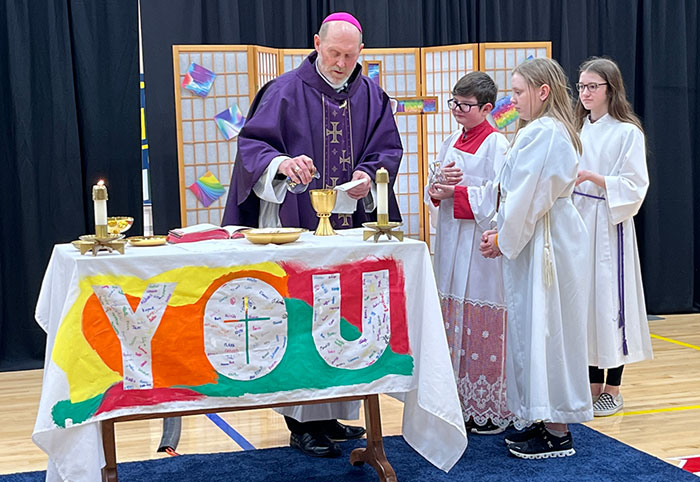
Bishop Thomas Zinkula celebrates Mass during the Iowa Catholic Youth Conference March 26 at Mount Mercy University in Cedar Rapids, Iowa.

By Lindsay Steele
The Catholic Messenger

CEDAR RAPIDS, IOWA — “Today is a celebration of our young Church and we are so glad you are here,” Mount Mercy University undergrad Clare Bechen told a group of 250 middle school students and parents assembled in the university’s gym for the Iowa Catholic Youth Conference.

The Diocese of Davenport and Arch­diocese of Dubuque organized the March 26 event, themed “You Matter, You Belong, You Are Loved,” to help youths in eastern Iowa recognize their value as children of God and as members of the Catholic Church.

Today, “we are hoping to share the greatest gifts our Church has to offer and you may be surprised to know that one of the greatest gifts is you,” said Bechen, a Bettendorf native who served as an event emcee with fellow undergrad Vanessa Milliman of Iowa City.

Mount Mercy President Todd Olson greeted participants and applauded the organizers for their “amazing work getting youth and young people here today. Staff from (both dioceses) have worked hard to make this big day come together. They thought a lot about what would help you most during the day.”

Nashville-based singer/song­writer Dana Catherine spoke to participants and led music worship. She admitted she used to base her self-worth on what other people thought of her, as well as her academic and athletic achievements. “I was obsessed with being the best at everything.”

In college, she could no longer rely on these anchors. She didn’t know anyone and worried she wouldn’t make friends because she didn’t feel comfortable engaging in the “cliché college party culture.” She was no longer a top student, but one of many top students. She struggled to open up to the few friends she did have because she was afraid of being judged negatively. “I vividly remember lying in my bed (and praying). There were tears streaming down my face… I was very confused. How could everything change so quickly? Most of the things I had relied on to feel like I was enough in life, the things I relied on to define myself and feel like I belonged and mattered, had been stripped away.”

Through time and prayer, she realized that temporary accomplishments did not define her worth. “If something can disappear in the matter of a month, that is not at the heart of what your identity is. When everything is said and done, we are children of God… that cannot be taken away.”

This acceptance allowed Catherine to thrive and become more vulnerable with others. “‘You Matter, You Belong, You Are Loved’ means we have strength in God,” no matter what. “That gives us strength to go through anything in life and to fulfill our mission” to love God, love others and share the good news of Jesus Christ.

Catherine reassured youths that God can work through anyone. “You have a specific personality, experiences, (areas) where you’ve fallen short, talents and interests. No person is better than another. God made you for a reason!”

Lindsay Steele
Nadia LeClair of St. Patrick Parish and Alecia Miller of St. Mary Parish, both in Iowa City, write prayer requests during the Iowa Catholic Youth Conference March 26 at Mount Mercy University in Cedar Rapids.

Alecia Miller of St. Mary Parish in Iowa City said she appreciated Catherine’s willingness to share personal testimony. “Getting to know her personally helped me understand (her message) more.”

“It was cool that she shared her story; I never heard a story from real life like that,” said Amaya Cervantes of St. Mary Parish in Pella. Harper Guess, also from Pella, added, “Everything can change so fast, but it’s okay” as long as you have God.

After the opening talk, youths participated in breakout sessions focused on caring for creation, self-acceptance and finding God in popular music. Faith formation directors asked youths to share their thoughts and concerns about the Church. The anonymous responses were to be shared later with Archbishop Michael Jackels. Other activities included writing prayer requests, making inspirational message cards, playing games and chatting with Catherine. After lunch, she shared more about her faith journey.

Bishop Thomas Zinkula offered a final talk, explaining the meaning and significance of his vestments, pectoral cross, zucchetto, miter, ring and crosier. He shared his connection to the archdiocese as a Mount Vernon native and a parish priest. Mercy Hospital in Cedar Rapids, not far from the

Lindsay Steele
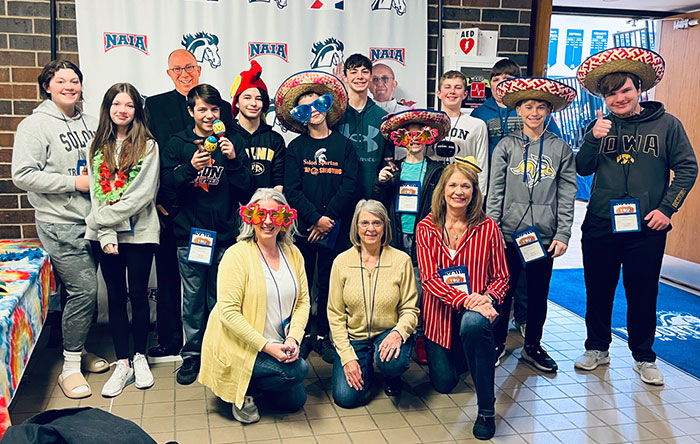
A group from St. Mary Parish in Solon poses for a fun photo with cardboard cutouts of Archbishop Michael Jackels and Pope Francis at the Iowa Catholic Youth Conference March 26 at Mount Mercy University in Cedar Rapids, Iowa.

Mount Mercy campus, was his birthplace.

Bishop Zinkula closed the conference presiding at Mass. “God loves us unconditionally and sacrificially,” he said during the homily. “We matter to God! He has blessed us with gifts, friends, family, nature, food, clothing, housing, school and recreation, but the best gift of all is our faith.” We show our love for God by loving others and sharing our time, blessings, gifts and talents. “We need to take Christ into the world, be Christ for others and see Christ in others,” he said. “That’s what we’re called to do.”

Liam Bellich of Jesus Christ, Prince of Peace Parish in Clinton said he enjoyed seeing Bishop Zinkula at the conference. Chloe Gardenier of St. Mary Parish in Solon left with the confidence of knowing “God always loves us.”

Agnoli

When your pre-teen asks a tough question
During the breakout sessions, parents hung out in the “parent lounge” and listened to a presentation from Marianne Agnoli, marriage and family life coordinator for the Davenport Diocese. She offered guidance on how to respond to their children’s questions on topics such as sex, pornography, abortion and LGBTQ issues. “Sometimes we avoid talking about it,” she said. “It’s important for them to know that they can talk to you about anything.” How parents respond will set the tone for future interactions. She offered eight steps for responding to tough questions:
• Prepare ahead of time for potential questions.
• Try not to freak out.
• Reassure your child of your unconditional love.
• Listen for understanding with “what” questions.
• Ask “why” questions — but don’t interrogate.
• Respectfully share your perspective.
• Provide access to additional support.
• Keep the door open to further conversations.

Posted on

Believe in your inherent goodness

By Jenna Ebener
A Reflection Column

“And now these three remain: faith, hope and love. But the greatest of these is love” (1 Corinthians 13:13). Many of us are familiar with this popular Scripture passage. I have always agreed with the truth of that statement without ever diving into what St. Paul meant when he wrote those words, words often said during the sacrament of matrimony and that appear on countless wall hangings. Have you ever paused to consider the true impact of love and how love impacts faith and hope? I always believed in the power of love but I had to witness the power of self-compassion within myself before I could truly feel its ripple effect.

I went into day one of a group therapy retreat in January feeling defeated. Of the three virtues, the only one I truly had at that time was faith. I believed in God and trusted in his guidance. I felt his presence, yet I no longer had hope that I would ever feel worthy of his love. I loved others and was extremely compassionate, yet I now see how limited my love truly was. We can only love others as much as we love ourselves — and I did not love myself.

I will always remember the difference in my demeanor from day one to day five of that retreat. On the first day, I was filled with such feelings of inadequacy that it took me minutes before I could even introduce myself to the group. When we looked each other in the eyes to share self-affirmations, such as “I am inherently worthy,” I did it, but could not believe in what I was saying. I could not bear the love and compassion in the eyes of my group members. By day five, something had shifted. I could look into my group members’ eyes, confidently say the phrase, and hold their gaze as tears of gratitude filled my eyes. I had finally accepted the gift of self-compassion that God had been trying to give to me.

Finally, I was able to comprehend what St. Paul meant. I saw how love truly is the key to all of the other virtues. With self-compassion, I am able to love others deeper than ever before. I have hope that life is worth the sometimes seemingly endless suffering that comes from discovering yourself and being authentic. My faith, which has always been my foundation, is able to grow and flourish now that I can finally believe that what God says of me, and all of us, is true — I am his beloved child, worthy of love without earning it, and very good.

Which of the three virtues come the most easily to you? Do they feel in balance? If not, I encourage you to look at how you treat yourself. Do you talk to yourself as you talk to your close friends when they are struggling? God lives inside you. Would you talk to him as you would talk to yourself? If not, then use the virtues of faith or hope to help you find self-love.

Scriptures and community with other believers are just two ways you can foster your faith and hope so that you are able to look deep inside to find those parts of yourselves that do not feel worthy of God’s love. Talk to those parts just as you would a close friend. My prayer is that every day, each of you will believe in your inherent goodness. “For I am convinced that neither death nor life, neither angels nor demons, neither the present nor the future, nor any powers, neither height nor depth, nor anything else in all creation, will be able to separate us from the love of God that is in Christ Jesus our Lord” (Romans 8: 38-39).

(Jenna Ebener, a graduate of St. Ambrose University in Davenport, is a social worker at a school in Colorado for students with a combination of medical, cognitive and behavior disabilities. She relies on God every day to aid her on this wonderful, yet intense journey.)

Posted on

Iowa Catholic Conference capitol update

The Catholic Messenger

House File 349, which would provide “earned time” credits for the completion of activities such as education, vocational training and work for individuals on probation passed in the Iowa House

Chapman

on a vote of 93-1 last week. The bill, which has the support of the Iowa Catholic Conference, the public policy voice for Iowa’s bishops, needs to get through the Senate Judiciary Committee before Friday, ICC Executive Director Tom Chapman said.

A House subcommittee has passed Senate File 326, a bill that makes it possible for pharmacists to provide hormonal contraceptives without a prescription. While opposing the provision, “we are also encouraging an amendment for safety reasons to make sure there is a physician visit somewhere along the line for women receiving the drugs,” Chapman said.

The ICC opposes House Study Bill 227, which would legalize online and app gambling with real money and is pleased to see that the bill has returned to the Ways and Means Committee without recommendation. The ICC believes legalizing online and app gambling with real money would damage a great number of families due to an easier path to a gambling addiction.

“Disappointingly,” Chapman said, ICC staff has heard it is not likely that Senate File 297 will be debated this year. The bill would protect health care providers’ ability to refuse to perform a medical treatment, if the provider regards the treatment as being harmful to a patient. 

Senate File 494, which requires the state to establish a new asset test and income/identity verification system for public benefits, passed the Senate by a vote of 34-16. One item of concern is the bill’s maximum of 10 days to respond to the state about an income discrepancy that disqualifies a person, Chapman said. The House version, House File 613, doesn’t include the 10-day limit.

The creation of a new verification system is not necessarily problematic. Only those who qualify should receive benefits, the ICC believes. “But we question why SF 494 is necessary. There are fewer people on food stamps in Iowa today than before the pandemic. The error rate for benefits being overpaid or underpaid in Iowa has improved. The Legislative Services Agency estimates that 1% of recipients will lose benefits due to the bill. They also project it will take 230 HHS staff to administer the new process.”

Gov. Kim Reynolds’ bill on parents’ rights in education, SF 496, passed in the Senate by a vote of 34-16. It includes a prohibition on instruction regarding gender identity in grades K-6 and requires a school to notify parents about a child’s desire to change their gender identity. The bill also includes language supporting parents’ rights to make decisions affecting their minor child related to medical care, moral upbringing, religious upbringing, residence, education and extracurricular activities. The governor signed Senate File 538, which prohibits “gender transition” treatments for minors. The ICC supported the bill.

In other news, the 10th annual celebration of Religious Freedom Day in Iowa includes a symposium on Thursday, April 13 from 10 a.m. to 5 p.m. It will be held at the World Food Prize Hall of Laureates in Des Moines. The event is free of charge. The Iowa March for Life will take place at the State Capitol in the early afternoon of June 24. More details to come.

In national news, the U.S. Conference of Catholic Bishops’ (USCCB) Committee on Doctrine issued a statement providing moral criteria to Catholic health care institutions for discerning which medical interventions promote the authentic good of the human person. 

In its statement, the doctrine committee acknowledges that technology offers chemical, surgical, and genetic interventions for the functioning of the human body, as well as for modifying its appearance. However, the committee says interventions for gender dysphoria “do not respect the fundamental order of the human person as an intrinsic unity of body and soul, with a body that is sexually differentiated,” and the committee states that Catholic health care services must not perform them (gender dysphoria interventions). The statement adds, “particular care should be taken to protect children and adolescents, who are still maturing and who are not capable of providing informed consent.” 

Visit the ICC website at iowacatholicconference.org for updates, action alerts and more information.


Posted on

Letters to the Editor: Words of Appreciation

I am so grateful to St. Ambrose University President Amy Novak, the university board, and planning committee for the recent “Francis at Ten” conference (March 16-18), especially for making it available online to those unable to attend in person. Speaking as just one Sister of Humility, I appreciated the rich content of the program. How grateful I am to the Holy Spirit who has blessed us with a pope who shows us when and how to speak and when to be silent. The thought came to me that there will never be a Pope Francis II.
Sister Mary Rehmann, CHM
Davenport

Posted on