




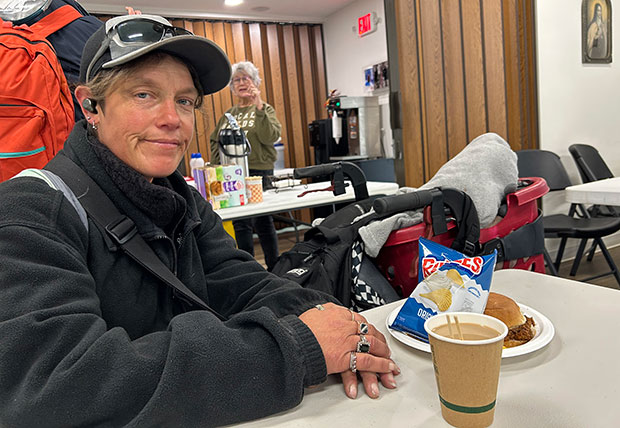
Andrea, who is homeless and struggles with health issues, is grateful to enjoy a meal in the dining space of McAnthony Window, a ministry of St. Anthony Parish in Davenport. McAnthony Window provides food, other basic necessities and support services for people in need.
By Barb Arland-Fye
For The Catholic Messenger
Forty-eight-year-old Andrea gingerly pushes a walker stuffed with her belongings — clothes and blankets — into the dining space of McAnthony Window at St. Anthony Parish in downtown Davenport. Sgt. Andrew Harris of the Davenport Police Department, who coordinates the off-duty police officers at the meal site, holds the door open for her.
It is a chilly November morning, just days before Thanksgiving, as Andrea eases into a chair at a table to eat her meal — a sloppy joe, chips and coffee and frosted doughnuts on the side. Bundled up for outdoor living, the Chicago native wears a weary look on her face. She has been homeless for four years and struggles to find employment after being diagnosed with lupus, a chronic, autoimmune disease. Hunger preoccupies her as she strategizes how to get enough to eat.
Andrea is among the 402,340 Iowans (including 129,340 children) who are food insecure, meaning she doesn’t know where or when she will eat her next meal. One in eight Iowans (12.4%) and one in six Iowa children (17.8%) face this predicament, according to figures from Feeding America provided by Katie Sorrell, executive director of the Iowa Food Bank Association (IFBA).



Gathering statistics on hunger in Iowa — and across the nation — became more challenging after the U.S. Department of Agriculture (USDA) in September 2025 terminated future Household Food Security Reports, calling the report “redundant, costly, politicized and extraneous …” Feeding America states it is collaborating with its nationwide network and partners “to explore alternative data sources to ensure local updates can continue in 2027 and beyond.”
Parishes throughout the Diocese of Davenport collected and organized distribution of Thanksgiving boxes for individuals and families struggling to put food on the table during this year of accelerated food and fuel costs. However, that generosity won’t sustain hungry Iowans in the long term, who find themselves depending on Supplemental Nutrition Assistance Program (SNAP, or food assistance) and/or food pantries to sustain them.
“Anecdotally, we are definitely seeing more and more people at our food pantries,” Sorrell said, “and it’s more expensive to purchase the food. And think about how much your grocery bill has gone up … and then, exponentially, at food banks with food costs and fuel costs, it’s just been really expensive.”
Food insecurity grows

“We are hearing from our partner agencies that the need in their communities remains significant, and in many cases, continues to grow,” said Samantha Sancen, donor relations manager for River Bend Food Bank, which serves a 23-county area in eastern Iowa and western Illinois. “Food insecurity across our 23-county service area is at a four-year high, affecting nearly 140,000 individuals, including more than 43,000 children,” Sancen said.
“We are also seeing the effects of changes to SNAP eligibility and enrollment. Some individuals who previously relied on SNAP benefits are now turning to food pantries for additional assistance. Our partners are on the front lines of this work, and they are seeing firsthand how difficult it has become for families to keep up with the cost of groceries and other basic necessities.”
River Bend Food Bank, based in Davenport, is among six food banks across Iowa that partner with the Iowa Food Bank Association to “collaborate in order to make hunger relief more effective and efficient within the state” and to provide “a means for food banks to have a stronger voice at the state level and become more involved in advocacy,” the association’s website states.
The association’s three focus areas are advocacy, collaboration and SNAP outreach. “We run the SNAP hotline here in the state of Iowa because we know that food pantries and food banks can’t fill the gap of a federal nutrition program,” Sorrell said.
Helping to make ends meet

Food pantries within the Diocese of Davenport do the best they can to fill the gaps. McAnthony Window, a ministry of St. Anthony Parish, provides food, other basic necessities and support services for people in need and serves anywhere from 85 to 120 households a day, said John Cooper, the parish’s pastoral associate. The average number of households served from January through October 2026 (18,362) increased just slightly over January through October 2025 (18,230). The need remains significant.
“If we have around 150 people at our meal site and/or food pantry, about 60 are homeless and the rest are people living in apartments and homes, some having a car to drive here, and most of them working jobs,” Cooper said. “The food pantry allows them to make ends meet. It can mean the difference of being able to eat and pay the bills without needing to choose between the two.”
“This past year we have seen a marked increase in people driving to our pantry. We have trouble with parking like we didn’t have before. This tells us that people who were doing well enough to have a vehicle, now can’t make ends meet and need help in doing so,” Cooper said.

Lawrence DuCharme, director of St. Vincent de Paul Food Pantry in Burlington, a ministry of Divine Mercy Parish in Des Moines County, said the pantry has seen an uptick in visitors in recent months. Housed in the parish’s gymnasium, the pantry serves a little more than 30 people a day. “Over the last 12 months, we served 7,521 families,” he said. “It’s actually down a bit from 12 months prior, just slightly. Last year, we had a really big year.” The trend has been moving upward for the past few years, he added.
“We do see people who haven’t been there before. When they haven’t visited before, they have to fill out paperwork,” DuCharme said. “Every month we do get new people. A lot of people don’t come every month, just when they need it. A lot of times, it’s people who are new to town.”
Information, Referral & Assistance Services in Clinton, which serves an average of 30 households daily Monday through Friday, sees a growing need for food assistance. “In our last Fiscal Year ending in September, we provided 5,551 households with food boxes, reaching 13,425 individuals. In our 2024-25 fiscal year, we provided 4,870 households with food boxes, reaching 11,333 individuals,” said Regan Michaelsen, the agency’s executive director.

“Our highest demographics are families and individuals in their mid-twenties to mid-forties. However, we do serve a fair number of seniors and younger individuals. Mostly with low-paying jobs or on fixed incomes. I can say that over the last couple of years we are seeing more people that have never had to ask for help before. On an average day we are starting four to five new files for new individuals,” Michaelsen said.
SNAP cut impacts
“Charitable programs are unable to fully support those facing hunger,” Feeding America says on its website. “The combination of charity and government assistance programs are necessary to help bridge the meal gap.”
The gap is widening. Last year, Congress passed H.R. 1, a bill that makes major cuts to SNAP, implements cost-shifting provisions for states and adds to the work requirement measures for able-bodied adults that includes raising the age from 55 to 65, according to congress.gov.
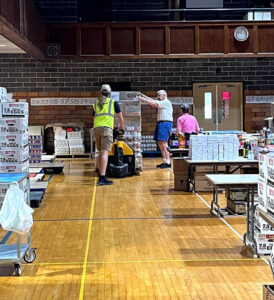
Two men unload a pallet of food at St. Vincent de Paul Society Food Pantry in Burlington. The food pantry is a ministry of Divine Mercy Parish in Des Moines County.
Iowa’s food banks and the IFBA already are experiencing the effects. For example, each food bank contributes funding to operate the SNAP hotline, which in fiscal year 2026 received 43,184 calls, resulting in 12,004 SNAP applications submitted. Of the calls, 177 required translation — in one of 24 languages. The federal government had been providing 50% toward administration of the hotline but H.R. 1 cut that contribution in half, to 25%. IFBA needs $170,000 to make up that lost 25%, according to figures Sorrell provided. With increasing food insecurity, “We want to make sure that every Iowan who is eligible for SNAP is applying,” Sorrell said.
That’s where advocacy comes into focus. Sorrell encourages readers to participate in these activities:
- IFBA SNAP Toolkit Training, a virtual training session Dec. 8 from 11 a.m. to noon. It provides an overview of the SNAP program and equips participants with the information and tools needed to encourage and support their neighbors as they explore and apply for benefits. Learn more and register (https://tinyurl.com/28emsuvd).
- IFBA’s “Feeding Iowa Day on the Hill” Feb. 10, 2027 from 1-4 p.m. at the Iowa State Capitol. Educate legislators about the face of hunger in Iowa. Register here: (https://tinyurl.com/36vstn2r).
- Consider making a donation or volunteering at your local food pantry or food bank.
Take time to get to know Iowans like Andrea, who is weary but determined. “I just keep pushing (forward). I have to.”
