




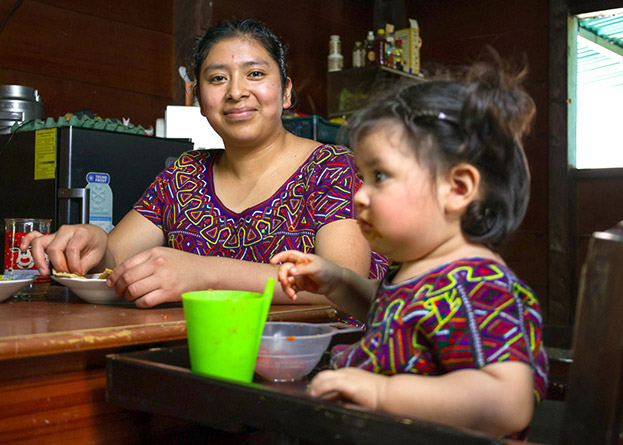
Maribel shares a healthy and delicious lunch with her daughter after participating in a nutrition education project with CRS in Guatemala.
By Lindsay Steele
The Catholic Messenger
DAVENPORT — The holy season of Lent is a special time for personal and spiritual growth. “It’s a time to reflect deeply on ourselves and others,” said Deacon Kent Ferris, diocesan director of Social Action and of Catholic Charities.

During Lent, Catholics are asked to focus more intently on donating money or goods to the poor and performing other acts of charity. Almsgiving, together with fasting and prayer, make up the three pillars of Lent. When done with humility — as Jesus instructed in his Sermon on the Mount — almsgiving is “a work of justice pleasing to God” (Catechism of the Catholic Church, no. 2462).
A Lenten tradition


Each year, the United States Conference of Catholic Bishops (USCCB) encourages the faithful to participate in Catholic Relief Service’s (CRS) Rice Bowl collection. This program, now in its 51st year, “brings hope to families struggling with hunger and poverty,” Deacon Ferris said during a Social Action Lunch and Learn presentation last month on Zoom. Three-fourths of the diocesan Lenten collection supports hunger relief efforts in more than 100 countries. The remaining 25% benefits local organizations that ease food insecurity.
An increased need
CRS’ international programs do more than just provide nutritious meals, according to the organization’s website. They work with local partners on education, finance, clean water, nutrition and microfinance projects to empower individuals and families. Many of these programs lost federal funding last year amid sweeping cuts to international aid initiatives. “The need is greater because there is less money available,” said Deacon Joe Welter, whose diocesan assignment is promoting CRS and Catholic Charities. Dozens of CRS employees have lost their jobs, he said, but the mission continues. “We believe in the mission of CRS. The (U.S.) bishops believe in the mission of CRS. So, it’s really paramount for us to support that because there isn’t as much money from other sources to support the missions they have been doing.”

Last year, Catholics in the Davenport Diocese responded to the aid cuts with a near-record Rice Bowl collection of $81,600. Local organizers hope diocesan Catholics will once again make almsgiving a priority this Lenten season. Deacon Welter believes that strong local support for international aid programs could help promote a sense of “buyer’s remorse” among legislators who supported the aid cuts. “I’ve gotten some feedback that there might be. We can show our officials that this (aid) really matters to us as constituents. Seemingly, it was important to (legislators) in the past — can we make it important again? I’m hopeful things will change.”
Local initiatives
The local portion of Rice Bowl funds is distributed to about a dozen local organizations each year, providing funds for food pantries, meals for youth programs and more. “We try very hard to stay in contact with local parishioners in order to identify hunger-fighting efforts they undertake, and to know where funds could be distributed,” Deacon Ferris said. Thirteen hunger-fighting initiatives in the Diocese of Davenport received grants last year, including Community Action of Southeast Iowa-Burlington’s ethnic foods program, First Presbyterian Church-Williamsburg’s food pantry, and the Iowa City Free Lunch Program. Organizations need not be Catholic to apply for CRS Rice Bowl grants.
More ways to give
The Church hosts several additional collections during Lent, including the Collection for the Church in Central and Eastern Europe, the National Black and Indian Mission Collection, and the Collection for the Holy Land. Pontifical Mission Societies USA (TPMS), a worldwide network at the service of the Pope that supports young Churches through prayer, charity, and missionary awareness, is another option, Deacon Ferris said. Catholics can also give alms to their local parish’s regular collections to support those experiencing hunger and/or homelessness in their communities.
Something is better than nothing
The amount given is less important than the intention behind it, Pope Leo XIV wrote in his 2025 apostolic exhortation, “Dilexi Te” (“On Love for the Poor”). “It is always better at least to do something rather than nothing. Whatever form it may take, almsgiving will touch and soften our hardened hearts. It will not solve the problem of world poverty, yet it must still be carried out, with intelligence, diligence and social responsibility. For our part, we need to give alms as a way of reaching out and touching the suffering flesh of the poor.”
