




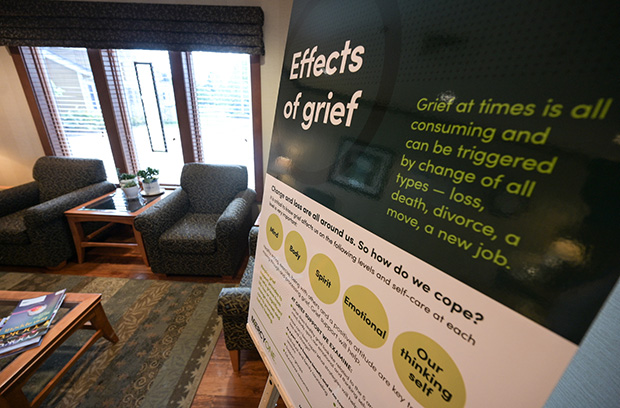
A waiting area at the Clarissa C. Cook C. Cook Hospice House in Bettendorf is shown. A poster informs visitors of the effects of grief.
By Dan Russo
The Catholic Messenger
BETTENDORF — Lisa Levy, bereavement coordinator for the Clarissa C. Cook Hospice House, first came to the building many years ago to visit a friend’s father who had come there to die.
“I was so impressed by the atmosphere,” she recalled.
As a Catholic, she says she saw how the Church’s teaching on “the dignity of the human person” could be honored, even under difficult circumstances at the final moments of life. The experience inspired her to take a job there as a nurse and, later, as the person in charge of aiding grieving families, a position she’s held for the last seven years.


“Hospice is about treating everyone with dignity and respect,” explained Levy, who is a member of St. Andrew Parish-Blue Grass, where her husband Matt serves as a deacon and parish life administrator. Levy cares for those left behind with the assistance of about 10 volunteers. “Just like every birth is unique, every death is unique. The goal of hospice is to make the most of life at the end of life … My work is primarily after the death in what we call grief support …”
The Hospice House, located in Bettendorf, provides care to the dying in the 12-16 beds on site and also sends personnel out into the community around the Quad Cities. Managed by MercyOne Genesis, the facility bears the name of Clarissa C. Cook (1811-1879), a philanthropist who, with her husband, contributed to many charitable efforts across the region, including providing funds for the construction of Trinity Episcopal Church in Davenport, which was a gift given as a memorial to her late husband.
Hospice is medical care and emotional support that occurs at the end of life when a cure is no longer an option, according to the Hospice Foundation of America. For many who work in the field, being able to endure the demands of the job requires support from colleagues and, often, reliance on faith in God.
“One of the wonderful things about hospice is we work as a team,” said Levy. “For most of us here, our spiritual life is fundamental.”
‘Reading the room’
Kevin Kramer, a registered nurse, began his career in oncology before switching to hospice. The member of St. Joan of Arc Parish-Bettendorf carries a rosary with him during his work day. It’s the same one his own father had in his hands at the time he died.
“I’ll just grab it and say a prayer to the Holy Trinity,” he said. “I usually (ask God) to guide my thoughts, words and deeds.”
There are two main types of hospice care — the kind that takes place inside an environment like the Cook House and the type where people like Kramer provide care for the dying at home or in a long term care facility. Upon meeting with a new patient, the nurse does his best to “read the room,” by gauging the emotional and medical condition of the patient, what is going on with visiting family members or friends, and other factors.
“I tell patients, ‘I’m here because you have living to do,’” said Kramer. “When that dying stuff happens, I will be here for you too.”
Kramer makes sure patients are comfortable, monitors medical situations and assists in other ways during house calls.
“Our experiences tell us when death is imminent,” he said. “Sometimes we can be blindsided, but typically we can see what’s happening. If I did my job right, this will be a good experience for the patient and the family as well. A lot of it is being honest and present and I don’t sugar coat things. (Maternity) nurses bring these beautiful souls into the world and hospice nurses give these beautiful souls back to God.”
Journey Quilts
Lisa Orwig, a social worker who works in hospice at the Cook House and elsewhere, has been working in the field for about 11 years. Like Levy, the hospice experience of one of her friends made her interested in caring for people who are dying.
“If you’re called to do it, you’re called to be here,” said Orwig. “It’s not depressing because we work as a team and support each other.”
Orwig is a woman of faith, but does not usually share anything about her faith tradition with patients or families because she feels it helps her “meet people where they are at.” Orwig’s job is to provide practical support for patients and their families that is not directly related to medical care. Orwig says that once in a while she engages in discussion about faith, but it “depends on the situation.”
The hospice team tries to do everything they can to help families say goodbye well. This includes having “journey quilts” ready for when a patient dies. These hand made coverings are placed on top of a person’s body as it is taken out of the Cook House and into waiting vehicles. Families can pick designs that have meaning for the deceased. Themed quilts have included Elvis, the University of Iowa Hawkeyes, and many other sports teams.
Perhaps the person on the hospice team with the most experience with talking about faith matters with patients at the end of life is Chaplain Thomas Janikowski. The Russian Orthodox priest carries a chotki, which is a loop of knotted prayer beads used in Eastern Christian traditions. Despite his deep faith, he often does not enter a patient’s room and start a conversation about religion.
“There’s a high percentage of people who have no faith these days,” said Janikowski. “I try to break the ice. I tell them I’m part of the care team. If they need help getting in touch with a pastor, I’ll do that. If the patient has no faith tradition or has no pastor, the chaplain has to fill in the gaps.”
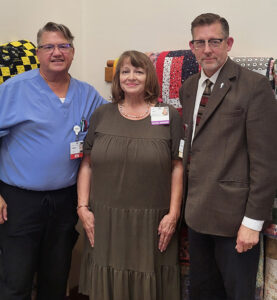
From left, Kevin Kramer, a nurse, Lisa Orwig, a social worker, and Chaplain Thomas Janikowski work on the hospice care team based at Clarissa C. Cook Hospice House in Bettendorf.
Janikowski also serves at a congregation in Davenport and says ministering to friends who are dying can be the hardest part of the chaplain job. He recalls one case where he was able to give communion to a woman for the first time before she passed. “She had just been made a catechumen. She kept saying ‘It’s so beautiful,’” he remembered.
The chaplain’s experiences have taught him that it is important to communicate with loved ones honestly when you can.
“No matter where one is in terms of faith,” he said. “Don’t let division fester. Start saying the things you need to say while you’re alive.”
Although those who work in the hospice field see difficult family or medical situations regularly, they also get to witness bonds of love that shine amidst suffering. Levy shared one case like this she’ll never forget.
“I worked with a young couple in their late 30s or early 40s,” recalled Levy. “He was profoundly ill. She was so tender at great cost to herself and he wanted to die at home. I was so humbled by her love of her husband. I will never forget it. We see this all the time with our families.”
Rooms inside the Cook House are made to look more like a bedroom in a home than a hospital room. While walking through one of them, Kramer pointed out the shelves placed there so that patients could display pictures and other items from home as a way to make them feel at ease. The nurse joined his colleagues in expressing a passion for working with hospice patients, despite the dramatic and complex nature of the field.
“I see forgiveness and healing a lot,” said Kramer. “It’s a very spiritual experience when that happens. I’ve seen contact with a family member that has been pushed away. Among our team, we get to see God’s grace every day.”
