




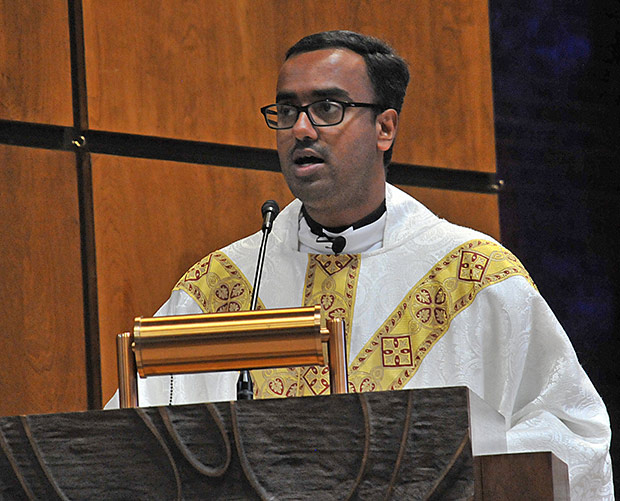
Father Manu John presides at Mass at Our Lady of Victory Parish in Davenport last month. Father John, a priest of the Diocese of Pathanamthitta, India, has served in the Diocese of Davenport since 2025.
By Lindsay Steele
The Catholic Messenger
DAVENPORT — Catholicism may be uncommon in India, but the southern coast — inspired by the missionary leadership of St. Thomas the Apostle — boasts a strong Catholic tradition and plentiful vocations to the priesthood.
“Christianity in India has deep historical roots,” said Father Arul Raj Dominic Savio, a priest from the south-Indian archdiocese of Madras-Myalpore serving Divine Mercy Parish-Burlington/West Burlington and St. Mary-Solon. According to tradition, St. Thomas arrived on the southern coast of India in 52 A.D. to spread the Gospel, and was later martyred there (www.trcmst.org).

Indian priests are increasingly serving abroad to help dioceses cope with priest shortages. As many as five Indian-born priests could be serving the Diocese of Davenport by the end of the year, Bishop Dennis Walsh said. “There is a general need in our diocese for priests, especially in the next couple years as priests move into retirement,” he said. In Iowa, seven Indian-born priests serve in the Diocese of Des Moines, four serve the Sioux City Diocese and one serves in the Dubuque Archdiocese.


Less than 2% of Indians identify as Catholic, and it is the largest Christian denomination in the southeast Asian country (catholicheiarchy.org). Its members primarily belong to the Latin (Roman Catholic) Church or one of two Eastern Catholic traditions in full communion with Rome: the Syro-Malabar Catholic Church and the Syro-Malankara Catholic Church. While some parts of India face legislative and social challenges regarding religious freedom and evangelization, Father Savio said his archdiocese “generally enjoys a peaceful environment where we can run schools, hospitals and pastoral ministries openly.”
Father Savio, who served his home archdiocese as director of evangelization and secretary for ecumenism from 2014-19, believes the abundance of priests in southern India stems from the strong, faith-centered foundations of its families. “In our culture, the family is the first seminary; parents actively encourage their children to listen to God’s call. Furthermore, the vibrant youth ministries and the legacy of the local clergy inspire young men to dedicate their lives to Christ.” Father Savio came to Davenport about two months ago at the invitation of his archbishop, who had previously spoken with Bishop Walsh about the possibility of sending a priest to serve in Iowa. The arrangements are mutually beneficial, Bishop Walsh said. The Davenport Diocese is able to fill ministry gaps, and the priests support the Church in India by donating a portion of their salaries to their home dioceses.
Father Manu John of the Diocese of Pathanamthitta, in August of 2025, was the first to arrive in the Diocese of Davenport. “When asked to come here (by my bishop), I said ‘yes’ immediately. I have always wanted to serve as a missionary,” he said. “I saw it as a profound call from God to step out in faith and share in the universal mission of the Church. I chose to say ‘yes’ because I felt a strong desire to serve a community in need of pastoral care and I wanted to experience the life of the Church in a different cultural context.”
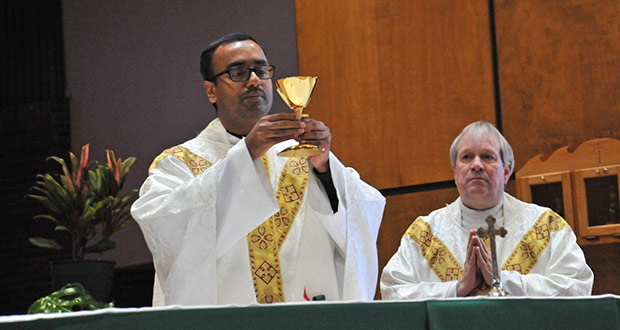
Father Manu John presides at Mass at Our Lady of Victory Parish in Davenport last month. Father Patrick Hilgendorf, pastor of the parish, concelebrates.
Father John’s cousin and fellow diocesan priest, Father Sijo James, arrived in Davenport last month and is in the process of becoming acclimated.
Like many Indian priests, Father John and Father James are fluent in English. It is one of two official government languages in the country. However, as members of the Syro-Malankara Catholic Church, they needed to learn the Latin Rite in preparation for their ministry in Davenport. “A missionary becomes effective only when he becomes one with the people he serves and learns to live within their culture,” Father John said.
Working in a new place and a new culture can be challenging at times, Father John admits. “Letting go of the customs and lifestyle I grew up with, and adjusting to a new way of life to become part of this community, is not easy. It takes time. It requires growth and total self-giving. I know I still have a long way to go.”
That’s not to say he’s forgotten his roots. “Who I am today is a gift from my parents, my family, my Church and my teachers,” he said. “I often share, without realizing it, the richness of the tradition in which I was raised.”
The Our Lady of Victory parish community has helped Father John feel at home. “My pastor’s (Father Patrick Hilgendorf) fatherly care and his willingness to help have made my ministry here a great joy. The kindness, prayer and support of God’s people (the parishioners) have also helped me live this time with real spiritual peace.”
Father Savio, too, feels blessed by the warm welcome he has received from the people of the Davenport Diocese. He enjoys sharing his heritage through incorporating traditional Indian hymns or prayers on special occasions, sharing cultural stories during homilies, and introducing parishioners to Indian hospitality and fellowship. “The parishes have been incredibly receptive and curious to learning about our customs,” he said.
He’s also enjoyed getting to know his new flock. “Their warmth, deep faith and openness in welcoming a priest from another part of the world has been incredibly moving. It truly reflects the universality of our Catholic faith, that no matter where we come from, we are one family in Christ.”
Foreign-born priests in the Diocese of Davenport
Currently, 11 priests ordained in other countries serve in the Diocese of Davenport as pastors, parochial vicars or hospital chaplains. That’s about one-fifth of all priests in active ministry. Five of these priests are from Cape Coast, Ghana, with whom the diocese shares a long and fruitful relationship.
The process of bringing a priest or religious to Iowa can take months, Bishop Walsh said. For priests, it starts with communication between Bishop Walsh, the priest and his bishop. The diocesan Office of Immigration helps the priest apply for an R1 (religious) visa. After the application is complete, the priest schedules an interview with the consulate in his home country. If approved, the priest then waits for the U.S government to approve the visa.
There is an adjustment period for both parishioners and priests when clergy from other nations begin assignments. Bishop Walsh, who learned Spanish as an adult and has ministered in Hispanic parishes, encourages the faithful to acknowledge the effort, and not focus on accents or cultural differences. “I think the people I served were just grateful I was making the intent” to speak to them in their language, he said. “I understand that sometimes we can be short-tempered because of difficulties understanding accents, but we should be grateful for their generosity in serving here.”
