




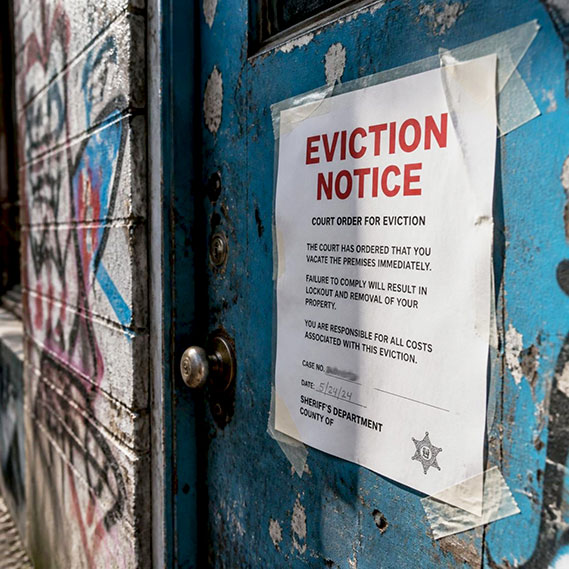
This image shows a blue door with an eviction notice taped onto it.
By Barb Arland-Fye
For The Catholic Messenger

DAVENPORT — Molly McDonnell, an Iowa Legal Aid attorney, speaks earnestly with a couple sitting across from her at a table in the lobby of the Scott County Courthouse in Davenport. Eviction hearings are about to begin in the courtroom just off the lobby, and the couple’s case is among 50-60 hearings that three magistrate judges will conduct in a little over an hour.
Iowa Legal Aid provides free, civil legal help and advocacy for underserved Iowans, many of whom appear at eviction hearings without legal representation, whereas landlords often have legal representation, the nonprofit law firm states on its website. These hearings determine whether tenants will lose or retain (even temporarily) the homes and apartments they are renting.

Inside the courtroom on July 7, adults and one child filled most of the 50 or so chairs facing the judges seated at their bench. Attorneys, landlords, property managers and tenants circulated in and out of the courtroom, including Iowa Legal Aid Attorney Chris Merkle, managing attorney of Iowa Legal Aid’s Eviction Diversion Project.


Eviction filings in Iowa have been rising for years — totaling 21,067 in 2025 — but plateaued during the COVID-19 pandemic because of eviction moratoriums and the infusion of funds for rental assistance. Since then, the numbers are “back on the upswing, and so we’re now at a point where we’re hitting near-record, all-time highs pretty much every year,” says Nick Smithberg, executive director of Iowa Legal Aid.
Iowa Legal Aid’s goal is to keep tenants housed, a tall order for people struggling to make ends meet. “Ninety-nine percent of the cases we do in eviction are for nonpayment of rent. And it’s not that people are forgetting to pay the rent. They don’t have the money,” Smithberg told The Catholic Messenger during an interview this past spring in Iowa Legal Aid’s Davenport Regional Office, which McDonnell manages.

Dennis Platt, co-chair of Quad Cities Tenant Alliance, and a regular at eviction hearings as part of his advocacy efforts for tenants, says there are “many reasons that a tenant is unable to pay their full rent … family emergencies, broken down cars, etc. Then property managers begin adding late fees and the vortex of trouble widens.” Smithberg acknowledges the difficult position of property managers and landlords. “At the end of the day, the rent is gonna need to get paid.”
Decent, safe and affordable housing is a human right, the U.S. Conference of Catholic Bishops states on its website. “Catholic teaching … recognizes that communities and the government have an obligation to ensure the housing needs of all are met, especially poor and vulnerable people and their families. In a time of rising homelessness and when many workers’ wages are stagnant and living expenses are rising, it is important to ensure housing security.”
Eviction Help Desk
During the COVID-19 pandemic (2020-2023), Iowa Legal Aid established its eviction diversion project, called the “Eviction Help Desk,” to assist tenants onsite at the courthouse as they await their hearings. The pilot project’s success in Polk County “spawned a statewide project where you have six help desks including here (in Davenport),” Smithberg said. “Since its inception, we’ve helped 75,000 people avoid eviction.” The six help desks are in Blackhawk, Johnson, Linn, Polk, Pottawattamie and Scott counties (https://tinyurl.com/mtmajmub).
Ahead of the hearings, Iowa Legal Aid staff review upcoming cases listed on the court database and mail informational flyers to tenants about the services the agency offers in areas of basic needs: housing stability, family, safety, disaster recovery and public benefits.
Iowa Legal Aid attorneys assist clients in determining their eligibility for public benefits, addressing credit issues, improper garnishment of wages, or missing child support payments. The law firm’s work with survivors of domestic violence plays an important part in alleviating housing instability.
“A lot of work leads up to the help desk,” Merkle explained during a presentation July 9 to the Quad Cities Housing Cluster in Davenport. Eviction-prone families often deal with issues beyond paying the rent, such as work, health care, child care and school. “We’re trying to keep people housed.”
“One of the things we’ve tried to do with our eviction diversion project is to change the muscle memory of the players in the system,” Smithberg said. “If you get a landlord that views us an honest broker, and I think Molly and the team doing that here has built that credibility with the landlord community, you can get people to come and work out a problem beforehand.”
 In-person presence matters. “People facing eviction cases are extremely traumatized. They’re stressed out. Imagine if you’re in that (courtroom), but you’re looking at losing your house,” Smithberg said. When tenants contact Iowa Legal Aid ahead of time (IowaLegalAid.org, 800-532-1275) that “tends to change the outcome of these cases rather significantly,” Smithberg said. “It means that there’s a defense there, and our batting average is pretty good.”
Collateral benefits
Most of the clients Iowa Legal Aid serves are working, disabled, seniors, or some combination of those categories, Smithberg said. “We see a lot of people who are working two or three jobs.” In some cases, Iowa Legal Aid attorneys are simply buying time for tenants, helping them obtain financial assistance to pay the rent owed, but “I assure you, that matters to our clients,” Smithberg said. “The work we do, among the many collateral benefits it has for clients is that it reduces barriers to workforce participation.”
Even if the case isn’t winnable, “we can still improve the outcome in the overwhelming majority of our cases.” It could mean the difference between having a forcible eviction and a scheduled move out, Smithberg said.
An eviction remains on a tenant’s record, and the consequences for tenants can be dire. “People get forced into substandard housing. I mean, it cascades into all sorts of bad outcomes because landlords will not rent to people with a record,” Smithberg said. That steers people toward dealing with landlords who might take advantage of them, he added.
Through the eviction diversion project, Iowa Legal Aid has been partnering with different social service agencies to assist with rent. “So that’s a place where you can really broker a deal with the landlord,” Smithberg said.
It takes a village
The Quad Cities Housing Cluster, which coordinates affordable housing efforts among not-for-profit service providers, developers, lenders, funders, local governments and the housing industry, is a valuable resource to Iowa Legal Aid. “With the help of the Cluster, we’re able to do that work,” McDonnell said during the July 9 presentation. “It takes a village. We have to do this together.”
Sometimes, tenants don’t show up for their eviction hearings. “They don’t think they have a shot or feel intimidated by it,” Smithberg said. “People feel powerless. They really do.” Platt is determined to help tenants feel more empowered. During the hearings July 7, he approached individuals respectfully, sitting down beside them to talk about resources and tenants’ rights. “There are services out there. They (tenants) just need to get connected.”
Funding sources
Iowa Legal Aid, a nonprofit law firm, works with a variety of people — domestic violence survivors, individuals aged 60 and older, children, and individuals with disabilities. Funding providers include Legal Services Corporation, a private corporation created by Congress, and corporations, law firms, foundations, social service agencies, cities and counties, said Nick Smithberg, the nonprofit law firm’s executive director.
For more information, visit Iowa Legal Aid’s website (iowalegalaid.org).
Rental assistance challenges
Obtaining emergency rental assistance is a challenge for tenants facing eviction. The Diocese of Davenport receives a fluctuating number of requests each month from people throughout the diocese requesting emergency financial assistance, most often for rent or utilities.

“We have neither the criteria established nor the staff to process the enormous number of requests we would field,” said Deacon Kent Ferris, director of the diocese’s Social Action Office. “Local parishes and their involvement with ecumenical ministerial association relief assistance allows local people to be able to more appropriately respond to local need.”
If local need is beyond the ability of a parish and the local ministerial association, “our office has been tasked to collect information for the bishop’s office to determine if a contribution by way of the Diocesan Works of Charity collection would be appropriate,” Deacon Ferris said.
Funds from the Diocesan Works of Charity collection, being taken up at Masses July 25-26 have been used to address housing needs in local communities.
“The Diocesan Works of Charity collection is one way that we, as a local church, can experience the encounter between equals, finding Christ in serving the poor,” wrote Bishop Dennis Walsh in a letter promoting the effort. Read the rest of Bishop Walsh’s letter on Page 3 of this week’s issue.
— Barb Arland-Fye
