




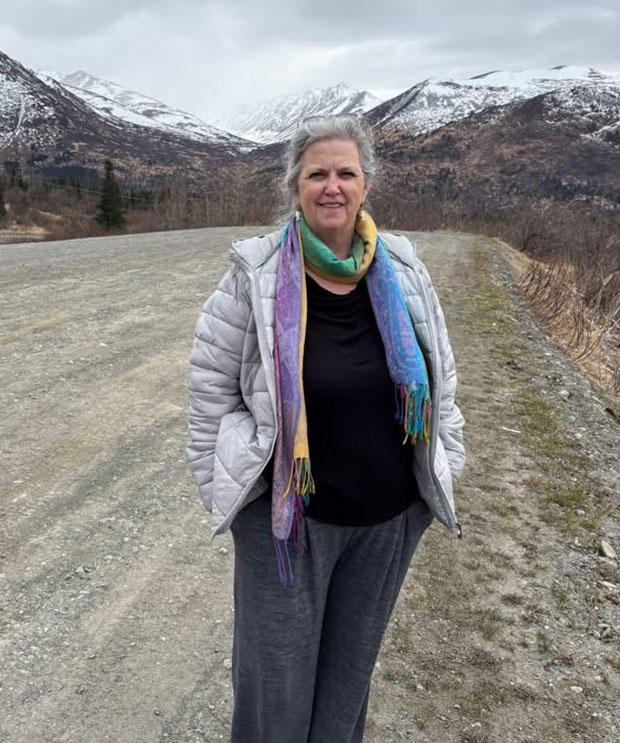
Melody Hobert-Mellecker
By Barb Arland-Fye
For The Catholic Messenger
IOWA CITY — Saving the lives of newborn babies and contributing to their positive health outcomes motivates and inspires Melody Hobert-Mellecker, a longtime nurse at the University of Iowa. After working for 18 years as a psychiatric nurse and then in administration, Melody needed a change to re-energize her career. She found it 12 years ago in newborn screening.
“The most incredibly rewarding 12 years of a nearly four-decade career in nursing,” declares Melody, a wife, mother, grandmother and member of St. Joseph Parish in Hills.
The Centers for Disease Control and Prevention (CDC) “has called newborn screening the ‘most successful public health initiative’ of the last century,” Melody says. Of the nearly 4 million babies born annually, “greater than 98% receive newborn screening and over 12,000 babies a year are identified with a serious health condition that, if left untreated, could result in permanent disability or even death.”


“Every one of the more than 37 core disorders (and numerous secondary conditions) that we screen for cannot be found by just looking at a baby and knowing whether they have a problem that needs prompt medical intervention. These babies look and act completely healthy at birth.”
“Since the advent of newborn screening in 1964, the goal is to find these vulnerable infants before they become symptomatic and bring them to medical attention,” Melody continues. “By intervening early, we quite literally save babies’ lives and improve their lifetime health outcomes. Disorders that 60 years ago would have resulted in death, severe disability, or institutionalization can now be treated and managed to the benefit of the child and their family.”
Newborn screening (required throughout the U.S.) is largely unknown to the general public, “yet tens of thousands of babies and families each year are saved because of it,” says Melody. Today, newborns are screened for cystic fibrosis, hemoglobin disorders such as sickle cell disease, endocrine disorders, neuromuscular disorders, severe immune deficiency disorders, congenital deafness, and congenital heart defects among others.
Behind the scenes
Melody’s work is behind the scenes, reviewing the screenings and notifying the appropriate health care provider if a problem is detected so that action can be taken immediately. In addition to her work in Iowa, she has traveled to Alaska, North Dakota and South Dakota because Iowa provides laboratory and follow-up services for those states. “It has been the honor and privilege of my nursing career to have played a role in the lives of children and families who thrive because of newborn screening,” Melody says.
“Social justice underpins a great deal of the framework of newborn screening, which seeks to offer equal opportunity for every baby born in the United States, irrespective of their social or economic background, to be tested for the discovery of one of these rare disorders.”
Work still needs to be done to equalize the playing field across diverse racial and ancestral backgrounds, Melody says, because “much of the knowledge base of genetics as a discipline is based on Caucasian populations. It is something that the national and international newborn screening community is keenly aware of and is actively working on improving.”
Melody, a convert to Catholicism, says her faith shapes her approach to social action and justice. “I am really centered around Jesus’ command to love others as he has loved us, and that love is the greatest commandment of all. If we would truly take that to heart and live it out to the fullest of our capability, we could never abide poverty, starvation, war, genocides, or any other human-made atrocities that exist in this world.”
“We would focus our time, attention and resources on ensuring that every living being, including our planet, thrives and flourishes. I also believe deeply in employment-related justice and the right of all laborers to have a fair and equitable work environment that supports their right to collective bargaining and their ability to earn a fair, living wage with benefits. I helped to unionize the nurses and professional staff over 20 years ago at the University of Iowa where I have been employed as a staff nurse since 1990. I am very proud of doing that as I believe it has quite literally changed people’s lives for the better.”
Sphere of influence
A commitment to social justice “becomes a way of life, a way of thinking and looking critically at the world around you. Everything becomes viewed through a lens of social, economic, and environmental justice and then you follow that with figuring out how to improve your tiny little corner of the world,” she says. “The world will not always change because of large-scale efforts by a few … the world will change when many, many people commit to consistently making the small-scale changes they can make in their sphere of influence.”
Her sphere of influence includes her immediate family — her husband of 36 years, Marty, and their three children, Meghan (33); Mark (31); and Morgan (30); and grandchildren, Sophie, Leon, Mina, Nora and Edie.
In addition to her family and career, Melody also makes time to contact her state and national elected leaders on issues that reflect her understanding of living out Catholic Social Teaching. Recently, Melody joined the evangelization and faith committees at her parish. “With retirement looming though, I have been praying and asking God to help me discern where I could be of most use,” she says.
Newborns’ health and wellbeing will also guide her approach to next steps. Newborn screening “turned nursing back into a vocation for me,” Melody says. “I thought I saved the babies, but the babies saved me.”
