




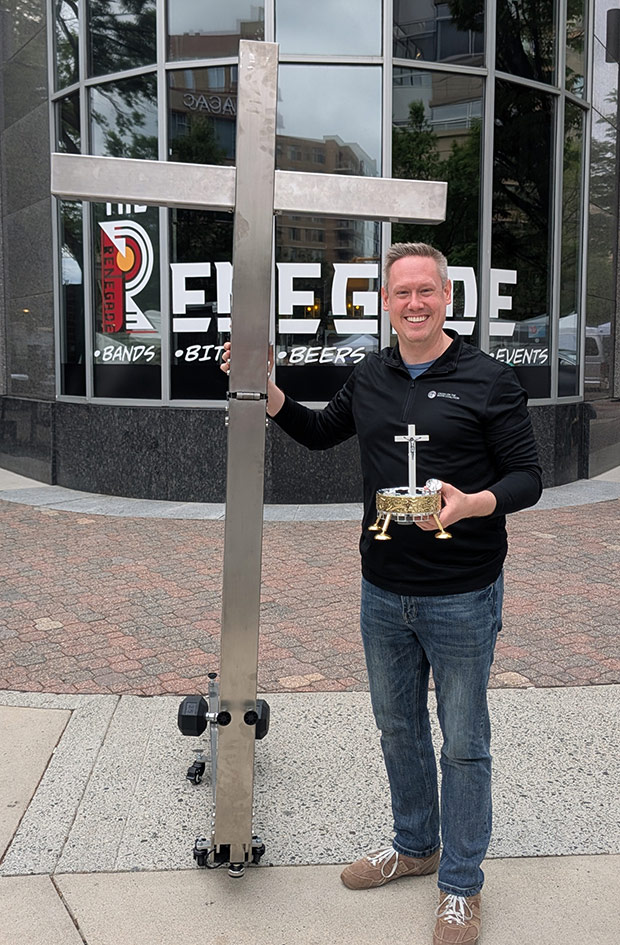
Justin Park holds a model of a cross he plans to send to the moon. He stands next to a sample of the height on the real cross that would unfold once landed.
By Dan Russo
The Catholic Messenger
Beginning with the contributions of Mount Pleasant native Dr. James Van Allen, known as the “Father of Space Science,” Iowans have played a pivotal role in humanity’s quest to explore the cosmos. Building on this legacy, another University of Iowa graduate, Justin Park, is hoping to use rockets and other advanced technology to evangelize the world by putting a tangible symbol of Christ on the lunar surface.
The Catholic computer scientist and entrepreneur originally from Dubuque is founder of the Cross on the Moon Coalition. Park is aiming to achieve this goal by the end of the decade.
“It’s kind of a culmination of the skills that God’s given me, and the vision,” Park said. “Most people don’t think about space every day, but I do. … I read the Gospel as much as I can, but I also read a whole lot of space news … (I) think that we’re going to be living in space, within a generation or two, and we definitely want to get out in front of this and lead with our virtues and our values, and that really starts with Jesus Christ … Putting a cross on the moon kind of sanctifies the lunar surface, and it’s our best foot forward … and hopefully we’ll create a culture based on Biblical teachings.”


Park studied computers at the University of Northern Iowa and in Iowa City, before going to the International Space University to earn another degree in aerospace management. He did an internship at the National Aeronautics and Space Administration (NASA) Ames Research Center and later held a job at NASA headquarters in Washington, D.C. His resume also includes stints in the private sector. Park launched the non-profit coalition in 2024.
A Little Miracle
Park grew up with his parents and sisters in Dubuque.
“(We) went to church pretty much every Sunday growing up until my mom passed away,” Park recalled. “She got cancer when I was a teenager and unfortunately couldn’t beat it. Yeah, it was really tough for the family, really tough for me personally. We didn’t understand why she didn’t get better after we had prayed so much, so I lost touch with God.”
Park described himself as “almost anti-religious at one point. I didn’t go to church for many, many years, but thankfully, by God’s grace, (my mother) came to me in a dream as an angel and helped me reconcile with God, and that was a…major turning point in my life … And now … faith is basically the center of my life.”
Everywhere Park goes now, he carries a “little miracle” with him, which is a tiny model of the roughly eight-foot tall metal cross that the coalition is hoping to send into space by hitching a ride on a privately-owned rocket.
“(The cross) sits on top of a lunar lander, and yeah, it’s got a little high-gain antenna on top,” explained Park. “There’s also a drill … It augers into the lunar (surface) because we also don’t want to get knocked over later on … (We’ll) have a video stream of the earth, and in front of it will be Jesus Christ.”
Telescopes of St. Ambrose
The Catholic connection to space exploration is not new in Iowa. Msgr. Sebastian Menke served as president of St. Ambrose College in Davenport from 1964-1973. Before that, the priest was the first astronomy professor at the institution. Father Menke was instrumental in establishing a space observatory on campus in Davenport. To this day, St. Ambrose offers a basic astronomy course to students.
“Its purpose is to teach critical thinking skills,” said Robert Mitchell, professor of astronomy and advanced physics.

In the 1990s, the university built a new observatory in Dixon, Iowa, which is named in honor of Msgr. Menke. The facility on the site of the Wapsi River Center is managed in cooperation with Quad Cities Astronomical Society. Mitchell believes projects like Park’s can have value because “the more interest we can foster in astronomy and space exploration, the better.” However, he says, there are many hurdles.
“One of the main obstacles is the cost,” said the professor.
Park addressed this, saying “lunar landing companies usually quote about $1.2 to $1.3 million per kilo, and that’s for a ride share.”
“We raised about a quarter of a million, so we’ve got a ways to go,” said Park. “The idea is really to find a big space advocate who hasn’t found the Lord yet. Ideally, we would want to convert someone like Elon Musk. The world would just be a whole lot better if we could, evangelize Musk and then make him into an evangelist …” Park has seen support from both Catholics and Protestants. “The cross itself has two sides. One side will have the corpus, and the other side will not, and hopefully that will make everybody happy,” he said.
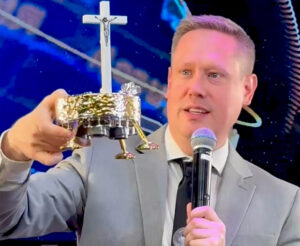
Justin Park holds a model of a cross he plans to send to the moon.
Space Catholicism
Astronaut Buzz Aldrin, a Presbyterian, was the first Christian to take bread and wine to the moon. He gave himself Communion in the lunar module hours before Neil Armstrong exited to take the first steps on the surface. Three Catholic astronauts received the Eucharist on the Space Shuttle Endeavor in 1994. Park hopes to add a very interesting chapter to this Catholic history.
“God has a reason for everything, you know, and I think the reason my mom died is because now she can help from the afterlife,” he said. “Bad things happen to good people, and good things happen to bad people. We don’t understand why that is, but God does have a plan, and it’s important that we live out that plan the best we can. And if you try and walk in the straight and narrow path, you’ll just feel better about yourself, and you’ll know that you’re doing what God put you there on earth to do.”
For more information, visit crosscoalition.org.
