




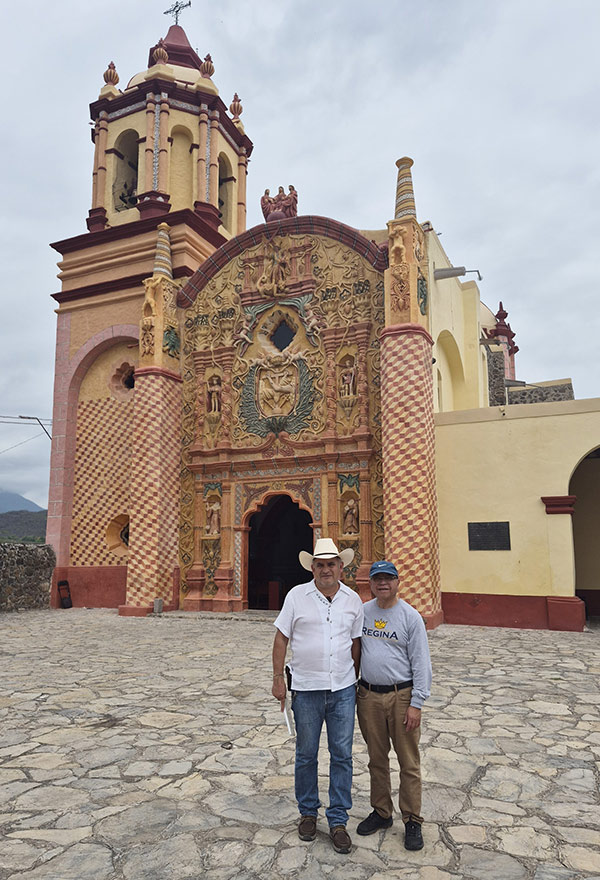
Father Rudolph Juarez. right, poses with his guide in front of The Mision de San Miguel Conca Church, which is dedicated to St. Michael the Archangel. The mission, founded by St. Junipero Serra and his Franciscan brothers, was completed in the 1750s in the state of Querétaro in the central region of Mexico.
By Dan Russo
The Catholic Messenger
DAVENPORT — As Father Rudolph Juarez drove through the Sierra Gorda in an air conditioned Volkswagen SUV recently, he thought of the sweat-soaked journeys of Father Junipero Serra and his fellow friars, who had made their way step by step through this rugged part of Central Mexico centuries before.
“He walked with his brother Franciscans wherever they went,” said the pastor of St. Anthony Parish in Davenport. “He took his vow of poverty seriously. They had no horses. The horse was the equivalent of a $50,000 car today.”
Father Juarez has visited Mexico regularly for many years. He often does pastoral work with Sacred Heart sisters in the Archdiocese of Morelia. This trip, however, was different. During a 10-day pilgrimage last month that began on Easter Monday, the Quad Cities native followed the path of one of the most famous evangelists in the history of the continent. Father Juarez visited each of the five missions St. Serra founded in Mexico.


“I had wanted to do this for a few years,” said Father Juarez. “To be able to accomplish so much. What a huge impact (the Franciscan missionaries) had on history and some of them in such a short amount of time.”
After building a series of churches and living complexes in the 1750s meant for ministry to the indigenous people, the Spanish-born priest canonized in 2015 then headed north to present-day California where he started 21 additional missions. Sierra Gorda means “Fat Mountains” in English. The Pame tribe, many of whom converted to Christianity, worked with the Franciscans to build the communities. The architecture of the five mission churches is stunningly unique because the buildings combine artistic influences from European, indiginous and even Arabic culture. They still serve as active Catholic parishes.
“Through (the Pame people’s) labor and the service of the missionaries, they built these beautiful churches that would house them and future generations,” said Father Juarez, whose grandparents and father immigrated to the United States from the country. “Everywhere you go in Mexico there’s a reminder of the Catholic faith … At the same time … some (Mexicans) are still unchurched.”
After getting off a ship in Vera Cruz, Father Serra walked over 250 miles to Mexico City. On the way, an insect bite became infected, giving him a limp, which he would have for the rest of his life. His legacy and that of other Spanish Catholic missionaries is complicated by the actions of the Spanish government which ruled “New Spain” for 300 years from 1521-1821. Spanish authorities at times engaged in violence and exploited indigenous peoples. In 2020 and 2021, critics of St. Serra in the U.S. began defacing statues depicting him, including one on the California capitol’s grounds. The California legislature passed Assembly Bill 338, which authorized the statue’s removal, accused the missionary of “enslavement of both adults and children, mutilation, genocide, and assault on women.”
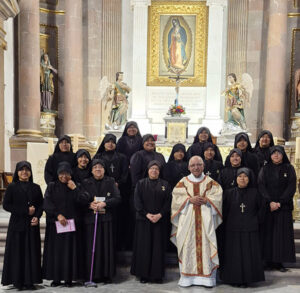
Father Rudolph Juarez poses in the sanctuary of Santiago de Queretaro with Guadalupe missionaries with Sisters of St. John the Baptist during his trip to Mexico in April 2026.
Historical records show that the saint did not commit atrocities or passively accept injustice. Documents provide evidence that he defended indigenous people. In 1773, he drafted the “Representacion,” a 32-point legal brief and traveled 2,000 miles to Mexico City to present it to the Spanish Viceroy. The proposal included provisions to protect natives in California from abuse by soldiers and to secure their legal rights.
“The reality is we judge by our current standards something that was historical,” said Father Juarez. “During the colonial period, there were debates in Spain over this new indigenous people. If these people are human beings and possess a soul, they are worthy of baptism and the new status as Christians. There was a heart involved there and a desire for the salvation of souls.”
Father Juarez was able to celebrate Mass at the Santiago de Jalpan Mission where there is a statue of Junipero Serra, the “patron of the permanent mission of the Diocese of Querétaro.”
“What I learned was the timelessness of faith and evangelization. To me, we’re all in the state of permanent mission work,” said Father Juarez.
Father Juarez continues to do outreach to immigrants from Mexico and other countries. The 2025 death of Father Guillermo Treviño, one of the diocese’s other Spanish speaking priests, had an impact on this ministry.
“Now that Father Guillermo’s gone, I have to do more. When someone’s missing, someone else has to take on responsibility and see it through.”
Father Juarez alluded to (1 Peter 3:15) when explaining his continued commitment to missionary work.
“We are able to give a reason for hope,” he said. “The reason for my hope is the continued newness of the call to faith and holiness. The work we do is God’s work.”
