




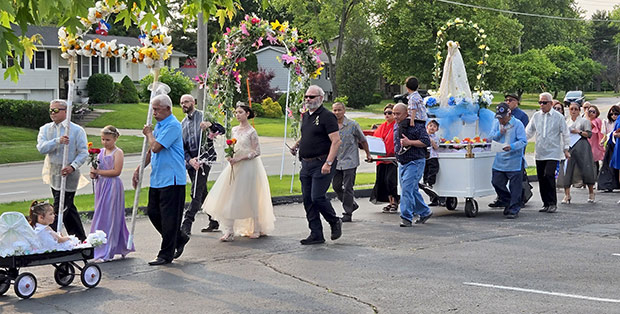
Members of the Filipino-American Association of the Quad Cities process in the parking lot of St. John Vianney Parish-Bettendorf during the celebration of Santacruzan in this May 2025 photo.
By Lindsay Steele
The Catholic Messenger
(This is the second part of a series on Catholics originally from Asia who have settled in the Diocese of Davenport. May is Asian American and Pacific Islander Heritage Month.)
Sister JonFe de Torres, OCD, credits the sometimes harsh realities of rural life in the Philippines with cultivating her strong sense of faith. “Our house was a nepa hut made of bamboo and bundled grass. I remember the typhoons that would come to us with 70-90 mph wind. I feel like you cannot not have faith when you keep experiencing that.”
Sister de Torres moved to the United States 20 years ago, as a young woman, to join the Carmelite community in Eldridge. She is among 11,000 Filipino immigrants who call Iowa home, according to U.S. Census Bureau data. Migrants from the Southeast Asian island cluster — in which nearly 80% of residents identify as Catholic — often bring with them a strong sense of faith, family and cultural traditions.


Unity and shared responsibility
Chris Kellner, a member of St. John Vianney Parish in Bettendorf, first became acquainted with the Filipino community 30 years ago when he met his Filipino-American wife, Perla. His awareness and understanding of the culture — both in the Philippines and in the Quad Cities, grew along with his involvement in philanthropic work and the Filipino-American Association of the Quad Cities (Fil-Am). “What I find most inspiring about the Filipino community is its deep-rooted sense of unity and shared responsibility,” said Kellner, who now serves as Fil-Am’s president. “There is a consistent emphasis on ‘bayanihan,’ the spirit of collective support which is reflected in how individuals come together to uplift one another, whether in times of celebration or hardship.”
Equally compelling, he believes, is the community’s strong connection to cultural heritage. “Traditions, values and faith are not only preserved but actively practiced and passed down across generations, creating a lasting sense of identity and continuity. This cultural pride is often expressed through family-centered living, respect for elders, and a genuine commitment to service.”
Filipino-American Catholics in the Quad Cities come together for two major celebrations each year. Santacruzan, which commemorates the finding of the Holy Cross and the pilgrimage led by Queen Helena of Constantinople, will take place May 31 at St. John Vianney Parish. The event includes a procession, Mass and a reception. In December, the community will celebrate Simbang Gabi, a Filipino tradition that celebrates the nine days leading up to Christmas.
Kellner said taking part in these types of celebrations is a great way for friends to show support. “Cultural awareness builds trust within the community,” he said.
A ‘rice’ gesture
Sister de Torres had a basic understanding of English from school and from working at an international company, and was familiar with the rhythms and prayers of community life. Still, moving to the United States was a major change. “It was my first time out of the country,” she said.
Sister de Torres felt like an observer of American life at first, but the sisters quickly welcomed her into the fold. “They made it easy for me to adjust. On the second day, they were at Kohl’s buying a rice cooker! I thought that was sweet.” She enjoyed cooking Filipino dishes for her sisters, and was open to trying their favorite foods, as well. “I love steak,” she discovered.
The new sister felt comfortable asking questions when she didn’t understand something. “I’m not shy, and I think that helped,” she said. The sisters were “patient in explaining.”
The rural setting of her new home provided a sense of familiarity. “I love the land here in the Midwest,” Sister de Torres said. Gardening has been a treasured pastime at both the Eldridge home and the sisters’ new residence, The Canticle in Clinton, home of the Sisters of St. Francis. Growing produce “has consoled me when I’m homesick or missing someone.”
The faith Sister de Torres embraced as a Filipino youth continues to bear fruit. “I think our faith is not just from the head, it’s from experiencing hard life.”
A devotion to Mary
Meliza Wise, a member of St. Thomas More Parish in Coralville, grew up in the Philippines and later moved to the Solomon Islands with her family. It was there that she met her husband, Bill, a Peace Corps volunteer from the United States. They married and settled in the U.S. in 1994. Being part of a religious minority in the United States was a big change. “Growing up, I thought everyone was Catholic,” she said.
Filipinos have a strong devotion to Mary, Wise said. She and another Filipino-American parishioner, Luigi Enriquez, honor their culture with a Flores de Mayo (Flowers of May) offering to Mary. This time of thanksgiving offers gratitude to Mary for blooming flowers and growing crops. Earlier this month, parishioners placed flowers around a bust of Mary in the sanctuary to commemorate the observance. Wise also expresses her appreciation for Mary by leading local rosary initiatives.
She is grateful for her heritage and how it has shaped her into the person she is today. “My Filipino Catholic upbringing kept me grounded in faith, always respectful to elders, and (fostered my) love and joy in celebrating family and community.”
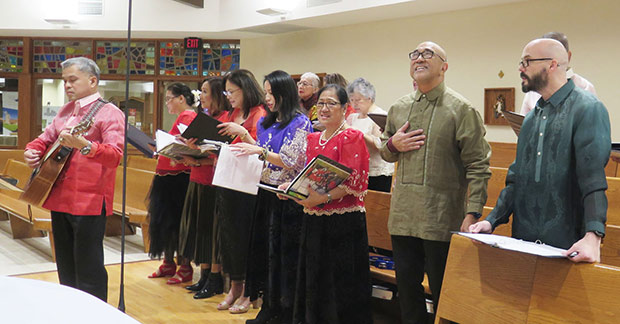
Members of the Filipino-American Association of the Quad Cities sing and play instruments during the Simbang Gabi Mass in this file photo at St. John Vianney Church in Bettendorf.
Heritage helps priest relate to other immigrant groups
Many Filipino immigrants come to Iowa to study or work in skilled fields like medicine, observes Father Joseph Sia, pastor of St. Joseph Parish in Ottumwa and St. Mary Magdalen Parish in Bloomfield. Father Sia came to Iowa from the Philippines in the early 2000s to study genetics at the University of Iowa in Iowa City, and left the PhD program after one year to pursue a calling to priesthood in the Diocese of Davenport. “I felt very welcome,” he said.
He also discerned a calling to Hispanic ministry. He was familiar with the Spanish language due to his mother’s Spanish heritage, though he needed to take classes to master the language. “I didn’t speak it, but I could understand it. … I thought I might as well learn it formally.”
He discovered close cultural connections between Filipino and Hispanic culture. “There is the communal aspect of the culture, and strong family values… a sense of extended family. I think I bring (that understanding) into my ministry.” They share similar Catholic roots, as well; Spanish colonizers and missionaries spread Catholicism through the Philippines, South America and Central America during the Spanish Colonial Period, which lasted from 1520-1898, according to the U.S. Library of Congress’ website.
Though there aren’t as many Filipino immigrants as Hispanic immigrants in the Ottumwa area, Father Sia celebrates Simbang Gabi at his parish each year for the Filipino-American Catholics in the region. “There are some Filipinos in the parish. There’s also a big group that comes from other places like Albia, Fairfield, Des Moines and Cedar Rapids (Iowa),” he said.
Like other immigrant groups — even those with strong family bonds — parents worry about their children losing the faith and culture of their ancestors, Father Sia said. “Hopefully, by having cultural celebrations rooted in the Church, that will help them grow in their faith” and connect to their heritage.
