


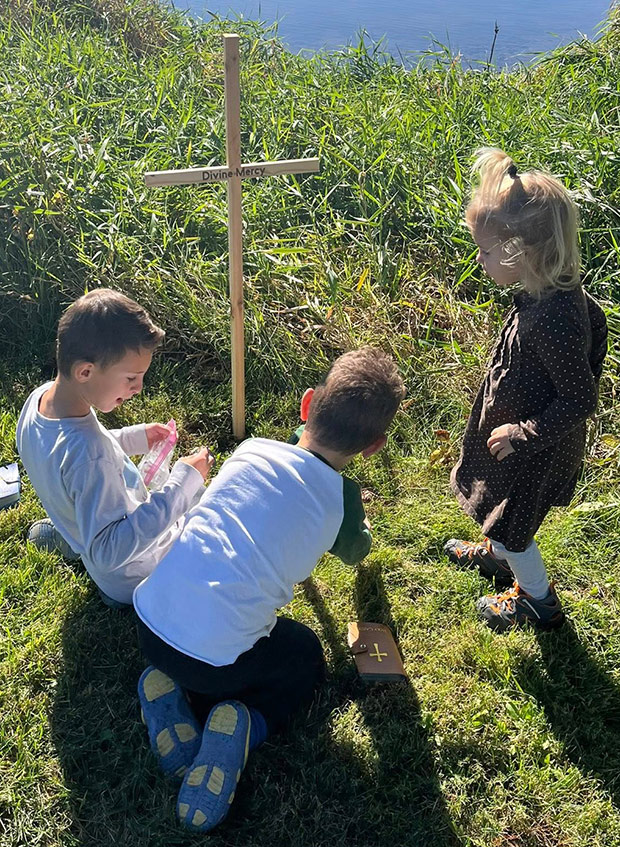
From left, Christopher, Benjamin and Katherine Hannum discover the “treasures” of Divine Mercy during a multi-parish geocaching activity in Lee County last month.
By Lindsay Steele
The Catholic Messenger
WEST POINT — Children, parents, grandparents, aunts and uncles traveled around southeast Iowa last month searching for treasures of the faith.
Families referenced a map of 10 coordinates linked to their phones or other electronic devices through the global positioning system (GPS) in an activity known as geocaching. At each location, they discovered a handmade wooden cross with the name of a saint written on the crossbeam. A mason jar at the base of each cross contained keychains and prayer cards specific to that saint. Treasure hunters took one of each before heading to the next destination.
The four parish cluster of St. John the Baptist-Houghton, St. James the Less-St. Paul, St. Mary-West Point and St. Boniface-Farmington planned the geocaching event as a way for families to have fun while learning about the faith together, said Liz Linnenbrink, a lay leader and wife of Deacon Mike Linnenbrink, who serves the parishes.


The activity is part of the cluster’s commitment to the National Community of Catechetical Leaders (NCCL)’s Parents and Families at the Center of Faith Formation Project. Nine diocesan entities are participating in the five-year, grant-funded program aimed at addressing a nationwide decline in Catholic participation. The Lee County cluster is working with NCCL representatives to develop unique strategies to encourage, equip, engage, involve and connect parents with the Catholic faith, their children and the parish community.
The cluster’s NCCL team, composed of lay leaders and clergy from the parishes, developed the family geocaching activity during a brainstorming session earlier this year. “Geocaching has been around for a while, and about 10-15 years ago, it was very popular,” Linnenbrink said. As the group discussed possible activities for All Saints Day and All Souls Day, “We were talking about what treasures the saints are for Catholics, and that led to geocaching.”
Families received “blessed bags” the last weekend of October with the treasure map and a variety of other items intended to help families learn about the Catholic faith together, including prayer cards, a candle, and directions for building an ofrenda (altar to remember deceased loved ones).
Families who found all 10 locations by the end of November were eligible to win a prize. The cluster encouraged families to take selfies of themselves during their geocaching adventures and upload them to parish Facebook pages. Treasure hunters could find all locations in one day or on multiple trips, said Father Dan Dorau, pastor of the four parishes.
Jacqueline Shinn and her children participated in geocaching over the course of a few weekends. “The first Sunday it was my family and a niece, and then the second Sunday my mom came along, as she was excited about it, too.”
The activity sparked conversation about the saints and how we can ask them to intercede on our behalf, she said. “The holy card, coupled with the keychain and Bible verse sticker (at each coordinate) helped to bring the saints into the daily lives of the kids, not just something referenced at church or when we lose things. They also prompted the (older) kids to ask about confirmation saints, why we chose who we did and then what our saints were known for. We even went into depth about how a person becomes a saint.” Shinn is hopeful that geocaching can become an annual activity in the cluster as a way for parishioners to continue learning about the saints.
Angela Hannum and her three children went geocaching over the course of several days. “They were so excited about their ‘treasure hunt,’ It was difficult to talk them into not doing all 10 searches in one day,” said Hannum, a member of St. Mary Parish in West Point. “They learned what it means to be a saint and how they have the opportunity to be one themselves. We also learned about different areas of our community that we hadn’t seen before. There were opportunities to teach the kids about cemeteries, veteran memorials, and even meet some fellow parishioners we hadn’t before.”
The cemetery stops, in particular, sparked the children’s curiosity. “It’s always eye opening when they ask questions that I may not know the answers to and we learn together,” Hannum said.