



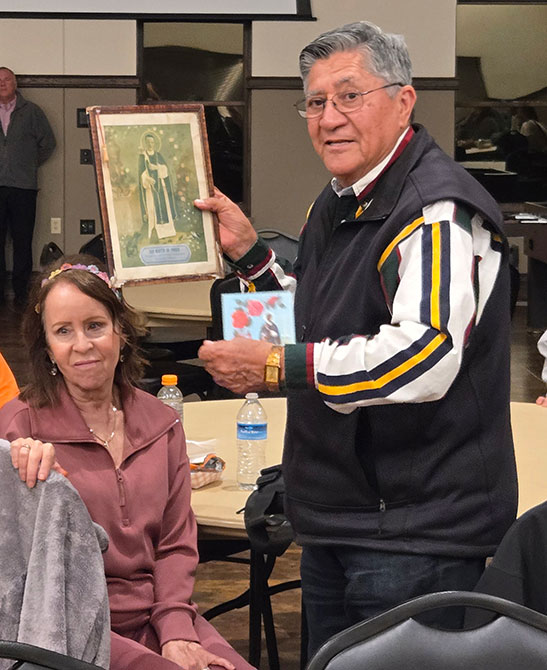
Leo Espinoza shows a portrait of St. Martin de Porres following a movie on the saint Oct. 27 at Sacred Heart Cathedral. Espinoza is a native of Peru.
By Anne Marie Amacher
The Catholic Messenger
DAVENPORT — Despite being an illegitimate child and of mixed race, St. Martin de Porres never let critics stop his passion to care for all people — regardless of race, wealth and more.
The St. Martin de Porres Society at Sacred Heart Cathedral, along with the Notre Dame Club of the Quad Cities, offered a viewing of the movie, “St. Martin de Porres” Oct. 27 in the great hall at Sacred Heart Cathedral.
Kelly Bush, president of the Notre Dame Club, said movies on racial unity have been shown for a few years — more recently teaming up with the cathedral’s society. Last year the two groups presented the documentary “Tolton Speaks: The life and letters of Father Augustus Tolton” by Stella Maris Films. It highlighted the life of the first African-American priest to serve in the United States.


Thomas Mason IV, president of the St. Martin de Porres Society, noted that St. Martin was the first Black saint from the Americas. “He knew exclusion. He looked for the underserved and expected nothing in return,” Mason said.
St. Martin de Porres was born Dec. 9, 1579, in Lima, Peru, the illegitimate son of a Spanish nobleman and a freed slave from Panama of African or Native American descent.
Growing up, he learned the trades of being a barber and healing using medicinals.
According to Mason, Martin sought admission to the Dominican Convent of the Rosary at age 15. Accepted as a volunteer, he did the cooking, cleaning and laundry in return for being allowed to live with the community. He was prevented from entering the order because Blacks were excluded from being accepted into religious orders. At age 24, he was granted the ability to profess vows as a member of the Third Order of St. Dominic — despite opposition because of his illegitimacy and race.
“By rejecting privilege and choosing service, Martin embodied the selfless banquet Jesus describes: a table open to all, where the reward is not worldly praise but the joy of God’s kingdom,” Mason said. “As Pope John XXIII said, ‘Martin’s charity never ceased.’ The saint reminds us that true discipleship is measured not by what we gain, but by whom we serve, trusting that our reward lies in the resurrection of the just.”
The movie primarily focuses on a Vatican official visiting Lima, Peru, where Martin de Porres was born, served and is buried. Martin de Porres died Nov. 3, 1639. The reason for the visit was to work on the process to gain the next step to sainthood. At the time, this was beatification.
Throughout the movie, various Dominican friars share their stories of Martin. They recount a variety of supernatural incidents, including cures he performed, visions he had and his ability to communicate with animals.
Flashback scenes are spread throughout to emphasize the stories being told. One shows Martin on his deathbed. He wanted “extreme unction” and the commendation of the dying as he faced death. He wanted to be aware when the “last rites” were offered. After his death, the bells were rung to announce that Martin had died. Crows flowed through the city for days. One friar said, “The people hailed him as a saint.”
The movie implies that 30 witnesses were called over two weeks to give testimony. Many more testimonies were given over the decades.
One witness was Juan Vasquez Parra, an orphan helped by Martin. Juan testified how Martin took care of him after the death of his family. Martin told Juan to follow him. “You will repay God by being a good Christian.” Juan accompanied and helped Martin over the years. He witnessed miracles.
One miracle, in 1637, involved Martin healing a man whose legs were said to be broken. “Never lose faith,” Martin told the woman who was with the man. “God heals.” The story goes on to say the man was able to walk and even run.
In another flashback, Martin’s dad visits his son. His dad noted to Martin that he is the son of a Spaniard and is a nobleman. He supported his son’s wishes to be in the Dominicans and hoped his son would take vows in the future. Although his dad abandoned him and his mother and sister, he did accept Martin later in life.
Despite all the positive testimony, there was negativity because of Martin’s race and illegitimacy.
The Vatican official from Rome confirmed through his visit that Martin de Porres was worthy of beatification.
The film later goes forward to 1863, in Rome, where Church officials had collected more than 100 miracles from around the world that were submitted for the beatification process for Martin de Porres. When the pope asked if there were two worthy for sainthood, the Vatican official said all were worthy.
On Oct. 29, 1837, Pope Gregory XVI beatified Martin de Porres. He was then canonized by Pope John XXIII on May 6, 1962.
St. Martin de Porres is the patron saint of mixed-race people, barbers, innkeepers, public health workers, social justice, racial harmony, the poor, Peru and animals.
The movie Martin de Porres is available through EWTN’s OnDemand or for free on the EWTN app.