




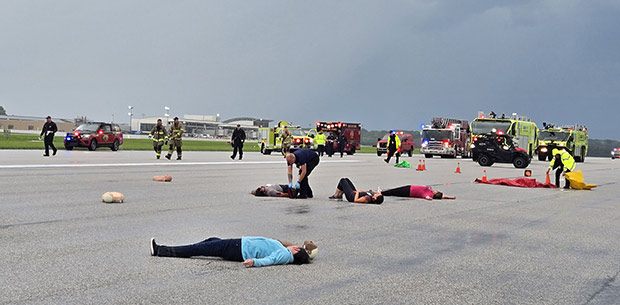
Volunteers portray “victims” during a mass casualty disaster drill at the Quad Cities International Airport in Moline, Ill., Aug. 12. First responders assess the victims.
By Anne Marie Amacher
The Catholic Messenger
The motto for both Girl Scouts and Scouting America is “be prepared.” How prepared are we for minor to major events in our homes to communities?
On Aug. 12 I was one of about 50 “victims” in a mass casualty drill at the Quad Cities International Airport in Moline, Illinois. The airport conducts a drill every three years as required by the Federal Aviation Administration (FAA).
Arriving at 7 a.m. I raced to beat the incoming thunderstorm. Safely in the building on airport property away from the terminals, I joined the other victims, airport staff and community partners.


As rain poured outside, thunder rolled and lightning flashed, we began the two hour prep for our drill.
Victims were given a lanyard with what type of injury we had, heart rate, pulse and if we were alert or not. Each of us went to the makeup station to make this a truly realistic drill. I was a victim who would be alert and have bruises.
When it was time, we boarded MetroLink buses and vans and headed out to the tarmac. First responders were already at various gates outside the property with lights flashing, awaiting the crash. We got to the end of one of the runways and exited. There is where what was about to happen truly sunk in for me. CPR dummies (adult and infant) were strewn all over the runway. They would be the dead. We spread out and the rains poured down.
After two real airplanes took off from a different runway, the fire simulation at the airport’s fire pit brought the heavy duty firetruck out to extinguish the flames. It was all done from a water cannon on the apparatus. Next, the first responders arrived at our location. There they told volunteers that if we could walk, we should go to a certain section. Separating those who can walk from those who can’t walk makes it easier for assessments for the more severely injured to get done first.
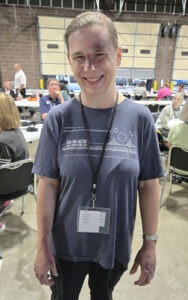
Anne Marie Amacher shows her makeup-applied bruising for a mass casualty disaster drill held at the Quad Cities International Airport in Moline, Ill., Aug. 12.
As level 3 injuries (minor), our group was moved to the green tarp. Level 2 injuries were moderate and wore yellow tags after evaluation. Level 1 was red for major injuries. Two people in our group received the black “dead” tag.
Ambulances from throughout the Quad-Cities began to roll in from their staging area. As they arrived the airport staff directed crews where to go. Emergency personnel participating in the simulation didn’t use full stretchers to transport victims. Instead, volunteers were walked to where they needed to be. Level 1 went first, followed by level 2 patients.
Vehicles transporting the injured were sent primarily to Rock Island, Moline and Silvis, Illinois, and Davenport, Bettendorf and Muscatine, Iowa, hospitals. Other ambulances not associated with specific hospitals were sent to varying locations, some of which were further away.
After another sweep through level 3 victims, a few were upgraded to level 2 and sent out. The rest of us were instructed to get on a MetroLink bus. We turned to get back on the bus we arrived on. “That’s the plane. Your bus is coming,” an airport official told us.
We boarded the “emergency response” bus and had an escort to get off airport grounds.
The bus took us to UnityPoint Trinity’s Moline campus, which is not far from the airport. Since it does not do trauma level care, more minor injuries went there.
Once at the hospital we walked to the ambulance bay that was converted into a triage center. Hospital personnel asked us our names, what our issues were, and whether we had lost consciousness. A few people were upgraded to level 2 and ushered into the emergency room via wheelchair.
Those of us mainly with cuts, abrasions and bruising took our hospital binders and were escorted to a waiting room away from the ER, but still out of sight of anyone visiting the hospital. Hospital workers brought us warm blankets.
Buses picked up all victims from the area hospitals and drove all of us back to our starting point and provided a warm lunch.
Watching the news on television later that evening I was excited to watch if I made it onto the media coverage. I didn’t see myself.
The airport’s chief said in the interview that there were some communications interrupted, potentially from the storm, but the problem was resolved.
This is exactly why drills are needed and having them during a storm doesn’t hurt. We learn from practice and feedback. If something goes wrong, we are better prepared with an alternative way to respond.
A long hot shower and using three different facial cleaners to get off my makeup felt so good. I hope to participate in this three years from now, despite being soaked and cold.
