




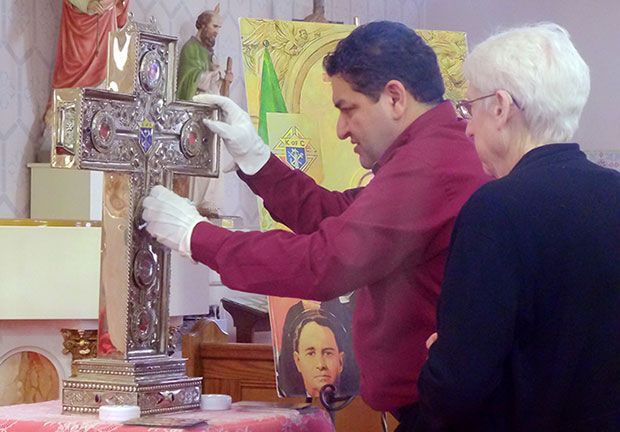
Manny Toquinto, a member of Knights of Columbus Council 14131, touches an item to a reliquary containing first class relics of six Mexican saints as Nancy Gusse of St. Anthony Parish in Davenport observes. The Mexican Martyrs national relics tour went through Iowa, stopping at St. Anthony Parish June 23.
By Dan Russo
The Catholic Messenger
When the relics of six priests martyred in Mexico recently stopped at several parishes in the Davenport Diocese as part of a national tour, Pona Magana, a Knight of Columbus from Our Lady of Guadalupe Parish in Ontario, California, aided local Knights as they hosted events that gave people a chance to connect with their faith by venerating the physical remains of the saints.
“I’ve been to almost all 50 states,” said Magana. “In every state it’s a different experience. One day we took (the relics) to a hospital and we took (the reliquary) to sick people. We had a man who had cancer. He pulled out a rosary and touched it (to the relics). I was in Nevada where I met a 90-year-old woman. She brought prayer cards to touch to the relics and was asking for vocations and praying for the men of her family and parish. The faith (they) had, we need to have.”
After stops in Nebraska, the tour went to six parishes in western Iowa before coming to St. Patrick-Iowa City, St. Joseph-West Liberty and St. Anthony-Davenport June 21-23. The tour then continued in New Jersey.


At St. Joseph Parish, Father Denny Martin, a retired priest who has been serving the communities in Columbus Junction and West Liberty, celebrated Mass as part of the event, which also included a procession and a talk by Magana.
“It’s not really often you get to host relics like that at your parish,” said Aaron Campbell, Grand Knight of Council 12994 at St. Joseph Parish. We were one of a handful of parishes in Iowa that got to host. It’s really an opportunity.”
Aside from the spiritual benefits, the Knights Council in West Liberty had a chance to reach out to the Spanish speaking Catholics in the area as part of a roundtable they are having to hopefully increase membership. The martyrs’ relics last toured the United States more than 10 years ago, according to Campbell.
The relics are from St. Luis Batis Sáinz, St. Rodrigo Aguilar Alemán, St. Miguel de la Mora de la Mora, St. Pedro de Jesús Maldonado Lucero, St. José María Robles Hurtado, and St. Mateo Correa Magallanes. The six priests were recognized among the Mexican martyrs canonized by St. John Paul II in 2000. Their steadfast example continues to inspire the Church as a testimony of courage, fidelity to Christ, and steadfast defense of religious liberty in the face of persecution. Organizers hope the program will help bring English and Spanish-speaking communities closer together as they celebrate the diversity of the Church, our unity in Christ, and the defense of religious liberty for which these martyred priests were executed.
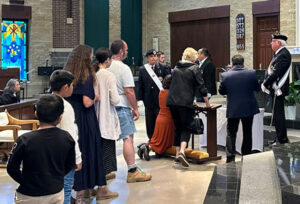
Catholics venerate relics of Mexican martyrs at St. Patrick Church in Iowa City.
Manny Toquinto, a member of Council 14131 at St. Anthony Parish in Davenport, joined Magana in greeting people in line during the veneration times June 23, speaking in both English and Spanish.
“We are blessed to have the relics here,” said Toquinto, who helped organize the events. “These priests were knights. For a knight, it means a lot to have the relics in your local parish.”
Magana and Toquinto, wearing white gloves, carefully took items from the faithful and touched them to the reliquary. According to Catholic teaching, relics are sacred objects and when a first class relic (usually part of a saint’s body) is touched by another item, that second object becomes a third class relic.
John and Joan Garrity of St. Thomas More Parish in Coralville were among those who took time after a Mass in Davenport to venerate the relics.
“It’s inspirational to know the history of the martyrs that stood up,” said Joan Garrity.
At St. Patrick Parish in Iowa City, people had time to spend with the relics before both an English and a Spanish language Mass on Father’s Day.
“Parishioners were excited to venerate and be in the presence of the relics of these holy and courageous priests and fellow brother knights who gave their lives defending the Catholic faith,” said Anthony DeLeon, a district deputy for the knights who attended. “Through their devotion to God and faithful adherence to his teachings, they exemplified God’s love in the ultimate sacrifice. Their witness is a profound inspiration to us all. Parishioners who were not previously familiar with these beloved saints, which hold a special place in the hearts of many Hispanic and Mexican Catholics, experienced a renewed sense of devotion and powerful moments of grace during their visit. Several families shared how they had grown up hearing stories of the ‘Cristeros’ from their grandmothers and great-grandmothers. For them, being blessed by the presence of these relics and having them so close, in their own parish, was a deeply moving and meaningful experience.”
During Magana’s talks at the parishes, he spoke about the history of the war between the “Cristeros” and a Mexican government that was anti-Catholic. Some Mexicans, like the martyr-priests, resisted peacefully, while others took up arms. Magana, a native of Guadalajara, Mexico, who immigrated to the United States at age 12, remembers stories of the war told by his older relatives.
He said persecution of Catholics started around 1910 when the government began trying to take the properties of the Church. Eventually celebrating Mass became illegal. Between 1926-1929, thousands of soldiers and civilians died in the fighting that took place. Many fled to the United States, while others stayed in Mexico.
“(Being with the relics) takes me back to those days,” said Magana. “They (the Cristeros) were regular men, women and kids. They lived their lives with faith in their hearts.”
Magana was open about his own journey of faith. He was raised Catholic, but became angry at God after losing his mother at age 14, he said. A serious accident later in life brought him back to the Church. Since then, he has endeavored to spread the Gospel. Magana said having a physical reminder of the Mexican martyrs has the power to inspire Catholics “to be brave and dedicated to the faith.”
