




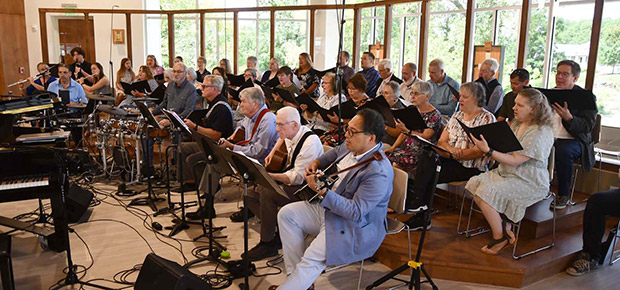
Vocalists and instrumentalists lead music worship during Mass at St. Thomas More Parish in Coralville last year.
By Lindsay Steele
The Catholic Messenger
(This article is part of a series.)
St. Thomas More Parish-Coralville’s music ministry includes vocalists, a full rhythm section and a variety of instruments. “The makeup of our music ministry are middle school/high school students, working professionals, young and old, retirees, religious, and people from all backgrounds,” said Luigi Enriquez, coordinator of music ministry. “Our ministry is to help celebrate God through our artistry and musicianship.”
During Lent, the ensemble retains its richness, but “the treatment of the music” changes, Enriquez said. “For me, it is about finding the right words and Scriptures and arrangements that add to our Mass rather than take away,” he said.



Music, and the liturgy as a whole, play a vital role in helping the faithful get into the Lenten mindset. “The ‘tone’ of the liturgy is more somber and reflective,” said Deacon Frank Agnoli, the Davenport Diocese’s director of Liturgy.
There are differences in what the faithful hear — and don’t hear — during Lent. “The experience of Mass tends to get more simplified,” said Colleen Darland, director of music and liturgy at Sacred Heart Cathedral in Davenport. The liturgy “speaks more to a need for penance, for Christ’s redeeming action.”

One major change, as prescribed by The General Instruction of the Roman Missal (GIRM), is the absence of musical interludes and postludes. Musicians create space for silence and reflection by playing only when the congregation is singing. “Where I might (usually) extend an instrumental,” such as when the priest is washing his hands, “I would end the hymn immediately and let the community sit in silence to reflect on the hymn they just sang or the action on the altar,” Darland said. The exception to this rule is on Laetare Sunday (the Fourth Sunday of Lent), as well as on feasts and solemnities.
This silence is even more challenging — and important — in today’s culture, Darland believes. “As soon as we wake up we reach for our phones. The news is noisy and messy.” These moments of silence offer opportunities “to reexamine things we need to work on and invite God into those things.”
Hymns should focus on the themes of Lent. “Save Your People” by Jim Farrell is among Darland’s favorites. “The refrain, being in a minor key, reminds me of the sorrow of Lent and the need for repentance, whereas the verses, which are in a more major key, remind me of the hope of the resurrection and eternal life in heaven. The text of the verses speak of our confidence that God will do what has been promised.”

The Ss. Joseph & Cabrini Parish choir sings during Mass March 8 at St. Joseph Catholic Church in East Pleasant Plain.
Music directors must avoid using hymns with the word “alleluia.” This omission “creates a sense of anticipation for when it is brought back at Easter,” Deacon Agnoli explained.
This celebratory word is also removed from the Gospel acclamation. As an expression of praise, parishes may instead sing or chant the verse before the Gospel, or choose another psalm or tract. Darland said most parishes in the Davenport Diocese use “Praise to you Lord Jesus Christ, King of endless glory” as the Lenten Gospel acclamation, though many options are available.

Additionally, parishes refrain from singing the “Gloria in excelsis” (“Glory to God in the highest”) during Lent. Historically, the Gloria was only used at papal Masses and especially festive occasions, according to Adolf Adam’s 1981 book, “The Liturgical Year: Its History and Its Meaning After the Reform of the Liturgy.” About 1,000 years ago, the Church began allowing priests to use it in Masses “of a festive character,” but never during Lent. Parishes may opt to sing or otherwise emphasize the “Kyrie, eleison” (“Lord, have mercy”) to draw attention to the penitential act.
“Musically, we tend to make things more connected and legato (in a smooth, flowing manner) rather than that sharpness of a ‘Gloria,’ per se, in Ordinary Time,” Enriquez said. “We also sing a little more a capella parts in Mass, and I switch the Mass (setting) to one that is more appropriate for Lenten services.”
The absence of these jubilant expressions of faith make them all the more meaningful when they return at Easter, Darland said. “The season of Lent is us without the Bridegroom, looking forward to the Triduum and Easter morning when he is risen, but also to his second coming, in God’s time.”
