




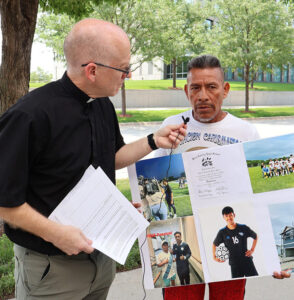
Deacon Kent Ferris, left, holds a microphone for Pedro Diego at a rally to “Bring Back Pascual and Free Noel Now” outside the Cedar Rapids, Iowa, Federal Building July 29, 2025.
By Barb Arland-Fye
For The Catholic Messenger
CLINTON — Two diocesan deacons served up eyewitness accounts of immigrants striving to follow immigration enforcement rules in and far outside eastern Iowa during a recent Peace Soup Lenten program in the Jesus Christ, Prince of Peace Parish Hall.
Deacon Kent Ferris, main speaker at the March 3 event sponsored by the parish’s Justice and Peace Commission, began with a six-minute video from the Fifth World Meeting of Popular Movements (Oct. 21-24, 2025). The late Father Guillermo Trevino, a diocesan pastor, was a delegate to the meeting, an initiative of the late Pope Francis to bring together grassroots organizations from five continents seeking to inspire the poor and organized peoples to become protagonists of change.
Father Trevino, who died shortly after returning home from the meeting in Rome, led two, largely Hispanic parishes in Columbus Junction and West Liberty, where Deacon Ferris assisted him. Father Trevino played an instrumental role in Escucha Mi Voz, a faith-based, immigrant-led advocacy group. He accompanied immigrants to their mandatory check-ins with the U.S. Immigration and Customs Enforcement (ICE) agency and advocated for immigrants to be treated with human dignity and due process rights. The Fifth World Meeting of Popular Movements paid tribute to Father Trevino, stating at the video’s end that the priest’s memory “remains alive in every struggle of the people for justice and peace.”


The deportation of one of his West Liberty parishioners, 20-year-old Pascual Pedro Pedro, an undocumented immigrant, drew national and international attention after ICE authorities detained the young construction worker after his annual check-in July 1, 2025. Authorities deported Pedro Pedro to his homeland of Guatemala, hours after a prayer service at the West Liberty parish at which Bishop Dennis Walsh presided and Father Trevino spoke.
Bishop Walsh and Deacon Ferris each accompanied immigrant families to their ICE check-in in Cedar Rapids the same day as the Peace Soup program on March 3. ICE officers required the bishop and deacon to remain outside while the immigrants they accompanied went inside the facility, Deacon Ferris said.
“I could not walk up to the building. I had to stop at a certain line where Homeland Security says you can’t cross unless you’re an attorney. And so I stand there and wait and I pray that they come back out … and they did,” Deacon Ferris said, getting choked up. “The folks that I drove to the check-in live four blocks from me. I didn’t know them before. Escucha Mi Voz told me that’s who my neighbor was …” He said he asked the family, in Spanish, if they would need to return in a year and “the mom said, yes. That’s the best you can hope for,” he continued, stressing the importance of being present to show immigrants that people care about them.
Deacon Ferris also supervises two immigration counselors as director of the Social Action Office for the Davenport Diocese. They focus on family reunification. Previously, the immigration counselors would receive updates on changes in immigration law and enforcement once or twice a year. Now the federal government’s enhanced enforcement means updates “can change daily, and that’s not an exaggeration,” Deacon Ferris said.
Five years ago, he and Deacon Andrew Hardigan of Prince of Peace Parish were among diocesan deacon candidates participating in a border immersion experience with then-Bishop Thomas Zinkula and Deacon Frank Agnoli to El Paso, Texas, and Ciudad Juarez, Mexico.
Deacon Hardigan returned to that area recently with a new group of deacon candidates where, among other experiences, the group accompanied immigrants to their deportation court hearings. He assumed that everyone would receive due process, but he said that was not the case. The judge “has very limited ability in what he can do.” The immigrants’ options: self-deport within 120 days, choose to be deported to Ecuador to apply for asylum or be deported to Uganda, according to the deacon.
Deacon Hardigan said he tried to imagine what it would be like to have such limited, devastating options. “One of these families had a 13-year-old son and all he’s ever known is the United States. You imagine picking up your life, going to a country that you don’t know.” The deacon said it was hard to look immigrants in the eye, in the light of options that made them feel anything but welcome in the U.S.
On a more positive note, Deacon Hardigan said he witnessed the care and compassion demonstrated by people such as Christina, a woman who was instrumental in opening a medical clinic in the Chancery in Ciudad Juarez that welcomed immigrants in need of medical care.
“People were coming in with broken ankles … cuts, infections … and God bless the doctors for volunteering their time, from El Paso, from Juarez, Doctors Without Borders,” Deacon Hardigan said. “There’s a lot of good things going on, and you see Christ at work.”
Deacon Ferris thanked the U.S. bishops, women religious of the Upper Mississippi River Valley, the Iowa Catholic Conference and other organizations and lay people for “standing in solidarity with and speaking on behalf of immigrant rights.”
He encouraged the Peace Soup participants to “pray, learn and act,” integral components of Catholic Social Teaching. “You’ve got to start in prayer. You’ve got to continually go back to it, and often it’s a prayer of lament. But there’s strength in that because, ultimately, at the end, you’re giving it back to God to help us and to give us the courage to ask, what is ours to do?”
