
Catholic convert shares story with students, talks about eucharistic miracles

Anne Marie Amacher
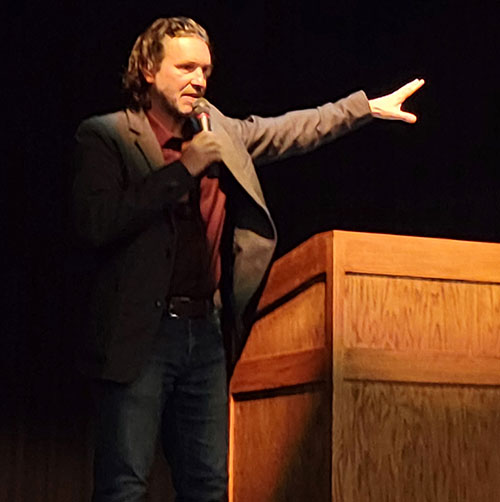
Guest speaker Keith Nester talks to students about eucharistic miracles at Assumption High School in Davenport on March 22.

By Anne Marie Amacher
The Catholic Messenger

DAVENPORT — Keith Nester, a former Protestant minister who converted to Catholicism, shared his story and his appreciation for eucharistic miracles with students at Assumption High School on March 22.

Greg Hansen, a member of Holy Family Parish in Davenport, introduced Nester, with whom he has developed a friendship through Nester’s journey to the Catholic Church. Nester told the teenagers, “I grew up going to church. My dad was a pastor. We thought Catholics were pretty whacky. We didn’t agree with things they did.”

He said many mainline Protestants view the Eucharist as a symbol of Jesus. Some believe in a “spiritual presence,” sensing that something happens in the Eucharist. Catholics “believe in the real presence,” transubstantiation. “It’s a hard thing to explain,” Nester said. While the consecrated Eucharist still looks like bread and wine, it is the body and blood of Christ, which is a difficult concept to grasp, he added.

Following the story of his conversion, he talked about eucharistic miracles and showed a video on a eucharistic miracle in Buenos Aires, Argentina in 1996. After Mass on Aug. 18 that year, a host was found discarded in the church. The pastor placed the host in a receptacle with water to follow proper protocol for disposal. On Aug. 26, the priest found that the host had not dissolved. It had grown in size and appeared to contain a “bloody substance.”

Then-Auxiliary Bishop Jorge Bergoglio, now Pope Francis, asked that photos be taken. Later, scientists examined a sample but had not been told it was a host. They identified the sample as a heart muscle from the left ventricle. Another sample from a separate eucharistic miracle elsewhere produced the same results, according to the video.

Nester asked the students, “What does science tell you? What does God tell you? You might believe. You might find the results interesting. You might reject it. Most people ignore it. Why should you care?  God is real and he is here for you. His promises are true.” He gave the students three tasks: spend one hour weekly in adoration, listen to or read the Bible and “ask God to show his will to you.”

Hansen shared information about Italian teenager Carlo Acutis who at age 11 began to investigate eucharistic miracles. He documented countless miracles over the next three years and created a website with the information he found before he died of cancer at age 15.

Assumption High School Principal Bridget Murphy said the school has a first-class relic of Carlo Acutis. “Don’t let today’s message go in one ear and out the other,” she said. “God is placing all these things before you.”

She told the students about several display panels featuring eucharistic miracles that the St. Serra Club and Bill Barrett, an Assumption graduate, are making available for Scott County Catholic schools. “The ideas for these boards were created by Carlos himself. There are 152 eucharistic miracles. Take time to read them.” The panels will rotate between Assumption and the feeder schools of Lourdes in Bettendorf, All Saints, John F. Kennedy and St. Paul the Apostle schools in Davenport.

Senior Charlie Leinart said, “Keith Nester’s talk was very engaging and energetic. After hearing his talk there is no denying the true presence of Jesus in the Eucharist.” Another senior, Cecilia Booth, said, “I was impressed that he came to our school to teach about a lot of new things that were both inspiring and challenging. … Grow in your faith and knowledge,” she added.
Posted on

An ‘interconnected’ approach to Rice Bowl

Contributed
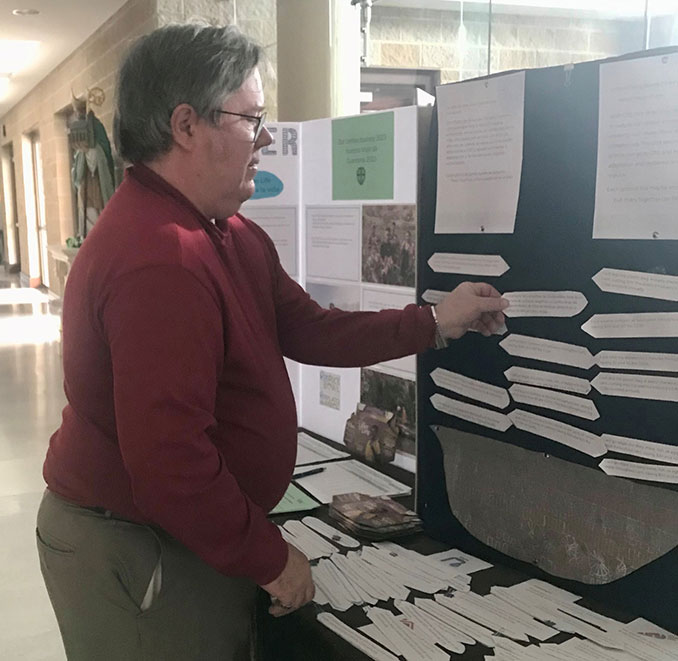
Bill McCoy interacts with a Rice Bowl display at St. Patrick Parish in Iowa City.

By Lindsay Steele
The Catholic Messenger

IOWA CITY — A few years ago, a group of St. Patrick Parish members studied Laudato Si’ during Lent. Pope Francis’ encyclical gave the group “a newfound respect for the interconnectedness of everything,” said Diane Platte, the parish’s social action committee chairperson. This Lent, the whole parish is celebrating that interconnectedness through ecological, stewardship, prayer and wellness challenges.

A display in the vestibule shows how countries and families spotlighted by this year’s Catholic Relief Services (CRS) Rice Bowl collection are adapting to climate change. Parishioners can choose a pledge — written on a slip of paper shaped like a grain of rice — and add it to the display board. “If we don’t take steps to mitigate our emissions, it’s going to keep getting harder and harder for our brothers and sisters to adapt,” Platte said.

These pledges explain how small, concrete actions — such as swapping a pound of chicken for two cups of beans or washing clothing in cold water — can save money and reduce carbon emissions. The cost savings from these actions can go to CRS to help foster adaptation and resilience in vulnerable regions. “Each grain of rice may be small, but many together can fill a bowl,” the display reads.

With a grant from Victory Noll Sisters, the parish is working to supply as many parish families as possible with climate action materials. Native plant seedlings, a kitchen compost container and household-efficiency materials such as LED bulbs, rope caulk and a WaterSense showerhead are available to households at no cost.

The parish’s Healthy Habits ministry is stepping into action by taking parishioners on a virtual Lenten pilgrimage through this year’s Rice Bowl countries — the Philippines, Kenya and Honduras. Each week, parishioners log hours of exercise and/or contemplative prayer, keeping in mind that some families must walk an hour each day for clean water. “Water is essential for life and a powerful symbol in our Catholic faith,” said Marygrace Elson, a member of the Healthy Habits ministry. Participants can meditate on weekly Scripture readings about water, which are posted in the vestibule and on the parish’s Facebook page, and log their hours. The parish encourages participants to fill their rice bowls with financial donations throughout Lent.

Information and materials for the Lenten projects are available in English and Spanish. Maria Lourdes Hernandez, wife of Deacon Angel Hernandez, provided translation and helped promote the activities within the parish’s Spanish-speaking community.

Platte hopes the parish’s integrated challenges can “make life a little easier for those who are bearing the brunt of climate change.”

Posted on

Chrism Mass is April 3

Anne Marie Amacher
Bishop Thomas Zinkula breathes over the vessel containing the Chrism oil during the Chrism Mass April 11, 2022, at Sacred Heart Cathedral in Davenport.

DAVENPORT — The Diocese of Davenport invites the faithful from throughout the diocese to participate in the Chrism Mass April 3 at 10 a.m. at Sacred Heart Cathedral. The Mass also will be available for viewing on the cathedral’s YouTube page at https://tinyurl.com/5cbxx5sw

Bishop Thomas Zinkula will preside at the Chrism Mass, which bring together priests, deacons, religious and laity for the blessing and consecration of the oils for use in the diocese’s parishes in the coming year. The bishop will bless the Oil of the Sick, which is used to strengthen, console and heal, and the Oil of Catechumens, which is used to strengthen and free those preparing for baptism. He will consecrate the Sacred Chrism, which is used to ordain bishops and priests, to confirm individuals, to anoint the newly baptized, and to dedicate churches and altars.

During this Mass, diocesan priests will also participate in the Rite of Recommitment.

(See Father Thom Hennen’s Question Box on Page 5 for more information on the Chrism Mass.)

Posted on

Students make blankets and winter gear for Native Americans

Contributed
Abby Korschgen uses a loom to make a hat for Native Americans in the Dakotas during class at Notre Dame Junior/Senior High School in Burlington.

By Anne Marie Amacher
The Catholic Messenger

BURLINGTON — Inspired by her mother’s knitting and crochet club, religion teacher Jennifer Baxter thought making hats, scarves, shawls and blankets for Native Americans in the Dakotas would be a good service project for seniors at Notre Dame Junior/Senior High School.

Baxter originally planned to have members of the Flying Hooks and Needles group from Stronghurst, Illinois, teach the seniors to crochet and knit. “But knitting and crocheting are not always easy skills to learn,” she said.

Senora Rosa Bailey, a Notre Dame Spanish teacher, suggested using looms and volunteered to teach the students in Spanish class how to create items on looms of various configurations. Loomers use circle looms to make hats or infinity scarves and rectangle looms to make blankets. “The steps are repetitive and have been pretty easy to pick up,” Baxter said.

Flying Hooks and Needles donated most of the yarn and the Notre Dame art department donated additional yarn. A few teachers donated some looms. “This is our first time trying,” Baxter said. Students worked on the looms at the end of class periods. “The project is not complete, some are still working; some have made more than one item. The project will end as soon as everyone has made at least one item,” she said.

Brad Beard from Roseville, Illinois, makes frequent trips to reservations in the Dakotas to deliver supplies, Baxter said. “He is coming to speak to the senior class next month about his experience and why he is so dedicated to this mission. He will be delivering the items we make on his next run up north.”

Students have completed eight hats so far and 30 students continue working on or starting another hat, ranging in size from infant to adult. A few students are making blankets and scarves. Baxter has been so impressed with the project that she plans to do it again next year.

“The students have really enjoyed the project. In the beginning, it was frustrating for some when the yarn would get tangled or their loom would unwind. But when they got the gist, they have had a really fun time. It has been a joy watching them do this project.”

Student Owen Gulick said his first experience with working on a loom “wasn’t too hard. We learned the names of the tools in Spanish.” Wyatt Pearson said, “It was pretty easy to learn. I am making a blanket. Senora Bailey taught us how to make hats. I have taught three other people how to make blankets and scarves.”

Brayden Edmunds described the project as “complicated at times, but I feel pretty good knowing that what I am making is going to keep someone warm. Some of my family is Native American so it means a lot.” He said it is “unfortunate that people have to worry about staying warm. So it’s good for us to help them out.”

Before the items are delivered, Father James Flattery, parochial vicar at Divine Mercy Parish-Burlington/West Burlington, will bless them. “The Holy Spirit is responsible for the idea,” Baxter said. “We try to allow him to lead our classrooms. He planted the seeds, put the idea in our heads and we ran with it. To God be the glory.”

Posted on

Support Iowa moms in need

By Barb Arland-Fye
Editorial

Proposed legislation that would extend postpartum Medicaid coverage to 12 months for moms on Medicaid is pro-life legislation, and it appears to have the backing of both Democrats and Republicans. It also has the support of the Iowa Catholic Conference, the public policy voice for Iowa’s bishops. We ought to join our voices in advocating for passage of this legislation that would help moms thrive so that their babies can thrive.

At present, Medicaid pays for more than four in 10 births and must cover pregnant women through 60 days postpartum. After that time, states can choose whether eligibility for Medicaid coverage continues, according to the Kaiser Family Foundation (KFF.org). Iowa is one of the states that has not yet extended Medicaid coverage beyond 60 days postpartum. In 2021, of the 36,786 births in Iowa, Medicaid reimbursed 15,027 of those births. Ensuring good healthcare for moms in that first year after their baby’s birth is crucial to the well-being of both and our state.

Statistics make the case. Mortality and mental health issues are among the challenges postpartum moms face; moms who struggle to make ends meet face even greater hurdles. The 2021 Iowa Maternal Mortality Review Committee report states, “Maternal mortality is higher in the United States (U.S.) compared to any other developed nations.” Particularly sobering is the fact that “63.2% of pregnancy related deaths (in 2018) were preventable” (Report from Nine Maternal Mortality Review Committees).

Couple the maternal mortality report with the Iowa Maternal Health Strategic Plan for 2021, which states, “Mental health conditions are the most common complication of childbirth impacting 1 in 5 individuals during pregnancy and the year following pregnancy. Untreated maternal mental health conditions can have (a) negative and long-term impact on (a) pregnant and postpartum (woman) and her infant.” Among the strategic plan’s recommendations is extending postpartum Medicaid coverage to 12 months.

The strategic plan’s recommendation adds strength to the argument for passage of legislation that, in turn, would strengthen the Iowa MOMs program (More Options for Maternal Supports) the Iowa Legislature passed last year. That program provided $500,000 to help pro-life agencies support pregnant women and new moms with baby essentials and counseling. However, funding was not included for the expansion of coverage for mothers who receive Medicaid, the Iowa Catholic Conference (ICC) reported.

Efforts are underway to convince Iowa lawmakers to pass this legislation, ICC Executive Director Tom Chapman says. Both Senate File 57, which all Senate Democrats co-sponsored, and House Study Bill 226, which State Rep. Bobby Kaufmann, a Republican, introduced, would extend postpartum Medicaid coverage to moms on Medicaid.

HSB 226 instructs the Iowa Department of Health and Human Services to submit a Medicaid state plan amendment to the federal government for approval to provide 12 months of continuous postpartum Medicaid coverage to pregnant women enrolled in the Medicaid program in accordance with the federal American Rescue Plan Act of 2021. The state’s general fund would allocate expenditures of $5.6 million for the 2023-24 fiscal year and $8.87 million for the 2024-25 fiscal year to extend postpartum Medicaid coverage to 12 months.

This is where our advocacy efforts can bear fruit to ensure that moms in need receive an extension on postpartum Medicaid coverage, STAT! Contact members of the Iowa Legislature’s Joint Health and Human Services Appropriations Subcommittee (https://tinyurl.com/yuckrmcy) and ask them to move forward with legislation to extend postpartum Medicaid coverage to moms on Medicaid. Contact Gov. Kim Reynolds as well (governor.iowa.gov/contact-office-governor). Also, visit the ICC website, which will provide updates and action alerts.

Last July, Archbishop William Lori, who chairs the U.S. Conference of Catholic Bishops’ Pro-Life Activities, called for building “a society and economy that supports marriages and families, and where every woman has the support and resources she needs to bring her child into this world.” He was responding to President Biden’s executive order on abortion access (https://tinyurl.com/mryz459d). Extending postpartum Medicaid in Iowa supports this call.

As early childhood educator Jeni Van Buer of St. Thomas More Parish in Coralville says, a child living with a healthy and thriving parent will have a greater opportunity for overall health and developmental success.

Barb Arland-Fye, Editor
arland-fye@davenportdiocese.org

Posted on

What is the Chrism Mass?

Anne Marie Amacher
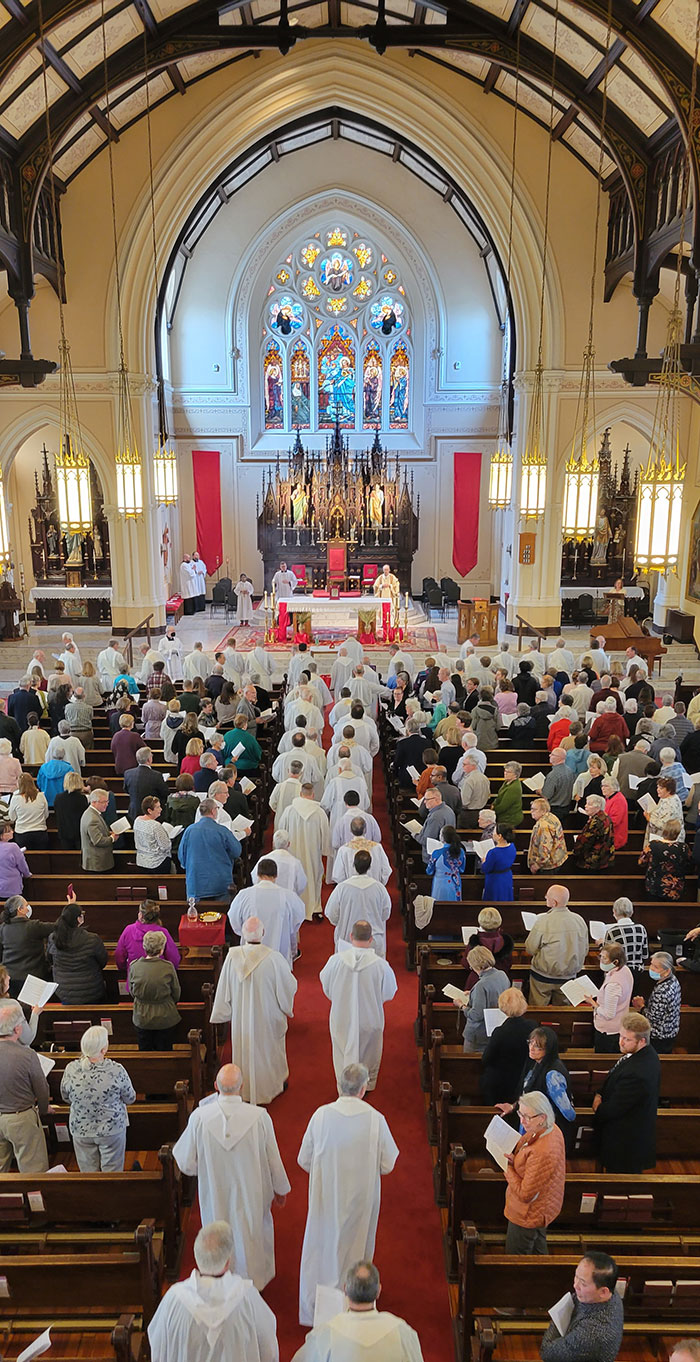
Priests and deacons process into Sacred Heart Cathedral in Davenport during the Chrism Mass in this 2022 photo.

By Fr. Thom Hennen
Question Box Column

Fr. Hennen

On April 3, Bishop Thomas Zinkula will gather with the priests and deacons of the Diocese of Davenport, and the lay faithful who are able to attend, at Sacred Heart Cathedral for this ancient, beautiful and solemn liturgy. While more traditionally celebrated on Holy Thursday morning, the Chrism Mass may be celebrated on a different day prior to Easter. Given the general busyness of Triduum and the distances that many of the priests have to travel, in recent years our diocese has celebrated the Chrism Mass on the Monday of Holy Week or even the week prior, in conjunction with our annual Clergy Convocation.

In one sense, the Chrism Mass is the local Church’s annual “oil change.” Early Christian texts  describe a blessing and consecration of oils as early as the 3rd century. At the Chrism Mass the Oil of Catechumens, used in the pre-baptismal rites, and the Oil of the Sick, used for the sacrament of the Anointing of the Sick, are blessed. The Sacred Chrism, used for the post-baptismal anointing, for Confirmation, for the ordination of priests and bishops, and for the dedication of churches and altars, is consecrated. In case of need, any priest may bless the Oil of Catechumens or the Oil of the Sick but only a bishop can consecrate the Sacred Chrism. The oils themselves must be plant-based (we use olive oil) and to the Chrism is added balsam, which gives it a darker color and a wonderful fragrance.

The other aspect of the Chrism Mass, as described in the Roman Missal, is that it is to be “a manifestation of the Priests’ communion with their Bishop.” For this reason, in addition to that most important sign of communion of sharing in the Eucharist with each other, the priests also renew their priestly promises. It’s not as though these promises expire and that we need to “re-up” each year but it is a powerful reminder of the commitment we made at ordination and of our connection with our bishop as “co-workers in the vineyard.”

My earliest personal recollection of the Chrism Mass is as a seminarian. The seminarians of the diocese would typically serve for this Mass and immediately following, go next door to the rectory to carefully transfer the oils from large urns to the bottles to be distributed later to the priests. Many helping hands from the chancery staff now make light work of this.

What happens to the old oil, you ask? Last year (my first at the cathedral), we bought a new metal outdoor fire pit for the Easter fire. In addition to the wood and kindling, we added the cathedral’s old oils as these should be properly disposed of either by burying or burning them. It was a noble idea. What we did not anticipate was that all of the oil would pool at the bottom. Once the fire was really going, the oil heated up and it sounded like a deep-fat fryer. Balsam-infused holy french fries anyone? As beautiful and powerful as liturgy can be, and while we absolutely believe that it is principally God’s work, it is also (literally) the “work of the people,” and this is where things can get messy.

Please pray for the bishop, priests and deacons who will gather on Monday for this solemn occasion and for all those who will be anointed with these oils in the coming year. In the words of the late and much loved Father Bill Meyer, “Merry Chrism Mass!”

(Father Thom Hennen serves as the pastor of Sacred Heart Cathedral in Davenport and Vicar General for the Diocese of Davenport. Send questions to messenger@davenportdiocese.org)

Posted on

Persons, places and things: The journey to Holy Week

By Barb Arland-Fye
Editor

This year’s Lenten journey has been especially arduous for a close relative, a friend, a colleague and another colleague’s young relative whose journey I have been following on his CaringBridge website.

Arland-Fye

Each one’s suffering weighs heavily on my heart, as if I am absorbing it, which doesn’t help them or me! How can I help them carry their crosses and alleviate their burden? Prayer is an essential response but I feel compelled to act on those prayers. The answers to my questions and my prayers are beginning to unfold like a flower blooming in spring.

My husband Steve spent a week earlier this month assisting our close relative who underwent surgery. He cooked meals, made a couple of household repairs and served as a healing and recovery coach of sorts. In the first few days of Steve’s absence, I felt a pang of regret about not being able to join him as an assistant coach. However, in prayer, I recognized that his gift of service was a shared gift, a sacrifice of our time together. In a light-hearted confession, our relative expressed abiding love for me but admitted that Steve makes a better nurse than I do!

A friend who lives out of town and recently lost her mother is among the people in my daily prayers. We have been able to commiserate over my friend’s loss through Zoom and texting but it’s not the same as in-person comforting. We had that opportunity just the other day and shared a good hug. I can’t say enough about the value of a good hug!

For the colleague embarking on a courageous battle against illness, I found the perfect card. The eloquent, brief, prayerful sentiments expressed in the card convey my appreciation for her positive attitude and the example she sets for all of us.

For the colleague whose young relative is in the midst of difficult medical treatment, I am following his story on his CaringBridge website and posting messages of encouragement to him and his family while keeping them in my prayers.

My Twitter feed contained a post (a snippet) from Pope Francis’ Angelus on Sunday, March 26, in St. Peter’s Square reflecting on the Gospel reading for the fifth Sunday of Lent from John’s Gospel. When I read the post, I immediately sent it to my relative whose suffering seems unbearable. The post reads, “Jesus invites us not to stop believing and hoping, not to let ourselves be crushed by negative feelings. He approaches our tombs and says to us, as then: ‘Take away the stone.’’’

While the excerpt moved me deeply (and I think my relative was moved, too), the entirety of Pope Francis’ Angelus message provides an inspiring gateway to Holy Week. He encourages us to read this passage from chapter 11 of John’s Gospel and describes it as a “hymn to life, and it is proclaimed when Easter is near.” The Holy Father asks, “Are we able to open the tomb of problems, are we capable, and look over the threshold, towards his light, or are we afraid of this? And in turn, as small mirrors of God’s love, do we manage to illuminate the environments in which we live with words and gestures of life? Do we bear witness to the hope and joy of Jesus?” (https://tinyurl.com/2pvtknm9)

Every year, my Lenten journey is a journey of discovery. This year, I have discovered not to fret over carrying other people’s crosses but to accompany them in whatever way I am able.

(Contact Editor Barb Arland-Fye at arland-fye@davenportdiocese.org)

Posted on