




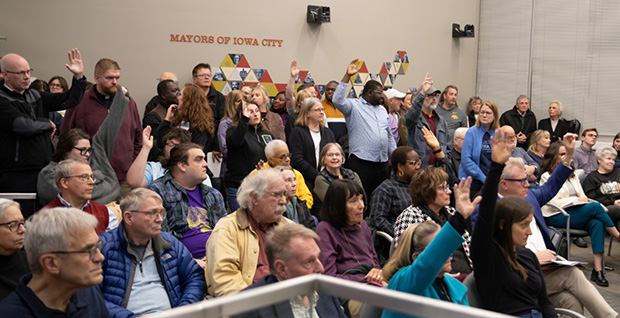
Citizens request to speak during the Iowa City City Council meeting Nov. 17 in City Hall. The council voted 6-1 to overturn the Historic Preservation Commission’s October decision to deny St. Mary of the Visitation Parish a certificate of appropriateness to demolish two of its properties in the Jefferson Street Historic District.
By Lindsay Steele
The Catholic Messenger
IOWA CITY — With a standing-room-only crowd of supporters as witnesses, the Iowa City City Council sided with St. Mary of the Visitation Parish in its ongoing mission to enhance its downtown footprint.
In a 6-1 vote on Nov. 17, the council overturned the Iowa City Historic Preservation Commission’s October decision to deny the parish a certificate of appropriateness to demolish two of its properties in the Jefferson Street Historic District. The parish recently embarked on a $10 million, three-year capital campaign in which half of the funds — pending city approval — will be used to demolish two aged houses-turned-office-buildings and replace them with a new parish ministry center that is aesthetically similar to the 157-year-old church, handicap accessible, and better fits the needs of the growing parish.
Hitting a wall


The church and rectory are on the National Registry of Historic Places, though the two buildings in question are not. However, their position in one of the city’s eight historic districts means any exterior changes must be approved by the city’s Historic Preservation Commission (HPC).
The commission considered the parish’s request over two meetings earlier this year. The parish, through testimonies and engineering reports, attempted to prove that the century-old buildings were both structurally unsound and irretrievable (unable to be satisfactorily repaired). The request was denied in a 4-3 vote on Oct. 8.
Appealing the decision
The parish exercised its right to a city council appeal. More than 150 people showed up at City Hall Nov. 17 to speak or offer support. The vast majority of community members spoke in favor of the parish’s plans, expressing how the downtown Catholic community has impacted their lives.
Some speakers brought up the relative inaccessibility of the current structures. Miriam Trautner, whose daughter uses a walker with assistance, acknowledged the existence of a ramp, but “once inside, these houses do not have the floor plan to accommodate a walker or a wheelchair. … We may be able to navigate these spaces with some awkward maneuvering, but at what cost?”
The ordinance in question, however, specifically addresses the physical condition of a building. A structural engineering report from Shive-Hattery’s Iowa City office determined that the buildings are experiencing significant foundational deterioration and other structural issues consistent with age. The west wall of one of the buildings is unstable, and offices in that section are currently closed off due to fear of collapse.
A focus on irretrievability
The council deliberated on the word “irretrievable” and whether there is any room for interpretation. In St. Mary’s case, repair is possible but “would require closure of both streets, significant demo of some of the right of way in order to provide a structural steel beam system that would essentially lift both houses off their foundation to enable (contractors) to repair them,” Matthew Barron, managing director for the Iowa City office of Shive-Hattery, an architecture and engineering firm, told the council.
“(St. Mary’s) staff generally believes that’s technically infeasible and financially completely impractical,” he said. “The amount of effort that it would take to preserve just the foundations alone is significant, in my professional opinion.”
“One could say that a building is not irretrievable if, theoretically, there is a way that it could be saved,” explained Father Andrew Rauenbuehler, the parish’s pastor. “This seems to be an impossibly high standard. With enough time and unlimited resources, anything could be retrieved.” The cost for foundation repairs alone would cost more than $600,000, he said.
John Hale, a member of the parish’s Property Management Commission, said “it’s not a wise investment to spend money jacking them up, replacing (the foundations) and putting them back down hoping it all fits okay. And, then, what do we have? We have two old houses with new foundations that are too small and don’t meet our needs.”
Councilwoman Laura Bergus, who voted in favor of the reversal, said she believes the majority of HPC voters were too rigid in their interpretation of the ordinance. “Irretrievable is a standard that is still bound by reasonableness,” she asserted.
A change to the ordinance may be needed
Josh Moe, the only council member to vote against overturning the decision, supports St. Mary’s plans but believes the language in the ordinance needs to be changed first. He said some of the HPC voters felt “uncomfortable” during the October vote because they sympathized with St. Mary’s, but felt there wasn’t any flexibility in the ordinance to take economics and feasibility into account. “I think the correct way for us to move forward is to… affirm the denial, and to quickly work to change our city’s ordinance to better work for instances like this.”
Mayor Bruce Teague encouraged the council to consider reviewing the historic preservation ordinances “particularly in how irretrievable is defined. Is it cost? Is it use? Is it accessibility? Is it all the things that go into the structure?”
The next steps
Shortly after the council vote, Iowa City Catholic Worker celebrated the news on its social media pages. “St. Mary’s has been a longtime partner of the Catholic Worker, providing space for meals and ministries that serve our neighbors in need,” co-founder Emily Sinnwell told The Catholic Messenger. “For us, this is about putting our faith into action and making sure everyone — including older adults, people with disabilities, immigrant families, and people experiencing poverty — has a welcoming, accessible place to gather, worship, and build community.”
Father Rauenbuehler told The Catholic Messenger that he was “super pleased and very encouraged” by the community support at the city council meeting, noting that some people were turned away once the chamber reached capacity. “Being able to listen to members of the community speak was something that was really, really encouraging for me, just knowing we can move forward and get past this first and necessary hurdle.” Although the denial and appeal process has added at least a couple months to the project, “to have the outcome we do is super important. I’m excited about it.”
There is still more work to be done: before demolition can begin, the HPC must vote to approve the blueprints for the new building. The parish presented plans at the September and October board meetings, and have been working with architects and city staff to fine tune design elements such as roof pitch and window placement, Father Rauenbuehler said.
The parish hopes to make a presentation and receive approval at the Dec. 10 HPC meeting. If that happens, the parish will be able to begin demolition and construction once funding is secured, per diocesan requirements. “I think this is going to be a really beautiful addition to the neighborhood,” Father Rauenbuehler said.
