



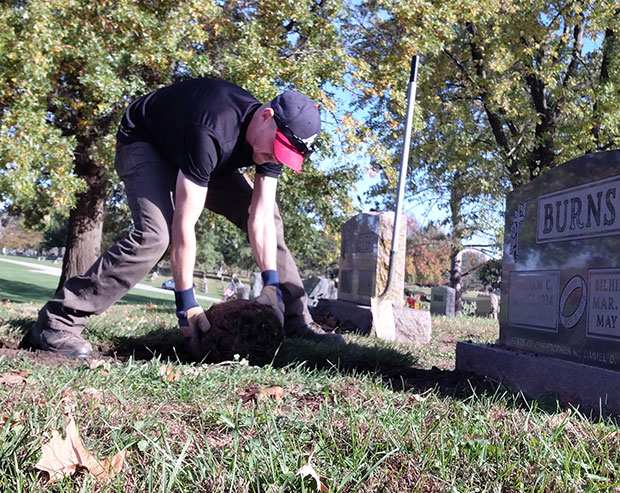
Nate Tyler, the head sexton at Mount Calvary Cemetery in Davenport, lays sod at a gravesite.
By Dan Russo
The Catholic Messenger
If Merlin Arensdorff sees a branch out of place or a headstone that needs attention at St. Ann Catholic Cemetery in Long Grove, he will make note of it and take action.
“I guess I like mowing my yard and I’m probably meticulous,” he jokes.
During the 75-year-old’s regular visits to the 17-acre St. Ann campus, which includes the parish church and is surrounded by picturesque open fields and trees, he may also notice people seated on benches who have come to pray quietly or a pack of unopened cigarettes or other mementos left on graves.


Like many who care for Catholic cemeteries, Arensdorff’s strong sense of the eternal bond between the living and the faithful departed motivates his ongoing work.
“My son is buried (at St. Ann’s),” said Arensdorff. “He had cystic kidneys. He lived about 15 hours. That was 47 years ago. He was a baby and we could never do anything for him. Maybe this is something I can do for him.”
The retiree explained that his son’s twin brother survived. Amazingly, he and his wife went on to have a second set of twins. However, the family still remembers the son they lost and the father’s work helps others dealing with grief similar to the kind they once experienced.
Arensdorff and others like him are combining two important works of mercy — the corporal work of burying the dead with the spiritual work of praying for the living and the dead (Matthew 25:31-46). What follows is a brief glimpse into the vital role Catholic cemeteries have in the Davenport Diocese.
Souls and Cemeteries
The Church recognizes November as a month dedicated to “Holy Souls in Purgatory.” The deceased in purgatory benefit from our prayers, according to “The Catechism of the Catholic Church” (Sections 1030-1032). Aside from providing earthly remains a place to be, the second essential function of Catholic cemeteries is to provide visitors a quiet and well composed place to pray for themselves and their deceased loved ones. Making that happen requires a sustained effort.
Arensdorff is one of roughly 10 regular volunteers from the parish who help one parish staff member maintain the burial site. There are graves going back to the pioneer days. He sees the great dedication some families have to remembering ancestors they never met.
“There’s some graves from the 1800s — the relatives are amazing because you’ll go by and see new flowers on each and every grave every year,” he said.
St. Ann Cemetery funds itself through donations from parishioners and the sale of new plots, which are overseen by volunteers. Another unique aspect of the location is its Shrine of the Holy Cross, added in 2016. Large statues depict Jesus on the cross, accompanied by St. John, the Blessed Virgin Mary and St. Mary Magdalene. The message of the shrine, chosen by donor Ray Boeding, is that we should pray for each other.
“It’s not just a statue for my (deceased) wife, but something for the parish. I hope it will inspire people to come and pray for their loved ones buried here and to say prayers for the people who no longer have anyone to pray for them,” Boeding told The Catholic Messenger the year the shrine was dedicated.
An overview
There are more than 45 Catholic Cemeteries in the Davenport Diocese, according to rough data provided by Barb Butterworth, archivist for the diocese. Personnel there are continuing their research into this matter and hope to uncover more information as time goes on. Some cemeteries are directly connected to and maintained by a parish, like St. Ann’s. This is often true in small towns and rural areas.
In the city of Davenport, the largest urban area in the diocese, the two Catholic cemeteries — Holy Family and Mount Calvary — are operated through a not for profit corporation that is affiliated with the diocese.
Mount Calvary is perhaps the most well-known in the area because it contains the graves of diocesan bishops, priests, women religious and famous citizens. It was established as St. Marguerite’s Cemetery in the 1850s on a 20-acre property donated by Antoine LeClaire, an army interpreter who helped negotiate an end to the Black Hawk War and was a founder of the city.
When the current Sacred Heart Cathedral was built, bodies of LeClaire, bishops and others were reinterred further north in the city at Mount Calvary.
Nate Tyler, Mount Calvary’s head sexton, explained that he did not seek out his position intentionally, but “that the work found me.”
“The thing that amazes me is that I get to know about a lot of (the) people (buried here),” he said. “I get to hear all the old family stories.”
Tyler estimated that there are about 70,000 people buried in the cemetery.
“We still have plenty of space,” he said, explaining that this is because “60% of burials now involve cremated remains.”
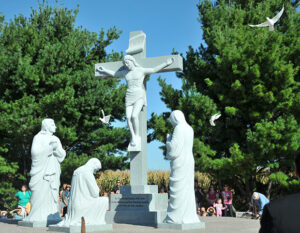
Doves fly over the Shrine of the Holy Cross in the Fields in St. Ann Parish’s cemetery in Long Grove Sept. 18, 2016.
The Catholic Church prohibited cremation until 1963. It was banned for centuries because of its historical context, according to an explanation of Church teaching from the Trappists of New Melleray, a religious order in Iowa known for its casket making ministry:
“In early times, Romans cremated their dead as a rejection of an afterlife, a direct contradiction to the Christian hope of resurrection …,” states the Trappist document.
Traditional burial is still recommended by the Church, but there has been a steady rise in cremation among Catholics. If the trend continues, Tyler believes Mount Calvary could continue to add remains for “another 250 years.”
Some visitors come to the cemetery to see notable graves such as LeClaire’s, “Happy Joe” Whitty’s, (founder of Happy Joe’s Pizza) or Johnny Lujack’s (Chicago Bears). Peter Littig, a soldier for Napoleon who fought at Waterloo, also receives many, according to Tyler.
“He came first to Louisiana with an Irish friend and eventually came to Davenport for business opportunities,” Tyler explained.
Through his work, Tyler has seen that every life leaves a mark whether a person becomes famous or not.
“There’s also a lot of regular people buried here,” he said. “You don’t know their names, but they have fascinating stories.”
Tyler and his staff hope to honor the deceased and create a welcoming place for visitors.
“It’s an honor and a privilege to serve all these people and their families,” he said.
Prayer for the dead
The Church dedicates the month of November to the souls in purgatory. The following sections from “The Catechism of the Catholic Church” (1030-1032) address purgatory and prayer for the dead:
1030 All who die in God’s grace and friendship, but still imperfectly purified, are indeed assured of their eternal salvation; but after death they undergo purification, so as to achieve the holiness necessary to enter the joy of heaven.
1031 The Church gives the name Purgatory to this final purification of the elect, which is entirely different from the punishment of the damned (604). The Church formulated her doctrine of faith on Purgatory especially at the Councils of Florence and Trent. The tradition of the Church, by reference to certain texts of Scripture, speaks of a cleansing fire (605)”
As for certain lesser faults, we must believe that, before the Final Judgment, there is a purifying fire. He who is truth says that whoever utters blasphemy against the Holy Spirit will be pardoned neither in this age nor in the age to come. From this sentence we understand that certain offenses can be forgiven in this age, but certain others in the age to come (606).
1032 This teaching is also based on the practice of prayer for the dead, already mentioned in Sacred Scripture: “Therefore Judas Maccabeus] made atonement for the dead, that they might be delivered from their sin” (607). From the beginning the Church has honored the memory of the dead and offered prayers in suffrage for them, above all the Eucharistic sacrifice, so that, thus purified, they may attain the beatific vision of God (608). The Church also commends almsgiving, indulgences, and works of penance undertaken on behalf of the dead:
Let us help and commemorate them. If Job’s sons were purified by their father’s sacrifice, why would we doubt that our offerings for the dead bring them some consolation? Let us not hesitate to help those who have died and to offer our prayers for them.