




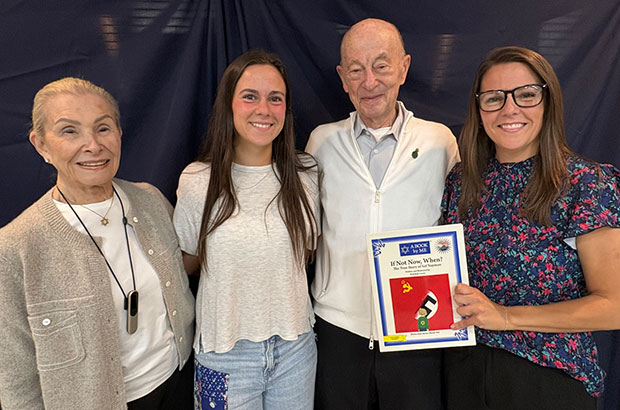
From left, Queenie Nayman, Clara LeConte, Sol Nayman, and Lisa LeConte pose Oct. 22. Sol Nayman spoke about the Holocaust at four sites last week.
By Dan Russo
The Catholic Messenger
DEWITT — At 91-years-old, Sol Nayman, still remembers fleeing Poland as a boy with his family after the Nazis invaded. He also recalls years living in labor camps of the former Soviet Union during World War II. When he came to speak in Iowa recently, he didn’t dwell on suffering in the past, however. Instead, he drew lessons from it to bring people’s attention to learning to love in the present.
“We’re all created in the image of God,” he reflected as he sat at a table looking toward his wife Queenie recently. The two have has been married for 65 years.
“We love life. We love one another. We’re blessed.”


After flying to Iowa from his home in Toronto, Canada, Nayman attended a lunch at the Jewish Federation of the Quad Cities Oct 21. The next day, he spoke at various venues, including Assumption Catholic High School in Davenport, the Rock Island (Illinois) Public Library, Scott County Community College’s Urban Campus in Davenport and St. Joseph Catholic School in DeWitt.
Late in life, Nayman was moved to start sharing his story after not talking about it for decades.
“I didn’t see myself as a Holocaust survivor because I didn’t spend any time in the (concentration) camps,” he said. “My first speaking engagement was four years ago.”
Nayman’s perspective on his experience started to change after he visited a Holocaust museum.
He learned that, according to historians, survivors are not just those who endured the Nazi camp system.
“Holocaust survivors are Jews who experienced the persecution and survived the mass murder that was carried out by the Nazis and their collaborators between 1933 and 1945,” according to the United States Holocaust Memorial Museum. “This included those who were in concentration camps, killing centers, ghettos, and prisons, as well as refugees or those in hiding. Holocaust survivors also include people who did not self-identify as Jewish but were categorized as such by the perpetrators.”
The museum also lists Roma, Sinti, Poles and other Slavic peoples, Soviet prisoners of war, people with disabilities, political prisoners, Catholic and Lutheran clergy who were seen as opponents of the regime and many others as victims of Nazi persecution.
The Holocaust Education Committee of the Quad Cities, part of the federation, regularly sponsors an essay contest for students and brings in speakers.
Demi Franck, a teacher from St. Joseph School, sits on the committee and has been instrumental in educating her students about this period in history.
“I found (the speakers and contest) to be a great way not to just have students write a research paper, but learn how history has impacted different people of our world,” said Franck, who began the effort in 2019. “It’s mind blowing to me we have been fortunate to have three survivors come speak (since 2019). To me (hosting Nayman) is like having a famous star coming to see us. There really are not many survivors left.”
A major turning point influencing Nayman’s decision to share his story occurred when family members invited him to the “March of the Living,” an annual event that brings students from around the world together with Holocaust survivors in Poland on Holocaust Memorial Day, observed in the Jewish calendar on Yom HaShoah. Thousands of participants march silently from Auschwitz to Birkenau, two of the camps where European Jews were executed.
After returning to Poland for this event, Nayman, then in his 80s, was walking along tracks that once transported railroad cars full of those condemned to death. During the march participants often stick written notes along the route. Initially, Nayman thought he should write the name of a lost family member, but instead he felt moved to put down the words, “learn to love.” That has been his core message when he speaks about the Holocaust in public.
In the midst of dark times, the Nayman family experienced love, even from strangers.
“No survivor has ever survived without the help of someone else and we certainly wouldn’t have survived without the help of the Mogila family,” recalled Nayman.
Born in 1935 in Stoczek, Wegrowsky County, Poland, his early years were peaceful. That changed in 1939 when most of the Jewish population of about 1,200 were killed by soldiers. Nayman’s father led the family away days before the Germans arrived.
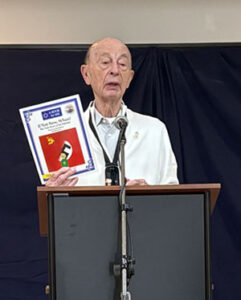
Holocaust survivor Sol Nayman speaks about his life while visiting St. Joseph Catholic School in DeWitt Oct. 22.
The family, including Nayman’s sister and parents, escaped to a forest, where they saw the Wehrmacht’s trucks and troops roll through. Once in the USSR, the Naymans were forced into Siberia, where Sol’s parents toiled away for many years. The family was placed in Syktyvkar, a labor camp in northern Russia. Food was scarce and conditions were harsh under Communist rule.
The Naymans made their way back to the west, to Ukraine, where they met the Mogila family. The Ukrainian farmers helped them, especially Nayman’s ill mother, during their time in another labor camp there. After the war, the Naymans went to the Wetzlar Displaced Person Camp in Germany.
“There, for the first time, we saw what really happened in the Holocaust. In the Soviet Union, not a word was said about the Holocaust … We met Holocaust (concentration camp) survivors,” Nayman remembered. “We saw their emaciated bodies.”
Nayman eventually returned to studying his Jewish faith and draws inspiration from the Great Hallel, a series of Psalms from the Bible that praise God. His family eventually immigrated to Canada and became successful.
Nayman’s speech at Assumption left an impression on the teens who attended, according to social studies teacher Donald Grant.
“Sol’s story sparked a deeper interest in hearing the stories of our elders, and they all appreciated his visit,” Grant said. “It is important to them to have these visits, especially now that the events seem so far away for many of them.”
During his visit, Nayman was able to meet Rebekah Lower, a college student with whom he has maintained a long distance correspondence for four years. Lower wrote a book on Nayman’s life called “If Not Now, When,” part of the ‘A Book by Me’ series.
“I’ve been in contact with Sol ever since I first met him, occasionally sending him messages telling him about my life,” said Lower. “To finally be able to meet him in person was an absolute delight. He and Queenie both were kind and so sweet, and it warmed my heart to hear how much writing and illustrating Sol’s story meant to them.”
Nayman gave simple advice to anyone facing hardship.
“Take every positive step you can,” he said. “Be open minded and if it doesn’t work, take the next step.”
Lower’s book is available at www.understandingworks.org
