




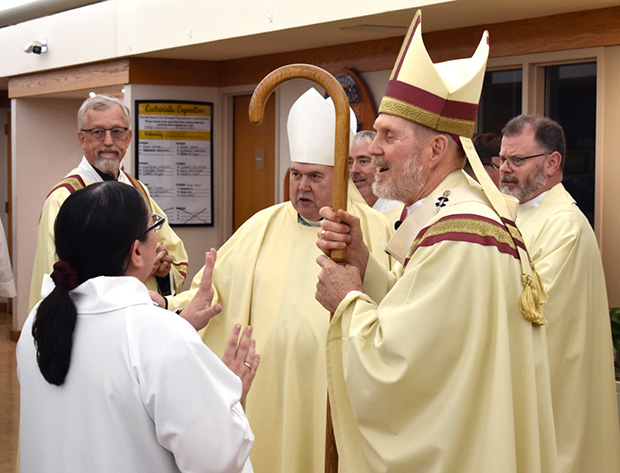
Bishop Dennis Walsh (left), the tenth bishop of the Davenport Diocese, stands beside Archbishop Thomas Zinkula, the ninth bishop who is now the Archbishop of Dubuque on Sept. 30. The pair were among clergy concelebrating Mass on the second day of the Federation of Diocesan Liturgical Commissions’ (FDLC) annual national meeting, held Sept. 28-Oct. 1 in Iowa City.
By Dan Russo
The Catholic Messenger
IOWA CITY — The Federation of Diocesan Liturgical Commissions (FDLC) held its national meeting for the first time in the Davenport Diocese recently. On the final night of the event, Abbot Douglas Mullin, OSB, asked a simple, yet profound question when accepting the Fredrick R. McManus Award on behalf of the monks of St. John’s Abbey in Collegeville, Minnesota: “What kind of people are we becoming because of how we pray together?”
The FDLC’s highest honor is given for significant contributions to liturgical renewal. During a speech in front of roughly 140 FDLC members from around the country in Iowa City, the Benedictine brought a quiet, contempletive air to a brightly decorated hotel banquet hall that moments before had been buzzing with laughter and conversation.
St. John’s Abbey is known for its world-renowned publishing operation, Liturgical Press, which creates books and popular publications such as “Give Us This Day” and “Worship.” The monks also teach theology and other subjects at their university. Over generations, monks from the community, including Dom Virgil Michel, founder of “Orate Fratres” in 1926, the liturgical journal later renamed “Worship,” have made significant contributions to Catholic liturgical studies. Abbot Mullin reflected on the past as the monks prepare to release the final issue of Worship this month. He also shared his thoughts on the future.


“The challenges facing the Church have changed, but the fundamental question has not changed: ‘How do we become a people whose prayer forms the way we live?’” he said “…The Second Vatican Council opened a remarkable door. It did not finish the work of renewal. “Every generation must enter that door again. Perhaps the next chapter of liturgical renewal will require us to recover something our fragmented culture makes increasingly difficult — the ability to become one people. We live in a time that encourages us to define ourselves by difference, to gather only with those who think as we do and sometimes to mistake agreement with communion. The Eucharist teaches something different. It gathers us not because every question has been answered or every disagreement resolved, but because Christ calls us. Perhaps one of the greatest tasks before the Church in the century ahead is not only to celebrate the liturgy well, but to allow the liturgy to teach us once again how to become one body in Christ. That work is not finished and neither are we.”
FDLC’s 57th annual meeting Sept. 28-Oct 1 focused on Scripture, with the theme of “Word of God: Living and Effective.”
Kay Temple and Deacon Frank Agnoli, director of liturgy and deacon formation for Davenport, were the local chairs of the event.
“We had an awesome committee,” said Temple. “Everybody did their job.”
Bishop Dennis Walsh, Archbishop Thomas Zinkula of Dubuque and Bishop Michael Woost, auxiliary bishop of Cleveland, concelebrated Masses at various locations with clergy from across the country over the four days. There were many talks by experts, including one full study day on Sept. 30. A variety of exhibitors gathered as well.
Bishop Woost, Chair of the U.S. Bishops’ Committee on Divine Worship, spoke with FDLC members about Pope Leo’s XIV’s liturgical priorities. He was the principal celebrant of the closing Mass at St. Mary of the Visitation Church, which took place on the feast of St. Therese of Lisieux (the Little Flower). Bishop Woost mentioned the statue of the saint present in the church at the opening of his homily.
Bishop Woost repeated the words, “Lord you give me joy in all you do,” which was a favorite prayer of St. Therese’s that he said was derived from the Psalms.
“She is woman who lives the Word of God and does so in a radical way,” said the bishop.
Even when she was dying of tuberculosis at age 24, during a “dark night” that lasted over a year, the young woman continued to praise God with her favorite prayer alluding to joy, he explained.
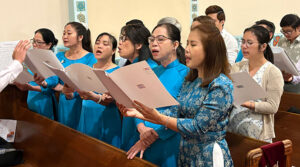
The Vietnamese Catholic community of St. Mary of the Visitation Parish sing in their native language during the closing Mass of the FDLC meeting Oct. 1.
“May her prayer, God’s word, continually be our own as well, Lord,” Bishop Woost concluded.
The closing liturgy featured a diverse mix of Catholic cultural traditions. The first reading was in Igbo, an African language. Some of the Communion procession music was sung in Vietnamese by a choir of immigrants from Vietnam who attend the parish. Some hymns were sung in English. Horns and an organ accompanied a large choir in the church loft. It closed with “Joyful, Joyful We Adore Thee,” a sacred hymn set to the melody of Ludwig van Beethoven’s Ode to Joy. A choir of local Catholics originally from Africa sang a postlude in French.
For the first time in the history of the annual event, a pope sent a letter to participants. The pope’s surrogate, Archbishop Paolo Rudelli, closed the letter by informing the meeting that “the Holy Father willingly imparts his Apostolic Blessing as a pledge of joy and peace in the Lord.”
“(Pope Leo XIV) has spent a lot of his time this year doing liturgical formation,” said Betty-Ann Hickey, association director of the Office of Worship for the Archdiocese of New Orleans as she looked at the document. “He wants us to share our love of the liturgy with people.”
Volunteers from diocesan parishes helped the event run smoothly.
“I helped decorate behind the scenes,” said Michael Peck of St. Mary & Mathias-Muscatine. “One of the best things is … I made new friends from other Catholic parishes.”
This year’s Alleluia Award, given to standout member serving within diocesan worship office or commission, went to Dr. James Starke, assistant professor of Systemics and director of Liturgy at St. Mary Seminary and University in Baltimore.
