




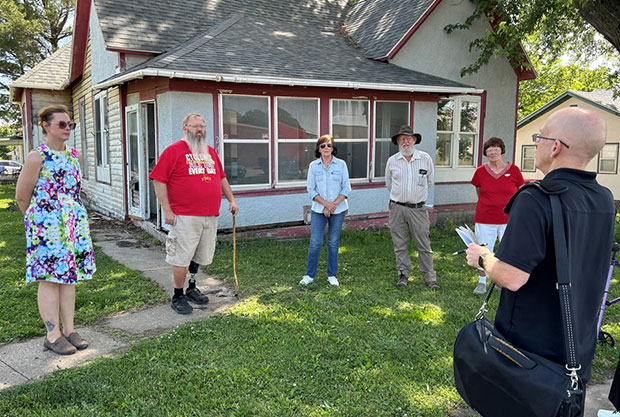
Deacon Kent Ferris shares his thoughts with members of the Appanoose County Homeless Coalition during a visit to the Lazarus House, a work-in-progress transitional home for people living unhoused. Pictured from left are Rev. Sarah Rohret, pastor of First United Methodist Church; Father Ron Hodges, pastor of St. Mary Park-Centerville; Jan Spurgeon, member of Drake Avenue Christian Church-Centerville; Jim Schweizer, member of First United Methodist; and Dewey McConville, member of St. Mary Parish.
By Barb Arland-Fye
For The Catholic Messenger
(This is part of an ongoing series on housing.)
CENTERVILLE — Inside a modest house on a corner, stripped to its bare walls and flooring, members of the Appanoose County Homeless Coalition share their vision for transforming this neglected structure into a home for a family living unhoused. In 2025, 15.4% of the county’s population of 12,100 was living with “severe housing problems,” according to Data USA. The percentage of Appanoose County residents living in poverty (17.5%) is higher than the national average (12.5%).
Deacon Kent Ferris, director of the Diocese of Davenport’s Social Action Office, and two volunteers from the office visited Centerville to learn more about the efforts of the coalition, whose members represent five Christian denominations, including the Catholic Church. The coalition grew from a priority of the First United Methodist Church in Centerville, which realized early on that collaboration with other faith communities would be essential, explained the Rev. Sarah Rohret, pastor of First United Methodist.


 On a warm afternoon in early June, she laid out the plans that the coalition has been working on for around 18 months while they cleared garbage, stripped walls and assessed the house’s many infrastructure and exterior needs. The house’s occupants abandoned the house a few years ago and the City of Centerville took ownership, selling it for a small dollar amount for the coalition to use as a transitional home for a family or individuals without housing.
“We envision a place where people can live for six months to a year and gather the resources they need (counseling, training, education, for example) so that they can be successful on their own,” Pastor Rohret said. The coalition, which conducted listening sessions and received input from people who work directly with individuals struggling with homelessness, chose the name “Lazarus House,” a place to begin anew.
A painful reminder of the struggle occurred last summer when unsafe living conditions at a mobile home park in Centerville resulted in police tagging 10 mobile homes as junk vehicles. Officers worked with Appanoose County Homeless Coalition, Common Ground and the Red Cross to assist residents in finding short-term housing, the Centerville Police Department’s Facebook page reported. “It was devastating,” Father Ron Hodges, pastor of St. Mary Parish said of that situation. He is a member of Common Ground, a ministerial association with close ties to the coalition. “The parish is 100% behind the coalition,” he added.
Gathering input
Pastor Rohret, who moved to Centerville in 2023 to serve as the Methodist church’s pastor, had asked her congregation to identify the pressing needs in their community. Homelessness was the top priority, but the congregation couldn’t address it alone. “I knew that Appanoose County was on the top of counties for homelessness (per capita) in Iowa … it’s a big problem and takes everyone to help,” Pastor Rohret said. She organized a public meeting to gauge interest in collaboration.
Dewey McConville, a retired physician assistant, longtime member of St. Mary Parish in Centerville and a mental health advocate, attended the meeting and subsequently became a coalition officer. “When you work with people with mental illness you end up working with people who are homeless,” McConville said. “I became very aware of the homeless situation.”
McConville returned to her parish to ask for its support. “Our parish completely embraced it,” she said, referring to financial as well as volunteer support. “We asked them to support the meals programs we have and we asked them to support the Lazarus House and we have asked them to fill blessing bags that we hand out with commodities” at events such as “Connections Day” in City Park in July for people who are unhoused or housing insecure.
Other faith communities also embraced the coalition’s efforts. Representatives from the Methodist, Catholic, Presbyterian, Lutheran and Disciples of Christ churches serve in leadership positions with the coalition, whose members also include civic leaders. Each faith community provides funding for the coalition to go toward the organization’s efforts, which include renovation of the house and creation of an Empowerment Center providing case management for people struggling with homelessness or housing insecurity. Fundraising is ongoing.
The coalition also serves a meal Monday evenings, which is as much about connection as it is about physical nourishment. “We want to invite them (the diners) to get to know us so they feel connected to the community,” Pastor Rohret said.
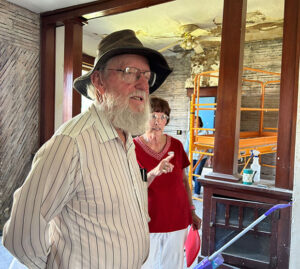
Jim Schweizer, a member of First United Methodist Church in Centerville talks with Dewey McConville, a member of St. Mary Parish in Centerville inside the Lazarus House, a work-in-progress transitional home for people living unhoused. This work is a major undertaking of the Appanoose County Homeless Coalition, an ecumenical nonprofit organization.
Empowering people
Providing the support necessary for people to gain self-sufficiency is an essential component of the coalition’s efforts. Their vision includes the Empowerment Center where people who are homeless or housing insecure would receive the support services they need to resolve their challenges. The coalition is working through Central Iowa Shelter & Services (CIS), which provides a counselor for several hours on Mondays in Centerville. Opening an Empowerment Center for daily services would help equip families and individuals to move toward independent living.
“Homelessness is often caused by and/or exacerbated by the inability of public support systems to address the complex needs of people in extreme poverty experiencing housing crises,” the Iowa Homelessness Needs Assessment study (2024) states. “These systems include education, hospitals, behavioral health, criminal justice, and child welfare. Engagement and service delivery approaches need to be responsive to the particular needs of people at imminent risk or experiencing literal homelessness.”
During his visit to the Lazarus House, Deacon Ferris praised the Appanoose County Homeless Coalition’s response. “Hats off to it being an ecumenical effort. You all understand your community. You all understand what is possible,” he told members.
Later, he said the ecumenical coalition efforts demonstrate how faith communities are “responding to an outstanding, urgent, unmet community need in ways that are thoughtful, realistic and enable the community to be supportive through their offerings of time, talent and treasure. It is also a great example of subsidiarity, local folks responding to local need.”
“Knowing how Centerville is responding to homelessness in their community is important for us in the Social Action Office because it can be a source of celebration and inspiration,” Deacon Ferris continued. “If indeed the best ideas are common property, sharing the Centerville story may give other parishes a sense of what is possible in responding to homelessness.”
