



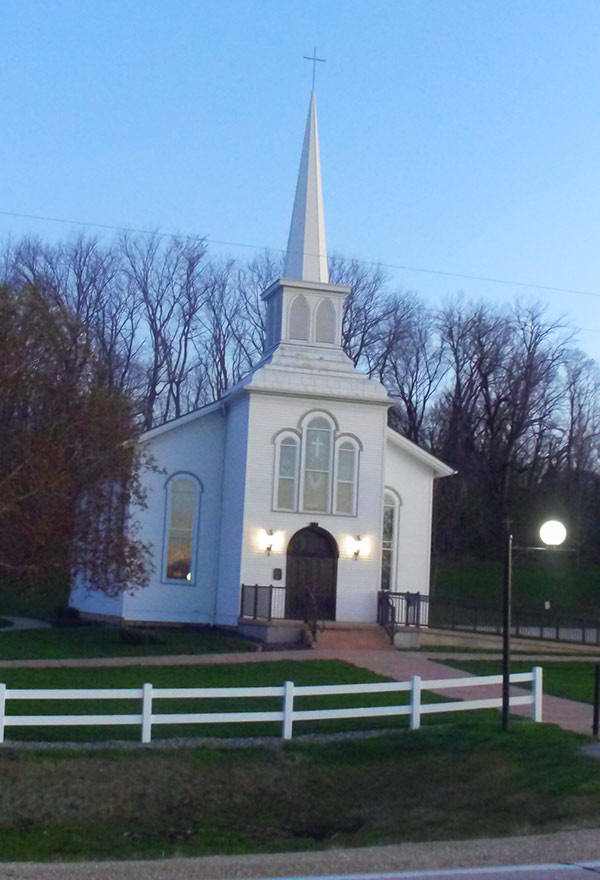
Olde St. Ann’s Church, in the pioneer village section of Scott County Park, was moved from its original location in rural Long Grove. Although no longer a Catholic Church, the building is used to help preserve local history.
By Dan Russo
Editor

I stopped for gas one evening in the small town of Park View. I decided to travel an extra few miles down a quiet two-lane stretch to see one of those things you can only catch a glimpse of on a back country road in Iowa. Dan Nagle Walnut Grove Pioneer village in Scott County Park offers visitors a meticulous re-creation of 1860s pioneer life. The three-acre open air-museum, which sometimes features historical demonstrations, was once a bustling cross-roads settlement and stage coach stop. Twenty-two historical buildings, some relocated from other parts of rural Scott County, are preserved and open for tours this time of year.
The park also features the childhood home of Wild West icon Buffalo Bill Cody. But that day, I wasn’t interested in Buffalo hunters. I wanted to see Olde St. Ann’s Church, which is part of the village.
By the time I got there around twilight, the tourists and guides were gone. As the sun went down behind me, I looked across the road at the spire of the white wooden building that sits toward the end of the village. Olde St. Ann’s originally served as the worship space for the Catholic community that was established in rural Long Grove in the 1830s.


According to “The History of St. Ann’s Catholic Church Long Grove, Iowa, 1840-1995,” by Chris and Cathi Farwell: “Due to the size and remote rural location of the church, they were not appointed a resident priest. Priests then (like today) were scarce, especially in a missionary diocese … From 1853 to 1870, St. Ambrose Academy and Davenport churches supplied numerous priests to serve the needs of the congregation … Many Irish, Germans and Belgians, seeing the advertisements of the church and experiencing the anti-Catholic mood of the cities, decided Iowa would make a wonderful new home. As the colony began to grow in numbers, so too did the Parish.”
A new St. Ann’s Church now serves the Long Grove area. The old one, completed in 1870, had its last Mass in 1985 before eventually being purchased by the county and moved down the road. It’s now used for non-denominational weddings and other events, a good example of how a formerly sacred Catholic space can be re-purposed. There’s been a lot of debate lately in Iowa and other places about what to do with beautiful old churches that are not being used. In 24 countries spanning Asia, the Pacific, Europe, Latin America, North America, and sub-Saharan Africa, Catholicism is losing more members than it is gaining right now, according to a new analysis from Pew Research Center. In the U.S., about 30% of people are currently raised Catholic, but only 17% of adults describe themselves as Catholic, the study says.
At the same time, over the last few years we have seen huge jumps in the number of new Catholics entering the Church in dioceses around the world during the Easter Vigil. The trend has been observed in the Davenport Diocese this year as well. These additions are not making up for the losses — at least not yet. From the mid nineteenth century until the mid-twentieth, the American Church saw a season of growth. For the last several decades, we’ve seen a season of decline. But if you look at nature, a burst of new life often follows a period of decline or death. John 15:1-8 talks about how pruning is sometimes necessary so that grape vines can grow back stronger. When pioneers migrated out west, they experienced prairie fires. These wild fires could be dangerous for wagon trains and they devastated towns or crops. We now know that fires are essential for the health of grasslands. Ranchers today use controlled burns to remove dead vegetation and return nutrients to the soil. The fires also allow sunlight to reach new places to stimulate growth. I tried to keep these things in mind as I stood in front of Olde St. Ann’s. I imagined the old building someday in the future full of people gathered for a standing room only Mass.
Dan Russo