




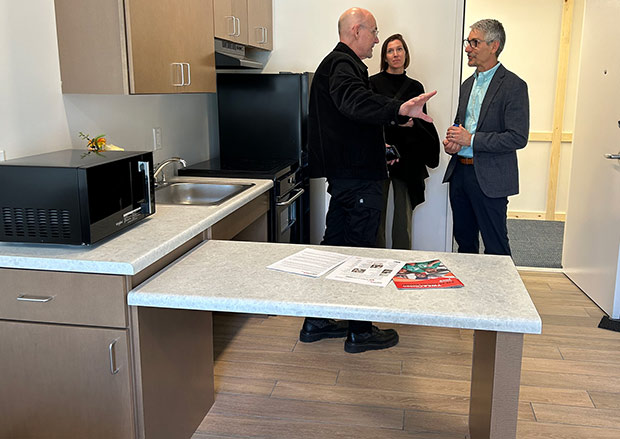
From left, Brent Schipper of the architectural firm ASK Studio, Des Moines, talks with Ashley McKenna of the Iowa Finance Authority and Brian Sullivan of the Iowa Economic Development Authority and Iowa Finance Authority inside an apartment of the newly built 399 Housing in downtown Clinton.
By Barb Arland-Fye
For The Catholic Messenger
CLINTON — Some 36 vulnerable, unhoused Iowans will soon open the door to a home and renewed hope for the future at 399 Housing, a Permanent Supportive Housing initiative of the YWCA Clinton Empowerment Center in the city’s downtown.
The Sisters of St. Francis of Clinton are among the ardent supporters of 399 Housing, a $6.9 million first-of-its-kind project in Clinton that overcame “not in my back yard” opposition. They and other supporters celebrated during an open house and tours of the new apartment building on April 7. The YWCA anticipates moving tenants into their new apartments in May.

These tenants will come from the YWCA Clinton Empowerment Center’s Coordinated Entry list for Clinton and Jackson counties in Iowa. Coordinated Entry assists people at risk of or who are experiencing homelessness, Shannon Sander-Welzien, YWCA Clinton’s executive director, told The Catholic Messenger. 399 Housing takes its name from its street address, 399 6th Ave. S.


“Today we celebrate 24 new rental homes. This project is a first for the YWCA and a first for the City of Clinton. It will also be a first for the 24 families who get to call this new building home,” Brian Sullivan, chief program officer with the Iowa Economic Development Authority and Iowa Finance Authority, told the gathering at the open house. “399 Housing will serve one of the state’s greatest housing needs, that of housing for our lowest income and most vulnerable populations.”
The National Low Income Housing Coalition (NLIHC) reports that Iowa has a shortage of 58,674 “rental homes affordable and available for extremely low-income renters,” who represent 25% of renter households. Many of these households are severely cost burdened, spending more than half of their income on housing (https://nlihc.org/housing-needs-by-state/iowa).
As a Permanent Supportive Housing property, 399 Housing provides a “long-term” lease for an apartment and supportive services to assist with tenants’ other needs (such as medical services and workforce training assistance) in an effort to secure long-term housing, Sullivan told The Catholic Messenger. “This is the first Permanent Supportive Housing project that we have funded for the YWCA and for Clinton. It is not a first for the state of Iowa. The program has awarded seven projects of this type since 2016.”
Projects like 399 Housing use the “Housing First” model, which Sullivan said saves lives and reaps other benefits for communities and the unhoused individuals, who depend on fewer services when they have housing.
“We think sometimes that poverty is only being hungry, naked, and homeless. The poverty of being unwanted, unloved, and uncared for is the greatest poverty. We must start in our own homes to remedy this kind of poverty,” said Dan Srp, quoting St. Teresa of Kolkata in his remarks as chair of the Clinton County Board of Supervisors.

“For Clinton County,” Srp said, “the YWCA has been one of the brightest lights of compassion for those whose life circumstances have forced them to the streets. The YW understands that not all of those on the streets are lost, many are just trying to find their way back.”
He thanked the State of Iowa’s leadership and the Iowa Finance Authority for “the historic grant that made the project possible.” It is “more than double any grant previously awarded in the State of Iowa for this purpose.”
The National Housing Trust Fund awarded a historic $4.4 million for the project, administered by the Iowa Finance Authority. Among other large funders were the City of Clinton and the Clinton County Board of Supervisors, with each pledging $500,000 as a one-time award for construction. An anonymous donor pledged $500,000 towards an Operational Reserve account for ongoing operations. Federal Home Loan Bank awarded YWCA Clinton $1.5 million for construction of the 24 apartment units.
“As this facility opens,” Srp said, “I hope all in our community remember that a home is more than four walls and a roof. It is a place where someone feels safe, feels loved, and feels human. It is my hope that this new facility brings stability and hope to those who are trying to find their way back.”
“The city and county’s investment in this space — offices, community areas, and essential services — means we can truly wrap support around the people who will call this place home. That’s a game changer,” Sander-Welzien said in her remarks.
 399 Housing represents “stability, dignity, and hope,” she continued. “It means that people in our community will have a safe place to land, to rebuild, and to move forward. And that’s something worth celebrating. We also know that something like this doesn’t happen alone. It takes a village — and in our case, a pretty LARGE and incredible one.”
She also thanked, among others, Lori Freudenberg and the Sisters of St. Francis, “who helped spark what is now the ‘Clinton County Housing Coalition.’ We truly would not be here without them, their vision and perseverance.”
Sister Jan Cebula, president of the Sisters of St. Francis, told The Catholic Messenger that her community called a group of people together more than 10 years ago to address the increasing number of unhoused people in Clinton.
“Some people, including myself, continue to meet monthly to try to address the housing needs in Clinton, especially for low-income people,” she said. “399 Housing grew out of these efforts and is a wonderful addition to the community, especially in the lives of those who will live there. However, the work is far from finished. There are many more people in need of affordable and decent housing. The Sisters of St. Francis are committed to keeping up efforts to serve the needs of the Clinton community however we can.”
“Housing is not something people need once they’ve figured everything out. Housing is what allows people to begin figuring things out,” said Michelle Plasschaert, the Empowerment Center’s director. Tenants of 399 Housing will have a place to call home and supportive services staff working with them to navigate benefits, employment, budgeting, and any barriers they may face.
399 Housing will also be a place “for those who are still out on the streets, a place where some of the most vulnerable members of our community can come inside,” Plasschaert said. There, “they can take a hot shower, do a load of laundry, change their clothes, or charge their phones, grab a cup of coffee, and most importantly, connect to others, connect to resources, connect to support, and connect to a path forward.”
A supportive approach
Shannon Sander-Welzien, executive director of YWCA Clinton, explains how Permanent Supportive Housing works:
Tenants “typically begin their housing journey with little or no income, so rental assistance covers most — or all — of their rent at move-in. As tenants stabilize and begin to access income through employment, disability benefits, or other sources, they gradually start contributing toward their rent.”
Rent is income-based; tenants generally pay a portion of their income (often around 30%), which is similar to other affordable housing models. “This approach ensures that rent remains manageable and never becomes a barrier to maintaining housing.”
The goal is to guide once-homeless tenants toward long-term stability and independence. “As tenants build income and confidence, contributing toward rent becomes part of that progress — done at a pace that is realistic and supportive, not punitive,” Sander-Welzien said.
“We know from research and from experience that supportive housing works,” said Michelle Plasschaert, director of the YWCA Clinton Empowerment Center, which will operate 399 Housing.
“It improves health, reduces emergency rate, visits, involvement with the justice system and increases employment. But beyond the data, we know something even more important. When people are housed, they have a choice. They have a chance. This is not a handout. This is an evidence-based and intentional approach that combines housing with support, case management, mental health services, employment services, all designed to help individuals build stability and independence over time.”
