


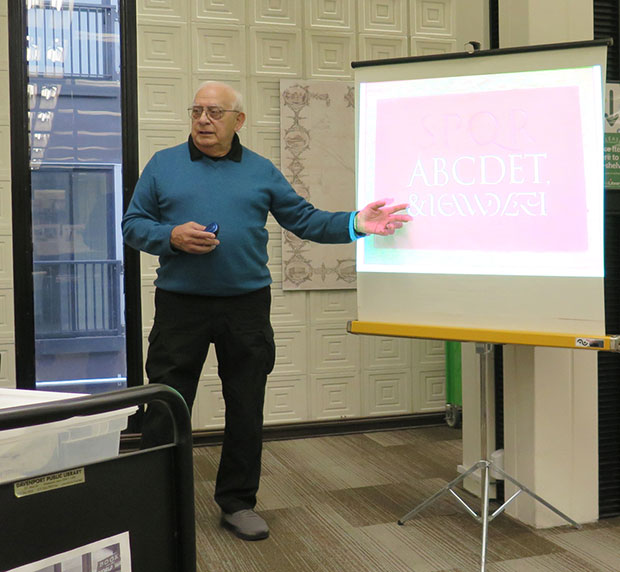
Paul Herrera talks about the late Father Edward Catich’s calligraphy alphabet during a talk at the Davenport Public Library Jan. 10.
By Anne Marie Amacher
The Catholic Messenger
DAVENPORT — Marking the 120th birthday of the late Father Edward Catich, a presentation on the life and legacy of the priest, artist, calligrapher, author and musician was presented in the Richardson-Sloan Special Collections Center at the Davenport Public Library downtown Jan. 10. Paul Herrera, a student and apprentice of the priest, offered the presentation.
Born in Montana to Croatian immigrant parents, Edward Catich’s parents died when he was young. The future priest boarded a train along with his three brothers and headed to Mooseheart orphanage outside Chicago. The school had many opportunities for students to work with the trade unions. Catich became a sign painter and played for its musical program.
Once he reached age 18, Herrera said, Catich was on his own and painted signs and delivery trucks. He enrolled in the Art Institute of Chicago and in the evenings he played the trumpet, cornet and trombone to support himself.


Catich arrived at St. Ambrose College in Davenport in the early 1930s. He was hired by the college president to lead the college’s band due to his experience as a professional musician. Catich worked out a deal for a scholarship to pay for his undergraduate work while at St. Ambrose, which he completed in three years. He dabbled in art, although there was no art department at the time. He entered contests. He composed music at St. Ambrose. Herrera noted that the trumpet was the primary instrument for which the pieces were written, which is not typical.
Catich then pursued a master’s degree from the University of Iowa. He then went to the North American College in Rome for seminary studies for the Diocese of Davenport.
There, Catich met Bishop Ralph Hayes who was serving as rector of the seminary and had been bishop in Montana — his home state. In the future, Bishop Hayes would become bishop of the Diocese of Davenport.
Catich spent as much time as possible studying and doing rubbings of the letters on the Trajan Column in Rome when he was not doing seminary studies. The ancient structure contains one of the most famous examples of Roman square capitals, a script often used for stone monuments.
As it was the 1930s, Catich wrote to his twin brother to send care packages to him at seminary. Herrera reminded the group that the U.S. was still in the Great Depression, but his brother had a good job. With a connection off school grounds, packages were delivered there and items given to his fellow seminarians.
In December 1938, Catich was ordained a Catholic priest. He returned to Davenport as tensions were building in Europe leading up to World War II. At St. Ambrose, he taught music and founded the art department there. Some of the specialties Father Catich taught his students over the years were calligraphy, slate etchings, stained glass and water colors.
An additional assignment the priest picked for a while was as an engineering instructor. Herrera said Father Catich told his students he was not versed in engineering, but in two weeks he would be ahead of them. And he was. Herrera noted that Father Catich could acquire knowledge of topics very fast and be proficient.
In the 1940s he founded Catfish Printing Press at the school where he published books, prints and his “holy cards.” There are 92 cards that Father produced, Herrera said. The St. Dorothy card was inspired by Dorothy Day, whom Father Catich met and corresponded with.
Father Catich’s art generated both praise and controversy. In the 1950s, his piece “Theophora” stirred up people when on display at a New York City museum because it depicts an interracial Mary and infant Jesus. That piece is displayed in Christ the King Chapel at St. Ambrose University.
His slate Stations of the Cross depict Jesus and the people in modern clothing. Herrera said Father Catich knew that young people sometimes start losing their faith in college. The priest knew his audience. “He wanted to relate to them and make the stations modern,” said Herrera. A set is in Christ the King chapel as well. Others are located at different churches.
The priest, who died on Good Friday in 1979, is buried with a simple headstone like his fellow priests at Mt. Calvary Cemetery in Davenport.
Catich display
The Richardson-Sloane Special Collections Center on the second floor of the downtown Davenport Public Library has a Catich display up until Feb. 7. Items are on loan from the Art Legacy League, which is dedicated to preserving and promoting the work of Father Catich.