




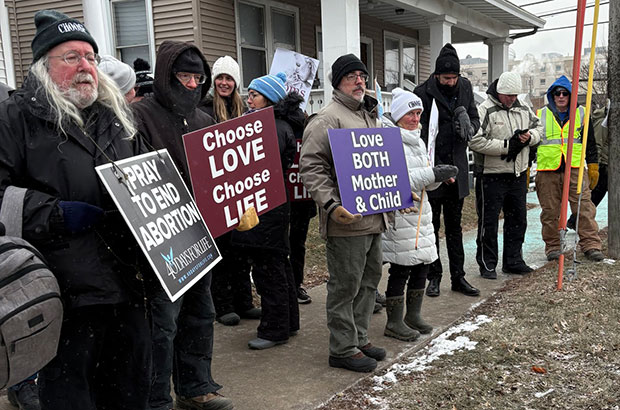
Pro-life advocates participate in the Iowa City March for Life in front of Emma Goldman Clinic Jan. 24.
By Lindsay Steele and Dan Russo
The Catholic Messenger
IOWA CITY — Two years after the Heartbeat Bill went into effect in Iowa, Catholics in Iowa City continue to prayerfully address the issue of abortion and those affected by it. Advocates for the unborn are planning to follow up on a recent march with participation in the 40 Days for Life campaign later this month.
Although locals involved in these ministries have had their boots on the ground for years, major changes in government policy and technology have drastically shifted the terrain on which they walk.
On Jan. 24, about 60 pro-life advocates marched in sub-zero temperatures from St. Wenceslaus Parish to Emma Goldman Clinic, which provides abortions. “We marched for babies in the womb, their mothers and fathers, women who have had abortions and for abortion workers…because all of their lives are a gift from God,” said Sheryl Schwager, executive director of Johnson County Right to Life.


Father Jeff Belger, priest director of Newman Catholic Student Center at the University of Iowa, and Father John Lamansky, pastor of St. Wenceslaus Parish, led the group in prayer. An additional 10 people stayed in the St. Wenceslaus parish hall to pray, Schwager said. As with past marches, organizers encouraged participants to bring baby items for local pregnancy resource centers.
March for Life events take place on or around the anniversary of Roe v. Wade, a 1973 U.S. Supreme Court decision legalizing abortion nationwide. The high court overturned the ruling four years ago. The Dobbs v. Jackson Women’s Health Organization ruling allowed states the freedom to pass their own abortion legislation. In 2024, Iowa Gov. Kim Reynolds signed the “Heartbeat Bill” into law, outlawing most abortions in Iowa when embryonic cardiac activity can be detected, typically around six weeks of pregnancy.
A growing concern
The number of abortions performed in Iowa dropped by about 60% after the law went into effect, according to Gov. Reynolds. Local advocates are grateful, but challenges remain, some of them new. “Relaxed restrictions to abortion pills, particularly by mail, pose a significant danger to women’s health,” Schwager said.
The Food and Drug Administration (FDA) in 2021 removed a requirement that mifepristone be dispensed in person at a clinic or doctor’s office. Mifepristone, when used together with another pharmaceutical drug called misoprostol, is used to end an intrauterine pregnancy through 10 weeks gestation, according to the FDA. With the rise of virtual healthcare, getting abortion medication from out-of-state providers through telehealth has become increasingly common.
The monthly average number of abortions steadily increased from 88,180 abortions per month in 2023, to 95,250 abortions in 2024; to 98,630 in 2025 (January to June 2025), according to the WeCount project of the Society of Family Planning, an advocacy group which supports abortion access. In the months before the Dobbs ruling was handed down, about 1 in 20 abortions was accessed by telehealth. During the last three months of 2024, it was up to 1 in 4. Twenty-two states and Washington, D.C. have shield laws protecting patients and providers in states where elective abortion is legal from the reach of states which have civil, criminal, and professional penalties related to the practice, the WeCount Project reports.
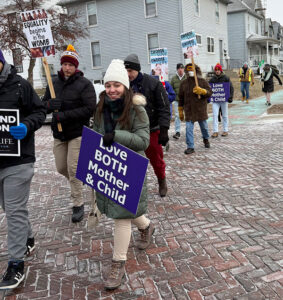
Pro-life advocates participate in the Iowa City March for Life Jan. 24.
Pro-life advocates worry about the complications experienced by some women who use the medications at home. The Senate Health, Education, Labor and Pensions Committee held a contentious hearing Jan. 14 on what its Republican majority called “protecting women from dangerous abortion drugs.” Sen. Patty Murray, D-Wash. called the effort a “sham hearing on medication abortion,” according to a report from OSV News.
Sen. Bill Cassidy, R-La., chairman of the HELP Committee, as it’s known, noted the hearing was being held shortly before the upcoming March for Life in Washington, and argued that mifepristone — a pill commonly, but not exclusively, used for early abortion — presents significant risks to those who take it, particularly outside of medical settings.
“At an absolute minimum, the previous in-person safeguards should be restored, and it should be done immediately,” Cassidy said.
The committee’s Democrats argued the drug is safe and attempts to restrict it are an attempt to ban abortion outright.
The FDA requires patients using mifepristone at home to sign a “patient agreement form,” which lists possible serious side effects.
Studies over the past 20 years have consistently reported that serious complications — like sepsis, blood loss requiring a transfusion, or other complications requiring hospitalization — occur in well below 1% of all medication abortions using mifepristone.
Pro-life advocates remain skeptical. The Catholic Medical Association released a document in June 2025 called “Telemedicine Chemical Abortion: A Catholic Medical Association (CMA) Policy with Recommendations.” It contends that: “estimates of adverse effects from U.S. studies have generally been far lower than those from international studies, raising concerns about their validity and bias.”
“Commonly cited U.S. complication rates from chemical abortion range between 0.18% and 0.32%, and are based primarily on limited, outdated clinical trials,” asserts the CMA. “In contrast, a recent European study with close medical supervision reported a 20.0% overall complication rate, including 15.6% with significant bleeding and 6.7% requiring surgical intervention for an incomplete abortion…”
“Minimizing the adverse effects of chemical abortion became more problematic with the FDA’s removal of common-sense safety measures, especially mandatory in-person visits with a physician, and expanded permitted use from 49 days gestation to 70 days,” writes the CMA.
A study from Ethics and Public Policy Center (EPPC), based on analysis of data from an all-payer insurance claims database that includes 865,727 prescribed mifepristone abortions from 2017 to 2023, suggested “potential dangers that may attend offering mifepristone without sufficient medical support or supervision.” The study reported that 10.93% of women experience sepsis, infection, hemorrhaging, or another serious adverse event within 45 days following a mifepristone abortion.
The Guttmacher Institute, a research and advocacy group which supports abortion access, attributes the discrepancy between the older studies and the EPPC one to real world vs. clinical research methods, as well as the EPPC study’s broader definition of what qualifies as a serious adverse reaction in comparison to the Food and Drug Administration’s.
Aside from medical complications, some pro-life advocates believe there are also other serious risks.
“The lack of direct medical supervision in telemedicine chemical abortions creates opportunities for coercion, particularly by abusive partners, family members, or sex traffickers,” asserts the Catholic Medical Association. “Without an in-person visit, abusers can more easily procure abortion pills for a woman without her consent or under pressure to terminate her pregnancy. In domestic abuse scenarios, women often have limited control over their healthcare decisions, and telemedicine allows perpetrators to exploit the system while concealing their actions.”
Another concern for pro-life advocates is the fact that minors can obtain abortion drugs without face to face teleconferences. This can happen through sites like “Aid Access,” according to Dr. Grazie Pozo Christie, a Catholic physician who explored the topic in a recent article for Angelus News.
Three U.S. states have sued to try to get courts to limit telehealth prescriptions of the medication abortion drugs, though efforts have been unsuccessful so far. The FDA is currently reviewing the safety of mifepristone.
(Kate Scanlon of OSV News contributed to this article.)
40 Days for Life
As the latest aspect of the decades-old struggle over abortion unfolds nationally, Catholics in Iowa are moving forward. In the coming months, local pro-life advocates will continue praying for the unborn and offering hope and healing to abortion-minded mothers and fathers through the 40 Days for Life campaign. Iowa City-area participants try to maintain a constant presence outside the Emma Goldman Clinic from 8 a.m. to 8 p.m. during the campaign, which begins Feb. 18 and will conclude March 28. Participants take shifts to pray, hand out brochures and/or hold signs. A kickoff event at Pizza Ranch will take place Feb. 10 at 5:30 p.m.
To sign up for the kickoff event, or to learn more about 40 Days for Life, go to jcrtl.org.
