




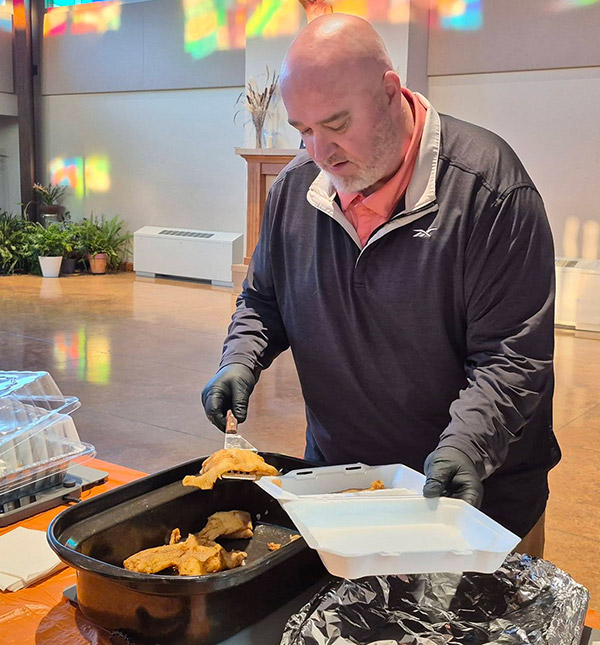
Jeff Maki scoops up a serving of fish during Sacred Heart Parish-Newton’s fish fry dinner on Feb. 20.
By Lindsay Steele
The Catholic Messenger
(This is part of a series.)

CLINTON — Sister Kathleen Holland sees Lent as a season of love and responsibility, not deprivation. Through fasting and abstinence, the Clinton Franciscan says she is able to cultivate self-discipline while focusing more intentionally on her spiritual life and relationships with others. “The rules of Lent set forth by our Church help guide me in prioritizing what is truly important.”
The Church designates Ash Wednesday and Good Friday as obligatory days of fasting and abstinence. When fasting, a person is permitted to eat one full meal, as well as two smaller meals that together are not equal to a full meal. The fasting obligation applies to Catholics ages 18-59. Additionally, Catholics ages 14 and older are required to abstain from meat on Fridays during Lent (usccb.org).


Origins
The concept of a Lenten fast dates back to the second century. It began as a two-day, grief-inspired fast and evolved into a 40-day period of preparation for Easter by the time the First Council of Nicaea met in 325. “The intention was to imitate Jesus who, after his baptism in the Jordan River, fasted 40 days,” author Adolf Adam wrote in “The Liturgical Year: Its History and Its Meaning After the Reform of the Liturgy.” Christians “saw in fasting a way of preparing for the reception of the Spirit, a powerful weapon in the fight against evil spirits, an appropriate preparation for such religious actions as the reception of baptism and the Eucharist and, finally, a way of being able to help the poor with money that would otherwise have been spent on food.”
A prayerful approach
The physical effort of fasting and abstinence is meaningless as a Lenten observance without its spiritual counterpart. “We should fast for God’s sake,” Father Andrew Schmemann wrote in his 1971 guide, “Great Lent: Journey to Pascha.” “We need first of all a spiritual preparation for the effort of fasting. It consists in asking God for help and also in making our fast God-centered.”
This concept extends to other forms of sacrifice during Lent, such as cutting back on screen time, abstaining from certain luxuries or comforts, and refraining from negative behaviors. “We are called not only to abstain from luxuries during Lent, but to a true inner conversion of heart as we seek to follow Christ’s will more faithfully,” the United States Conference of Catholic Bishops (USCCB) states on its website. “We recall the waters of baptism in which we were also baptized into Christ’s death, died to sin and evil, and began new life in Christ.”
Sister Holland and her housemate, who is also a Clinton Franciscan, make simple meals during Lent as they strive to “keep alive our hunger for God, and for justice for all.” They participate in a weekly Lenten Scripture series on Zoom and minister to Clinton residents experiencing homelessness and near homelessness. Literature, too, helps them focus on the season of penance, abstinence and almsgiving.
“A book that we often read during Lent is ‘The Emptiness of our Hands’ by Phyllis Cole-Dai and James Murray,” Sister Holland said. “The authors invite readers into Lenten reflection through the lens of those who experience homelessness, encouraging a reconsideration of attachment, humility, and what it truly means to live with open hands.”
Food for thought
While eating the flesh of land animals and birds is forbidden on Fridays during Lent, the Church permits the faithful to eat fish, dairy and eggs (usccb.org).
Many parishes in the diocese host Friday fish dinners to help the faithful fulfill the meatless requirement, including Sacred Heart Parish in Newton. “What may seem like a simple Friday meal is, in reality, one of the parish’s most meaningful traditions — bringing together faith, service, and community,” said Michelle Miller, the parish’s stewardship coordinator. Knights of Columbus and parish youths work together to serve about 100-200 fish dinners every Friday, with proceeds benefitting youth ministry and other parish ministries. “It is always uplifting to see different generations working shoulder to shoulder, sharing laughter and responsibility in service to their parish.”
Though not a day of fasting, the USCCB urges Catholics to exercise restraint when it comes to Friday meals. “Indulging in the lavish buffet at your favorite seafood place sort of misses the point. Abstaining from meat and other indulgences during Lent is a penitential practice” (usccb.org).

Deacon Kent Ferris, diocesan director of Social Action and of Catholic Charities, encourages the faithful to check out this year’s Catholic Relief Services (CRS) Rice Bowl materials for simple, meatless meal ideas. The collection, which began on Ash Wednesday, supports local and international hunger relief efforts. Recipes from countries served by CRS can be found at https://www.crsricebowl.org/recipes.
